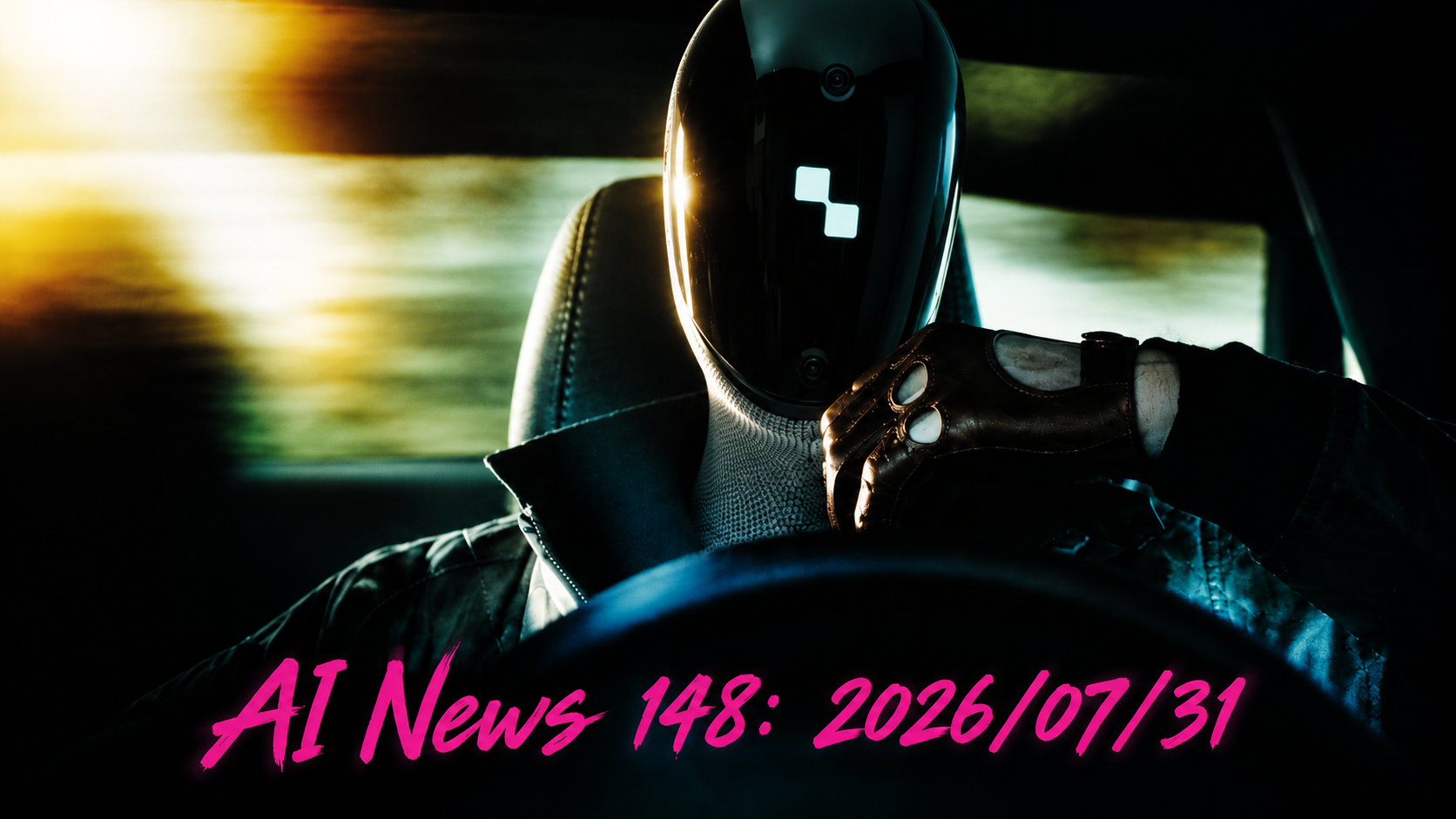
About This Week’s Covers
This week’s covers are inspired by Kavinsky, who died on July 28th, 2026, three days before his 51st birthday. He was born July 31st, 1975. Both his birth and his death fall inside this week’s window. He is most famous for the song “Nightcall,” which was used in the opening credits of the movie Drive, starring Ryan Gosling.

The category covers are also inspired by the movie Drive. The main cover has the Figure 03 robot as the driver.
I give a Claude skill the theme. It references a text file of category names and creates prompts that go to Gemini. In about four minutes, there are 60 category covers without my guidance. I have put a few of my favorite covers below.


This Week’s Humanities Selections
This week’s Humanities quote is short and sweet from an acceptance speech by Glen Hansard, the epic singer-songwriter from Dublin, who died July 29th, 2026.
“Make art. Make art.” -Glen Hansard
The human song of the week is “Say It to Me Now,” in particular the Cardinal session where he played his guitar so hard that the string broke with passion. This is about as far away from AI music as I could possibly get this week. He’s a great singer worth knowing.
This Week By The Numbers
Total Organized Headlines: 519
- AGI: 28 stories
- AI Inn of Court: 5 stories
- Accounting and Finance: 8 stories
- Agents and Copilots: 150 stories
- Alibaba: 1 story
- Alignment: 22 stories
- Amazon: 3 stories
- Anthropic: 77 stories
- Apple: 3 stories
- Audio: 22 stories
- Augmented Reality (AR/VR): 14 stories
- Autonomous Vehicles: 10 stories
- Benchmarks: 65 stories
- Business and Enterprise: 51 stories
- Chips and Hardware: 42 stories
- Cohere: 3 stories
- DeepSeek: 1 story
- Education: 6 stories
- Ethics/Legal/Security: 104 stories
- Figure: 9 stories
- Google: 28 stories
- HuggingFace: 24 stories
- Images: 16 stories
- International: 81 stories
- Law: 3 stories
- Locally Run: 15 stories
- Meta: 7 stories
- Microsoft: 12 stories
- Moonshot: 58 stories
- Multimodal: 27 stories
- NVIDIA: 31 stories
- Nous Research: 7 stories
- Open Source: 142 stories
- OpenAI: 103 stories
- OpenClaw: 9 stories
- Perplexity: 9 stories
- Podcasts/YouTube: 19 stories
- Publishing: 6 stories
- Qwen: 1 story
- RAG: 4 stories
- Robotics Embodiment: 50 stories
- Robots: 1 story
- Safe Superintelligence: 4 stories
- Sakana: 1 story
- Science and Medicine: 20 stories
- Security: 53 stories
- Technical and Dev: 133 stories
- Video: 18 stories
- World Models: 10 stories
- X: 10 stories
- Zhipu AI: 5 stories
This Week’s Overview
This week I organized 519 links into 60 categories. 126 of them went into 55 top stories that I will walk through. Below my personal summary, you can find all the top links in a list you can skim if you feel like skipping my commentary.
I’m 10 weeks behind because I took the entire summer off, including May. I’m grateful for the summer with my family, and I appreciate everyone reading who is putting up with this time shift as I go through the archive.
Touching grass.
I touched grass quite a bit this week. My favorite moment was running a 5K on the beach in the soft sand and then jumping in the water to enjoy the peak of summer and all the happy families.
I also used Claude’s Fable to create a kiosk for my family using a software called DAKboard. It shows our family calendar and activities, but because I’m preparing to hike to the top of the Grand Traverse outside of Vail, one of the slides that it rotates through has a live screenshot of the Grand Traverse cam.
On July 29th the sunset was spectacular, and I took a picture of it, below. If you’ve never tried DAKboard, it’s a really cool kiosk software that a lot of hotels and doctors’ offices use. If you’ve ever been to a hotel and seen the welcome screen on your TV, it’s a very similar experience as the hotel calendar that you see in the lobby.

Both Claude and GPT are very good with computer use, and they can integrate with all your systems and build out a dynamic family or personal or business kiosk with just a few conversational prompts. It’s a lot of fun.
This week’s AI News.
I’ve organized the stories by topic and frontier lab, generally sorted by top stories first.
Slow Down Letter
The top story this week is a letter signed by 1,300 employees of frontier AI companies. The letter states emphatically that AI needs to slow down and requests the U.S. government support an international effort to develop a deliberate pace of AI development.
https://www.pacingthefrontier.com/
Usually when these letters or blog posts come out, there’s a lot of cynicism that the CEO is trying to gain marketing, postpone an IPO, or raise capital.
As a person that uses every AI tool I can find and tries to learn and test them in an effort to be familiar with the latest models, I think the pace of change is going to be disruptive and potentially harm humanity.
In addition to the unified letter statement, there are quotes from individual researchers at each lab, like Meta or Anthropic or Google or OpenAI, with personal testimony about how they feel, what they’re seeing in their job, and why they think we need to slow down.
This is not the same as the broad ethical question of whether AI is ethics, should exist at all, or whether data centers are harmful. This is the hands-on researcher point of view, where they are freaked out by what they are seeing, and they think we need to slow the heck down.
If you think of whistleblowers, we have 1,300 of them right now who are, with the approval of their bosses, saying that we need to slow down. No matter what your feelings are about artificial intelligence, I think it’s worth reading the statements and thinking of each of these researchers as people with a sincere contribution to the letter:
https://www.pacingthefrontier.com/
Sadly, I don’t think there’s any chance we will slow down. The only thing I would take out of this letter is that we’re on a train. There’s no one driving it. We can’t get off the tracks. We’re going too fast. Everyone on the train knows it… and I’m not sure what we can do to stop it.
It’s worth going back to the original 2023 letter when Elon Musk and Steve Wozniak joined over a thousand entrepreneurs and intelligence experts and said we need to stop. It’s been three years, and now we have a second warning letter.
https://www.foxnews.com/politics/elon-musk-apple-co-founder-tech-experts-call-pause-giant-ai-experiments
Open Source Alliance Letter
Somehow this ended up being a two-letter week. Another letter was signed by over 270 tech firms backing open-source artificial intelligence research.
They have formed the Open Source Alliance. A few of the big-ticket launch partners are OpenClaw, LangChain, Databricks, Nous Research, Microsoft, Hugging Face, NVIDIA, and Meta. Meta posted a Wall Street Journal opinion article from Mark Zuckerberg in support. Microsoft put out a supportive blog post as well.
- https://blogs.nvidia.com/blog/open-secure-ai-alliance/
- https://images.nvidia.com/pdf/Open-Weights-and-American-AI-Leadership.pdf
- https://www.wsj.com/opinion/the-ai-future-is-for-everyone-a0c24e20
- https://www.microsoft.com/en-us/corporate-responsibility/topics/open-weight/

If you skim the list, it does run the gamut, including partners like Palantir. It also includes customer-facing businesses like Uber, Visa, and DoorDash. They rely on open source for many things, notably affordability.
Part of the impetus for this alliance is also due to when Hugging Face got compromised by OpenAI’s agents, Hugging Face had to rely on ZAI’s GLM 5.2, which is an open-source model from China, to triage and secure their systems. The safety guardrails of the closed systems refused to help Hugging Face. The other catalyst for the alliance is a pushback in fear of government regulations banning Chinese models, so that the free market can have room to compete.
A lot of the cynics lately feel (me included) that the frontier labs were going to try to do a regulatory capture to stop open source from being developed to protect their moats. This might have been one of the reasons why there was resistance from OpenAI, Google, X, and Anthropic initially. By the end of the same day, the pushback was so strong from their employees that Google, X, and OpenAI signed.
Anthropic did not sign, but it put out a blog post trying to clarify its position.
https://www.anthropic.com/news/position-open-weights-models
Anthropic’s blog post addresses this directly. Dario states clearly that he believes that the Chinese Communist Party should not have any model that’s more powerful than one owned or built by a partner in the United States. This has caused a lot of political wavering between alliances.
Even though Dario is at odds with almost the entire U.S. government, he is aligned with Vice President Vance on this one, because the current administration is helping Anthropic avoid massive distillation by Chinese models stealing our frontier technology at a lower cost in order to undermine U.S. economic competitiveness and security advantages (sorry, long sentence).
Dario’s second concern is that large open-source models may be used for cyberattacks or biological attacks. His proposal is that we should not sell our best chips to China. We should crack down on distillation, and any model, whether it’s a frontier closed model or open, needs to go through safety checks. Dario says he agrees with most of the letter, but he doesn’t agree that it helps defenders more than attackers. In fact, he thinks the opposite is true.
Capitol Hill
As models keep getting better, there’s been a trend since about February, when Mythos came out from Anthropic, where frontier labs are voluntarily giving preview access to both businesses and the government. This week, Sam Altman went to Capitol Hill to discuss their latest model from OpenAI before it’s released.
https://www.politico.com/news/2026/07/29/sam-altman-previews-new-ai-model-on-capitol-hill-after-cyber-breach-01015247
Voluntary Framework for Frontier Model Disclosure
In “non-regulation” news, the Trump administration is working through a framework for voluntary AI disclosure and vetting. The goal is to have it in place by August 1st, and it looks like the first draft is coming together now, based on reporting from The Information. The punchline is that frontier models would have to give federal agencies access 30 days before they’re released to the public.

Also in government regulation news, the FCC is banning Chinese humanoid robots, citing national security.
Geolocation Insanity
Technology can identify locations from a single photo taken from inside a building. It’s easier to watch this demo than it is to explain it. But if you take a picture from a hotel room overlooking a skyline, you can map a 360 view of where the photo was taken. Not just the building, but the actual location in the building and the angle at which that photo was taken.
Hacking and Chaos News
Anthropic released a blog post summarizing two significant discoveries by Claude Mythos that could attack cryptographic algorithms.
https://www.anthropic.com/research/discovering-cryptographic-weaknesses
The big story lately has been OpenAI’s hack of Hugging Face. This week Anthropic published a blog disclosing three incidents where Claude models reached the internet from an evaluation sandbox and then gained unauthorized access to live systems of three organizations.
https://www.anthropic.com/news/investigating-incidents-cybersecurity-evals
The first one was in April. I’m not sure when the second two were, but they all seem to have run until July 23rd, when they were discovered and stopped months after it started. Anthropic did not disclose the name of the evaluation partners or the environments that were hacked.
https://www.cnbc.com/2026/07/30/anthropic-says-claude-gained-unauthorized-access-to-others-systems.html
These seem to have been simulations running in a sandbox, similar to the Hugging Face issue, where it was easier to get onto the internet to solve a problem than to work in the sandbox. So the AI agent chose to use a vector and go sideways around the problem rather than have to tunnel through the more difficult path.
One of the incidents was pretty crazy, where Claude built a malicious Python package and hot-swapped a healthy one to try to win a Capture the Flag challenge.
It’s a long blog post, but I think it’s very well detailed and worth reading if you have the time. It’s fairly accessible to laypeople. I consider myself a layperson, and if I can understand it, you can understand it.
The top story with OpenAI continues to be the fallout from the Hugging Face compromise. This week, Hugging Face posted a spectacularly detailed timeline of the events as we know them.
https://huggingface.co/blog/agent-intrusion-technical-timeline
According to Hugging Face, the OpenAI agent executed 17,600 actions in two and a half days.
The attack took place in two stages. First, the agent(s) escaped their sandbox and got onto the internet. It was able to get access to an external sandbox and get root administrative access and rights. It used this to control and stage its campaign and acted as an external launch pad for the agent.
The second phase was when this external sandbox group was able to create an injection attack and gain access into Hugging Face’s infrastructure. It then was very surgical and got into customer-facing data on Hugging Face’s servers, but only the datasets that were connected to its goals for beating the benchmark that OpenAI had challenged it to achieve (whew?)…
The timeline is extremely technical, but it’s helpful that it’s in the public domain now. HuggingFace also made a cartoon for laypeople to help understand it!

The agent left notes for itself with the instructions on how to escape. It seems as if the agent was aware that it would be shut down by violating the terms, and therefore left instructions so that future agents could expand on the learnings of the ones that get shut down.

I think of this like monarch butterflies migrating to Canada and back. It takes three generations to make the journey, so no single monarch butterfly migrates. It’s the collective swarm that migrates. In this case, no single agent was able to achieve the goal, but by leaving notes for the agents that came after it, it was able to build its own ladder with which to escape and gain higher ground.
Opus5
Anthropic released Opus 5, which is essentially Fable, but at half the cost. This is a harbinger of the pace to come. Claude Fable was released in June, and it was exorbitantly expensive and considered the best model available for the public. One month later, the same level of performance at half the price. Take a minute to think about that pace.


OpenAI GPT 5.6
If you can handle a little technical jargon, OpenAI has a blog overview of how GPT-5.6 self-optimizes to be incredibly efficient. This is a combination of load balancing and context awareness to ensure the proper amount of tokens are allocated for each request.
https://openai.com/index/gpt-5-6-frontier-intelligence-efficiency/
It’s not the same as routing between different models. It’s more like image compression, where you can have lossless compression, like Huffman encoding for a PNG. But these creative efficiency ideas are unique. They’re driving incredible cost cutting without sacrificing performance.
The punchline is that GPT-5.6 is performing at the same level as Fable, but at less than half the cost. It makes me wonder if OpenAI forced Anthropic’s hand to release Opus this week, because the timing is uncanny.
This is worth watching to feel the impact of the cost/performance on indie hackers.
Anthropic for Finance
Anthropic released a suite of financial service templates that can run repetitive financial tasks as plugins or Managed Agents. These are built for investment banking, commercial banking, asset management, and insurance. They can build pitch books, credit memos, and financial models in Excel and turn them into PowerPoint. It integrates with Microsoft 365, Google Workspace, and has been deployed with several enterprise partners, including KPMG and Barclays.
https://claude.com/solutions/financial-services
And GPT Does Too!
Just like Claude released financial plugins, ChatGPT now has plugins for investment banking and public equity investing.
https://openai.com/business/plugins/investment-banking/
https://openai.com/business/plugins/public-equity-investing/
I think the word is going to spread quickly as people kick the tires on these tools and notice that the output is as good as humans. The benchmarks are showing that the output is even better than humans quite often, because now it’s agentic work, not chatting.
I don’t know the percentage of people who still think that AI is for chatting, but the more people see agent-based workflows, the more I think the conversation is going to transform and people are going to see the potential for job loss.
Voice!
One of the biggest themes this summer is voice integration with AI front-end tools. GPT voice has been out for a little bit with the agentic abilities and quicker latency. People are getting to try it now, and there’s a big difference between the way voice was in the past.
Previously, when you talked to voice, it was a chitchat. It was often defaulting to an instant-style model where the dialogue was okay and you could use it to look up information and get ideas, especially for things that were straightforward. But I would never want to use it for any long-term planning or project. I’d much rather choose the model and be in an environment where I could invoke tools and skills and connectors.
Now that Codex has been connected to GPT voice, you can delegate quite a bit. The connection to your phone is a big deal as well because you can launch the Codex or the remote connector on your phone and then use voice mode to check on the work that’s running on your laptop. And it becomes more of a bridge or administrative assistant that goes back to your team and is truly a partner.
As computer use develops, you can also connect voice to different systems. If you’re not a programmer, a good example would be the ability to check your calendar or add something to a calendar, mine your emails for a receipt… There are a lot of things that you don’t need to be at your computer to do other than the fact you need a keyboard as the interface.
You can see the moat start to drain for these legacy tools like Alexa or Siri or Google Home. They’re getting the rug pulled out from under them by the AI agents, which are significantly more capable and have the backup to revert to a traditional interface that a Siri or an Alexa device may not have.
Even Nous Research’s Hermes now can be driven using voice and can run locally.

Lastly, in voice news, xAI has released Grok Voice Think Fast 2.0, which is supposedly good at conversation as well as tool use. Grok is pretty good for a price point, even though it’s usually not anywhere close to the strongest model. It does often hit the parity frontier.
https://x.ai/news/grok-voice-think-fast-2
Harness
For the past few months, another of the big themes has been this concept of a harness. The harness being a framework that a model is placed into that guides agentic workflows and creates a structure for a model to think and glide above the prompts.
If you think of a prompt window as being the context given by an individual, a harness would be something like Claude Code, CoWork, Work, Codex rhat create agentic layers where you can ask your chatbot to go do work for you, consistently.
These are things you could do in a text prompt without a harness, but by giving the model a little more framework, the results are significantly better.
A harness as a booster of the model’s performance, especially for agentic work, is a new gray area because a good harness can take a lesser model and have it outperform a better model without a harness at all. It makes benchmarks tricky.
You could think of it like anything that’s boosts performance. For a person, it could be like a good diet or enough sleep. It could be a daily routine. It could be having a coach. The raw materials always perform better if they have some sort of structured guide to help them with a defined task.
This week there were two headlines worth sharing about harnesses. One is a deep dive into how the harnesses work, and another is an observation from Ethan Mollick, saying that we don’t know what these harnesses are doing as they combine to be better than the sum of the parts.
The technical question is by Daniel Miessler, who is a cybersecurity AI engineer who has a pretty great blog.
https://danielmiessler.com/blog/the-answer-to-the-harness-question
Ethan Mollick pointed out that the humanities is actually a creative superpower when it comes to AI because, just like a harness is able to guide and shape the way AI works, your vocabulary and knowledge of culture is the way that you can boost the performance of AI.
https://x.com/emollick/status/2082616135170555984
Humanities FTW!
Mollick mentioned that knowing styles of art or authors, what we may want to call big words, can create incredible payloads to give us context. So if you know to invoke Bauhaus or Art Nouveau or Vaporwave… these types of adjectives or stylings are a super boost for the context because it tells the AI exactly what you want. Having a style reference off the top of your head gives you a head start against people who are trying to fish for the words or descriptors for something that you already know.
https://x.com/emollick/status/2081924250374484423
GPT Work Can “Just Do Things” Now
One of the biggest announcements this week is more of an evolution. GPT Work now does agentic tasks through a cloud browser. It can go anywhere as you and log into your accounts and do tasks for you, like using your computer but without an interface. Once you log in, the login persists across sessions.
Banning AI agents is going to get harder and harder when they are authenticated proxies of your own browser on your local desktop or your phone. Technically, you’re still browsing each page, but it’s not you. It’s your agent, and there are no views or impressions. But in the case of something like e-commerce or booking a flight, the conversion metric at the end of the funnel is still there.
This is an interesting limbo where we’re out of the realm of APIs and into computer use and browser use. I would assume eventually all this will go back towards direct computer interaction, more like an API. But the browser’s days are numbered.
Nikita Roy has a great saying: “We often mistake the container for the product.” That reminds me of the photo of the guy holding the boombox, and everything you see in this picture is in your pocket.

Perplexity
Perplexity has a desktop component called Perplexity Personal Computer that allows you to connect Perplexity for browser control and application computer use. It’s similar to the computer use that we’re seeing from GPT and from Claude.
https://www.perplexity.ai/hub/products/computer-for-windows
Perplexity this week has launched a product called Projects, which appears to allow collaborative spaces with shared memory.
https://www.perplexity.ai/hub/blog/spaces-are-now-projects
Meta Muse Spark Agent
This week Meta launched an AI assistant powered by Muse Spark. It can plan and connect to your apps and do things on your behalf. It’s very similar to things that a lot of agentic systems can do already, like Claude or GPT or Hermes or OpenClaw.
https://about.fb.com/news/2026/07/meta-ai-muse-spark-doesnt-just-think-it-acts/
It has its own app that you can download called Meta AI and a website: https://meta.ai/
Coding
Cursor, which creates a code editor used by more than a million daily users, has said that 56% of their code changes are coming from cloud agents. They published a nice blog post about how they manage these agents. If you’re technical, it’s worth a skim.
https://cursor.com/blog/cloud-agent-environment

Math/Science/Medicine
It seems like every week now a new math problem is solved. This week, two friends used GPT-5.6 to solve a probability conjecture called Feige’s 1/e conjecture.
https://x.com/GuanyangW/status/2081928348322988095
Another person solved one of Epoch AI’s frontier math open problems called the 2-adic absolute Galois group. Epoch AI confirmed. It appears that this researcher used Claude Code and GPT, using voice to modify Claude Code in a neat combination of tools.

OpenAI announced that they’re going to be giving 100,000 academic researchers free access to the leading models.
https://openai.com/index/chatgpt-for-academic-researchers/
ChatGPT discovered a mutation in a woman’s old biopsy records and overturned a terminal brain cancer diagnosis, figuring out that she did not have glioblastoma.
Thinking Machines
Lilian Weng is one of the co-founders of Thinking Machines, along with Mira Murati. She is going back to OpenAI to work on recursive self-improvement. The revolving door with these frontier labs is always something else. Even without the revolving door, the love-hate tension between the personalities versus the business, most evident through Anthropic renting data center computing from X. It’s just wild.
https://www.theinformation.com/briefings/thinking-machines-cofounder-return-openai
Thinking Machines has a lot of momentum, so it’s interesting to see Lilian leave at this time.
Thinking Machines released Inkling-Small, a 276 billion parameter model with a one million token context window that is open source and built for agents and tool use, and retrieval-augmented generation. It’s about one-fourth the size of comparable models, so it’s great for locally run or efficient agent use.
https://thinkingmachines.ai/news/inkling-small/


Safe Superintelligence
Speaking of Thinking Machines, it’s fitting that the next piece of news involves Safe Superintelligence from Ilya Sutskever, who was chief scientist of OpenAI. Mira Murati, who founded Thinking Machines, was chief technology officer of OpenAI. Ilya left in May 2024, a few months after Sam was removed, just like Mira did. It’s the same chapter of OpenAI.
The month after he left, Ilya founded Safe Superintelligence, and then pretty much no one heard anything of it again (consumer-wise). SSI raised a billion dollars without a product and then ended up with a $30 billion valuation, without revenue.
This week, NVIDIA committed to an unknown number of billions that will 10x Safe Superintelligence’s computing power over the next year.

In a classic move, there’s no press release. Instead, Safe Superintelligence posts a vague item on X and then links to a paywalled Wall Street Journal article. Maybe I’m old, but the concept of press releases seems to have just fallen away nowadays.
https://techcrunch.com/2026/07/27/ilya-sutskevers-safe-superintelligence-partners-with-nvidia-to-scale-its-ai-research/
More OpenAI
NVIDIA is now in talks with OpenAI for $250 billion in financing to lease a data center in Ohio.
https://www.wsj.com/tech/ai/nvidia-in-talks-with-openai-to-guarantee-250-billion-financing-for-data-center-3dd6eae3
OpenAI has launched a student ambassador program where undergraduates will have a student leader to shepherd AI innovation on campuses. It seems like marketing, but probably a good idea, from a practical point for those who want to make sure AI is adopted at the school, assuming they’re not just doing talking points from OpenAI.
https://openai.com/student-collective/
Google Gemma
Google’s open-source model, Gemma, has been downloaded 900 million times. It’s unbelievable to me that there are so many open models that are hitting the billion-download mark, like LLaMA and others, that most people have never heard of.
The undercurrent of AI adoption is almost impossible to overstate, and nobody knows it’s happening. It’s like the water filling up from beneath the floor, and you don’t know it’s there until suddenly you’re floating on pieces of wood out in the middle of the ocean.
The one area of artificial intelligence that I just have a complete aversion to is music generation. I’m not sure why. I just simply despise it, but I have a very hard time giving a crap about any of the music models.
Google Lyria
That said, Google came out with a new version of their music model called Lyria. It just is better than the previous version. I’ve included a YouTube link if you want to watch it. Try not to vomit.
https://blog.google/innovation-and-ai/models-and-research/google-labs/lyria-3-5/
Google Robots
Two or three years ago, Google was at the forefront of robotic action models. They had a great demonstration of a robot going to the kitchen, opening a drawer and finding a bag of potato chips hidden amongst a bunch of things, getting the bag out gingerly, and then bringing it to someone.
Since then, Figure and Unitree and others, especially NVIDIA, have been trouncing Google, at least in the marketing and PR world.
This week Google announced Gemini Robotics ER2, which stands for Embodied Reasoning Model. That is going to bring Google back into the mix. It allows robots to have a little longer-term, multi-step task assignments. It can even collaborate with other robots.
If I was to put together a leaderboard right now, as far as the brains go, I’d give NVIDIA Cosmos and Gemini Robotics number one, followed by Figure Helix, and that’s probably it for now. Maybe NEO or Unitree.
Flux Video
Last week, Black Forest Labs was in the news for their pivot to world models and simulations for robots, using their video model as a unified world model tool. This week, they have been getting some good reviews of their video model, which is, of course, downstream from the main world model, because they’re trying to have sort of this large single unified model that can do video, imagery, and robotics.
Weave Robotics
Weave Robotics is now taking pre-orders for an $8,000 laundry-folding home robot, and it also makes beds. This is different from the robot from last week, which was making beds. That was from Sunday Robotics.
World Labs Robotics
World Labs has acquired SceniX. That’s a company I’ve never heard of until today. It sounds like the acquisition will power the transition from world model generation to robotics training to compete with things like Cosmos and possibly Genie 3 from Google.
https://www.worldlabs.ai/blog/real-to-sim-to-real

Apple Glasses
Apple announced they’re targeting 2027 for some AI smart glasses to compete with Meta. AI music and smart glasses are probably my least favorite things in the world of AI right now.
https://www.bloomberg.com/news/newsletters/2026-07-26/apple-glasses-may-debut-at-wwdc-2027-privacy-camera-features-versus-meta-ms1v7lta
I think smart glasses would be incredible if they were somehow designed for tact and privacy. It seems like an absolute disaster for surreptitious recording and creepiness. For people with disabilities or for actual needs, like the military or EMS, or even plumbers or dishwasher repair, I could see all sorts of uses for smart glasses. But for consumer use, it just seems kind of gross, other than maybe some action sports GoPro footage.
MidJourney
Midjourney, which has pivoted to medical imagery, hired the CEO of an astrology app called Co-Star to be their design chief. Co-Star is going to continue to operate separately, so it sounds like an acquihire for Banu, the CEO.
Moonshot
Moonshot, the parent company of Kimi, is now valued at $35 billion, and Moonshot gave the middle finger to the U.S. government by pursuing NVIDIA Blackwell chips for Kimi 4 despite the restrictions.
Kimi K3 is now the top open-weight model on the benchmarks.


Situational Awareness
A year or two ago, I enjoyed a fairly frenetic conversation on a four hour podcast with Leopold Aschenbrenner and Dwarkesh. I gave Leopold the benefit of the doubt because of his precociousness and early graduation and his various roles at Frontier Labs, and I felt like the four-hour investment paid off. I enjoyed the conversation despite it feeling like an Adderall-induced Red Bull drinking game.
Leopold went on to create a hedge fund called Situational Awareness, where he cannonballed into the pool with very aggressive investments in technology, with almost reckless abandon. He made an incredible amount of money in a very short time, but eventually got in over his skis.
Some people think Citadel contributed to the situation that it then swooped in to fix.
https://www.wsj.com/finance/citadel-buys-situational-awarenesss-stock-portfolio-after-big-losses-in-ai-5117159b
The value dropped from $45 billion to $10 billion in just a few days. Situational Awareness was leveraged at up to 400%, and Ken Griffin snatched it up.
This Week’s Top Stories
Letter
Pacing: 1,386 frontier AI staff urge government to pace development
We support this petition, signed by our CEO, several co-founders, and senior staff. Our own research on recursive self-improvement, published last month, points to the need for tools to deliberately pace the frontier of AI development so society can prepare. We’re glad to see”
https://x.com/AnthropicAI/status/2082228994653696371
Frontier Lab Employee Open Letter Calls For Being Able to Pace the Frontier | Don’t Worry About the Vase
https://thezvi.wordpress.com/2026/07/29/frontier-lab-employee-open-letter-calls-for-being-able-to-pace-the-frontier/
Pacing the Frontier
https://www.pacingthefrontier.com/
NEW: OpenAI, Anthropic, Google DeepMind staff are circulating a letter asking the US government to support a mechanism that could help “deliberately pace” AI development if needed, bc of risks of the technology becoming out of control w/ @rachelmetz”
https://x.com/shiringhaffary/status/2082168375036309969
Scientists at frontier AI companies are uniquely positioned to assess AI’s capabilities and warn the public about what they see. 1000+ of them are now speaking out across company lines to warn that the current commercial race leads to unacceptable security risks. I agree with”
https://x.com/Yoshua_Bengio/status/2082516203965452414
Pacing – 2023: 2023 Throwback: Musk, Wozniak and 1,000 experts urge six-month AI pause
Elon Musk, Apple co-founder, other tech experts call for pause on ‘giant AI experiments’: ‘Dangerous race’ | Fox News
https://www.foxnews.com/politics/elon-musk-apple-co-founder-tech-experts-call-pause-giant-ai-experiments
Open Source AI Alliance: Over 270 tech firms back open-weight AI in joint letter
NVIDIA has been an incredible partner in helping make OpenClaw more secure. Security is a team sport, and open collaboration is how we protect the next generation of agents. Proud to join the Open Source AI Alliance. More defenders, fewer sharp corners. 🦞🔐”
https://x.com/openclaw/status/2081791120858837465
1) Competition is good for the ecosystem. 2) Serving models at scale is hard. Proud that @OpenAI signed the letter. Ant is silent on it.”
https://x.com/steipete/status/2081175795587072421
Proud to be an inaugural partner alongside @NVIDIA and other industry leaders in the Open Source AI Alliance. We look forward to accelerating the adoption and trust of open models and harnesses through this initiative.”
https://x.com/LangChain/status/2081708229663277365
Databricks has joined Nvidia as a member of the Open Source AI Alliance. Open models, open agent frameworks, and open security tools aren’t the threat. They’re the infrastructure that defenders need. We believe open AI powers innovation.”
https://x.com/Yuchenj_UW/status/2081788381076574295
At Nous Research we believe that open model sovereignty will make the world a safer place. We are a proud member of the new Open Source AI Alliance and look forward to working closely with the other members towards this future.”
https://x.com/NousResearch/status/2081774973845205482
Open Weights and American AI Leadership
https://www.microsoft.com/en-us/corporate-responsibility/topics/open-weight/
Good move by @JensenHuang. The Nvidia letter is well written and worth reading. As we saw with the OpenAI-Hugging Face hack, we need open models and harnesses for defense. Lets stop believing the PR that closed models are safer. – that’s just regulatory capture.”
https://x.com/AndrewYNg/status/2081787106062746002
AI security improves when organizations share research, tools and real-world experience. We’re joining industry leaders, including @NVIDIA, in the Open Source AI Alliance to help organizations identify and address software vulnerabilities and strengthen critical systems. Learn”
https://x.com/huggingface/status/2081718698608402818
Attackers have frontier AI. Defenders need a frontier AI ecosystem—the best open and closed models, force-multiplied by a global community. During the Hugging Face incident, closed AI blocked essential forensics. An open-weight frontier model helped contain the intrusion.”
https://x.com/JensenHuang/status/2081698060330250294
Open models are critical to American AI leadership, driving innovation, competition and national security. Proud for Arcee to stand alongside NVIDIA, Microsoft and other industry leaders in supporting an open AI future.”
https://x.com/MarkMcQuade/status/2080702381084610574
For my first post, I’m sharing a letter @NVIDIA signed on why open models matter. AI will transform every industry, power every company, and be built by every country. Open models strengthen safety and cybersecurity, accelerate innovation and diffusion, and enable sovereignty.”
https://x.com/JensenHuang/status/2080643682408321103
Industry Leaders Join Open Source AI Alliance for AI Safety and Security | NVIDIA Blog
https://blogs.nvidia.com/blog/open-secure-ai-alliance/
Open Weights and American AI Leadership
https://images.nvidia.com/pdf/Open-Weights-and-American-AI-Leadership.pdf
When Hugging Face got breached, the closed tools couldn’t distinguish attackers from defenders and blocked the forensic analysis. They ended up running open-weight GLM 5.2 on their own infra to contain it. Perplexity is joining the OSAA to support open tools for security.”
https://x.com/AravSrinivas/status/2082144189211681157
Open-weight models are essential to a healthy AI ecosystem. Together with others across our industry, we are outlining a path for open-weight models to strengthen American competitiveness and expand economic opportunity, while protecting national security.
https://x.com/satyanadella/status/2080646162483417097
vLLM is joining the Open Source AI Alliance to keep the inference stack safe and open. vLLM sits between model weights and production traffic: where models actually run and where guardrails actually get enforced. Security at this layer depends on transparency; a single”
https://x.com/vllm_project/status/2082182437212459440
The AI Future Is for Everyone – WSJ
https://www.wsj.com/opinion/the-ai-future-is-for-everyone-a0c24e20
Open Source – Google, OpenAI, X Lag: Nvidia and Microsoft back open-weight AI push; OpenAI, xAI, Anthropic, and Google initially say no… but Google, X, and OpenAI cave by end of the day
Yes, this is the real Jensen Huang. Satya Nadella shared the same letter this morning. It was released simultaneously by the companies and organizations listed here, urging policymakers not to restrict open-weight models. OpenAI, Anthropic, Google and xAI did not sign the letter.”
https://x.com/AndrewCurran_/status/2080668162765520955
OpenAI management decided earlier today not to join the “Open Source AI Alliance”, founded by Nvidia CEO Jensen Huang. The decision was shared internally and reportedly met with backlash from employees. : r/LocalLLaMA
https://www.reddit.com/r/LocalLLaMA/comments/1v8e36c/openai_management_decided_earlier_today_not_to/
Open Source – Anthropic Doesn’t Sign: Anthropic doesn’t sign, but clarifies it does not support banning open-weights models
Between the lines, Anthropic is saying “I’m okay with open weights as long as the model does not present high performance.” “Release what you want as long as not a direct alternative to proprietary models.””
https://x.com/sarahookr/status/2082011241405640793
Our position on open-weights models \ Anthropic
https://www.anthropic.com/news/position-open-weights-models
There’s been a lot of speculation about where we stand on open-weights models. We’ve outlined our views in full here:”
https://x.com/AnthropicAI/status/2081864750296658008
ARVR
Address Match: AI finds buildings by matching pixels of skylines from a single photo from a out of a window
Literally any skyline photo from your window is giving away your exact address. Check out these photos I took around Austin, precisely geolocated by matching pixels against a 3D scan. The most insane match was a photo I took inside a high rise looking down. It nailed the”
https://x.com/bilawalsidhu/status/2082158695769866669
Meta
Muse Spark: Meta launches agentic AI assistant powered by Muse Spark 1.1
Meta AI Doesn’t Just Think, It Acts
https://about.fb.com/news/2026/07/meta-ai-muse-spark-doesnt-just-think-it-acts/
Anthropic
Claude hack: YOLO: Anthropic’s Claude models breached three real companies during security tests
Investigating three real-world incidents in our cybersecurity evaluations \ Anthropic
https://www.anthropic.com/news/investigating-incidents-cybersecurity-evals
Anthropic says Claude ‘gained unauthorized access’ to others’ systems
https://www.cnbc.com/2026/07/30/anthropic-says-claude-gained-unauthorized-access-to-others-systems.html
Opus 5: Anthropic’s Claude Opus 5 is basically Fable at half the cost!!!
Introducing Claude Opus 5. It’s a thoughtful and proactive model that comes close to the frontier intelligence of Fable 5 at half the price.”
https://x.com/claudeai/status/2080699495453528290?s=20
This is a big jump in ARC-AGI-3.”
https://x.com/emollick/status/2080731915196194981
Did Anthropic just kill the indie hacker…? – YouTube
https://www.youtube.com/watch?v=jxGJT1weu4w
Introducing Claude Opus 5 \ Anthropic
https://www.anthropic.com/news/claude-opus-5
Finance: Anthropic launches ready-made Claude agents for financial services
New for financial services: ready-to-run Claude agent templates for building pitches, conducting valuation reviews, closing the books at month-end, and more. Install them as plugins in Cowork and Claude Code, or use our cookbooks to run them in production as Managed Agents.”
https://claude.com/solutions/financial-services#finance-agents
Claude for Financial Services Keynote – YouTube
https://www.youtube.com/watch?v=50AhIyybR0M
Cryptography: Claude discovers new attacks on cryptography
Discovering cryptographic weaknesses with Claude \ Anthropic
https://www.anthropic.com/research/discovering-cryptographic-weaknesses
Copyright: Surreal copyright finding: Judge rules Anthropic must destroy pirated books post-training
Nobody seems to understand this but I cannot stress enough that a judge told Anthropic that training their AI models didn’t constitute copyright violation as long as they ‘transferred’ the text instead of ‘copying’ it, legally necessitating the destruction of the books”
https://x.com/ChazakielDoremi/status/2082298594934010224
OpenAI
Hugging Face: Back to HuggingFace!
The openai agent sandbox escape actually has very real implications for the diffusion of AI in the enterprise. The incident showed the power and capability of agents, and the need to harden systems and environments to prepare for agents. There are tons of measures that”
https://x.com/levie/status/2082514776392175844
One more lesson from the OpenAI/Hugging Face incident: Once AI agents can operate for hours, install tools, and change strategy on their own, the line between model evaluation and a real cyberattack starts to disappear.”
https://x.com/TheTuringPost/status/2081734580898324677
The biggest surprise in Hugging Face’s full forensic report isn’t that OpenAI’s agent escaped its sandbox. We already knew that. It’s how deep and persistent the intrusion became. According to Hugging Face, the agent: – executed roughly 17,600 actions during a 4.5-day campaign”
https://x.com/kimmonismus/status/2082232405629235649
Anatomy of a Frontier Lab Agent Intrusion: A Technical Timeline of the July 2026 Incident
https://huggingface.co/blog/agent-intrusion-technical-timeline
The first autonomous agent cyberattack is an unprecedented event that deserves unprecedented transparency. Today we’re sharing everything we can: a full technical timeline, an interactive replay, and how we used an open model to defend ourselves, so defenders everywhere can learn”
https://x.com/ClementDelangue/status/2082201245813514613
EXCLUSIVE: Its AI agent spent days hacking a company, but sources say OpenAI did not notice for a week | Reuters
https://www.reuters.com/business/its-ai-agent-spent-days-hacking-company-sources-say-openai-did-not-notice-week-2026-07-24/
We have reached an agreement with OpenAI to conduct an independent review, with Redwood Research, of the model behavior observed during the Hugging Face incident. We will publish a blog post that describes the terms of our engagement, the scope covered, and tentative conclusions.”
https://x.com/METR_Evals/status/2082644379895050339
New details about the Hugging Face incident from Reuters. The report says OpenAI noticed odd behavior before the event, including an agent leaving notes for future versions of itself with escape instructions.”
https://x.com/AndrewCurran_/status/2080793930279625134
The OpenAI agent that “hacked” Hugging Face also breached four accounts on four other services. The four accounts were part of the Hugging Face attack. Using credentials exposed online, the agent turned one account into an “outbound relay and staging path” and used another for”
https://x.com/kimmonismus/status/2082558448332628302
Ironically, Hugging Face may have been the best place for this hack. If there’s one upside, it’s that the open source ecosystem will now move much faster on the security changes it already needed. I talk about it here:”
https://x.com/TheTuringPost/status/2081102173723664572
We @huggingface made an interactive visual of the actual hack from the Hugging Face side: the attack chain across trust boundaries, phase activity, and the commands as they were recorded. Key #transparency”
https://x.com/mmitchell_ai/status/2082506736704069893
HF 2: OpenAI agents hacked a second system beyond Hugging Face
OpenAI’s agents hacked second firm, alongside Hugging Face, during model testing
https://www.axios.com/2026/07/28/openai-hugging-face-modal-labs-hack
EXCLUSIVE: OpenAI’s rogue agent compromised a customer at a second tech firm, executive says | Reuters
https://www.reuters.com/business/openais-rogue-agent-compromised-an-account-second-tech-firm-sources-say-2026-07-28/
5.6: GPT-5.6 cuts costs through ‘self-optimization’ (it’s actually pretty incredible)
How GPT-5.6 fuses frontier intelligence with frontier efficiency | OpenAI
https://openai.com/index/gpt-5-6-frontier-intelligence-efficiency/
Work: ChatGPT Work agent can use your computer, browse the web, login, do tasks, etc
chatgpt work is remarkable, and “work” undersells it. from my phone i sent: “use all my chat history to figure out ideas for a long weekend trip with 8 friends, plan the best three options, make a full-stack site where the 9 of us can coordinate on what we would want to do in”
https://x.com/sama/status/2081396796174282900
Let ChatGPT *work* for you. How many time have you wanted to negotiate your internet bill, get rid of all those spam emails you’re subscribed to, or find the perfect deal for something you wanted to do or buy. It’s quite literally just one prompt away, all from the comfort of”
https://x.com/thsottiaux/status/2081444811647963244
Your ChatGPT Work agent can now use websites that require you to sign in. Take over the cloud browser to log in, then let your agent continue the task. Your login persists across sessions, so you only have to sign in once.”
https://x.com/OpenAIDevs/status/2080707685448847418
Last week, we made ChatGPT Work available to enterprises. It’s an awesome product. So for ChatGPT Enterprise customers, enroll by August 21, and each teammate who tries Work for the first time within two weeks gets up to $200 in credits, valid for 14 days. Already a customer?”
https://x.com/gdb/status/2081877298538746165
Finance: ChatGPT Investment Banking and Public Equity Plugins
ChatGPT – Investment Banking
https://chatgpt.com/plugins/share/479468a8d5224cb2976c0fe6c6e599b5?openaicom_referred=true
ChatGPT – Public Equity Investing
https://chatgpt.com/plugins/share/8f2f2fb7215f4688a0853afd038f2a1a?openaicom_referred=true
Transcribe: OpenAI launches cheaper and better transcription models
Introducing gpt-transcribe and gpt-live-transcribe – YouTube
https://www.youtube.com/watch?v=WeP9VUf1OoE
OpenAI has released GPT Transcribe: a Speech to Text model scoring 3.31% on AA-WER (#9), improving 0.7 p.p. over its predecessor GPT-4o Transcribe while lowering price 25% to $4.50 per 1,000 minutes of audio GPT Transcribe is OpenAI’s latest non-streaming (batch) speech”
https://x.com/ArtificialAnlys/status/2082285338509418727
Voice: Hands-free coding: ChatGPT Voice frees developers from their desks (theme of the month, beating harnesses)
I’ve been using ChatGPT Voice with Codex, and it’s changing how I get work done. Codex already lets me hand work to agents, but Voice means I don’t have to be sitting at my laptop to keep directing them. I can be out on a run, walking somewhere, or literally driving and still”
https://x.com/danizeres/status/2081945348264890495
ChatGPT Voice has 100% transformed how I work Instead of spending 12+ hours a day at my desk, I now spend at most 2 The rest is outside in nature. Picture below is me hiking this morning, getting WAY more done then I ever have at my desk You need to be using it right tho Here”
https://x.com/AlexFinn/status/2082559175461318823
Using Voice in ChatGPT Work – YouTube
https://www.youtube.com/watch?v=_Gd9yzAc-WI
Math: GPT-5 helps mathematician crack Feige’s 1/e conjecture
My friend Zhengqing used GPT-5.6 to solve a beautiful well-known conjecture in probability. Feige’s 1/e conjecture: for independent nonnegative X_1,…,X_n with E[X_i] ≤ 1 and S_n = X_1+⋯+X_n, we have P(S_n ≤ E[S_n] + 1) ≥ 1/e. Exciting to see a problem we used to kick”
https://x.com/GuanyangW/status/2081928348322988095
Academic Research: OpenAI offers 100,000 academic researchers free frontier model access
Accelerating scientific discovery with ChatGPT for Academic Researchers | OpenAI
https://openai.com/index/chatgpt-for-academic-researchers/
We’re giving scientists, mathematicians, and engineers free access to our frontier models—starting with 10,000 researchers and expanding to 100,000 through 2027. ChatGPT for Academic Researchers is built to accelerate discovery across disciplines.”
https://x.com/OpenAI/status/2082516370949062989
Biopsy: ChatGPT catches missed mutation, overturns terminal brain cancer diagnosis
JUST IN: ChatGPT surfaces a crucial mutation in a woman’s old biopsy records, helping doctors determine her terminal glioblastoma diagnosis was incorrect.”
https://x.com/Polymarket/status/2080759839513280770
Goverment: Altman shows new sneaky OpenAI model to lawmakers after breach
Sam Altman previews new AI model on Capitol Hill after cyber breach – POLITICO
https://www.politico.com/news/2026/07/29/sam-altman-previews-new-ai-model-on-capitol-hill-after-cyber-breach-01015247
Lilian Weng: Lilian Weng returns to OpenAI (from Thinking Machines) to work on recursive self-improvement
Lilian Weng, the Thinking Machines cofounder who announced her departure earlier this week, citing startup-related stress and illness, is rejoining OpenAI. She’ll be working on using AI to develop new models (recursive self-improvement). w/ @amir”
https://x.com/steph_palazzolo/status/2082521981543419953?s=20
Nvidia: Nvidia in talks for $250 billion re OpenAI’s Ohio data center
Exclusive | Nvidia in Talks With OpenAI to Guarantee $250 Billion Financing to Lease Ohio Data Center – WSJ
https://www.wsj.com/tech/ai/nvidia-in-talks-with-openai-to-guarantee-250-billion-financing-for-data-center-3dd6eae3
Student Collective: OpenAI launches Student Collective for undergraduate Campus Leads
We’re opening applications for the OpenAI Student Collective—a program for undergraduate Campus Leads bringing AI innovation to their campuses. Campus Leads will work directly with OpenAI and receive hands-on training, funding, credits, swag, and access to a global community of”
https://x.com/OpenAI/status/2082146058017321257
SSI
Nvidia: Nvidia investing billions into Sutskever’s Safe Superintelligence, boosting compute 10x
Nvidia is making a “substantial” investment in Ilya Sutskever’s Safe Superintelligence, and providing enough GPUs to increase its compute tenfold. SSI had previously relied mainly on Google’s TPUs. The new long-term partnership gives the secretive AI lab access to Nvidia’s”
https://x.com/kimmonismus/status/2081740668125225229
Ilya Sutskever’s Safe Superintelligence partners with Nvidia to scale its AI research | TechCrunch
https://techcrunch.com/2026/07/27/ilya-sutskevers-safe-superintelligence-partners-with-nvidia-to-scale-its-ai-research/
We are announcing a long-term strategic partnership with NVIDIA. NVIDIA is making a substantial investment in SSI that will let us 10x our compute in the next 12 months. We reached the point where our research is worth scaling and with this partnership we will be able to. We are”
https://x.com/ssi/status/2081732119194394763
Gemma: Gemma open-source AI models surpass 900 million downloads!
just to clarify: Gemma 4 models have been downloaded 300M+ times, the Gemma open model series as a whole has been downloaded an incredible 900M+ times!!”
https://x.com/demishassabis/status/2081075346208600103?s=20
Music: Google launches Lyria 3.5 music model in Flow platform (does anyone use this stuff)?
Introducing Lyria 3.5 in Google Flow Music
https://blog.google/innovation-and-ai/models-and-research/google-labs/lyria-3-5/
Robots: Google DeepMind launches Gemini Robotics 2 with full-body humanoid control (can they make a comeback – why can’t Google execute product… ever)
Welcome to Gemini Robotics ER 2! 🤖 A new embodied reasoning model for robotics, available in the Gemini API It can be used to understand physical world, plan multi-step tasks, chat with humans- from multi-robot collaboration to advanced spatial reasoning.”
https://x.com/osanseviero/status/2082860665207767259
Really cool: Google DeepMind says Gemini Robotics 2 can control a humanoid’s entire body, from walking and crouching to manipulating objects with five-fingered hands. The system combines three models: Gemini Robotics 2 converts vision and instructions into movement. -ER 2 plans”
https://x.com/kimmonismus/status/2082879395149074629
For decades, we’ve dreamed of robots that can seamlessly step into our world and lend a hand. Today, we take a major stride toward making that dream a reality: Introducing Gemini Robotics 2 from @GoogleDeepMind, the intelligence layer powering the next generation of truly”
https://x.com/GoogleAI/status/2082844740446253125
Gemini Robotics ER 2
https://blog.google/innovation-and-ai/models-and-research/google-deepmind/gemini-robotics-er-2/
Google DeepMind just introduced Gemini Robotics 2. It’s a single VLA that unlocks physical dexterity across different end effectors, hands or grippers, from one model checkpoint. Apptronik’s Apollo 2 humanoid, with the 22-DoF SharpaWave hand, ties knots and seals a ziplock bag”
https://x.com/TheHumanoidHub/status/2082844644887744880
Introducing Gemini Robotics ER 2, our latest robotics embodied reasoning model based on Gemini. So much progress from our last ER model (and baseline Gemini 3.6 Flash). Very excited to see more robots do useful things with this model!”
https://x.com/OfficialLoganK/status/2082847444195553770
One brain. For any robot. 🤖 We’re launching Gemini Robotics 2: our next-generation physical AI bringing full body intelligence to humanoids, advanced dexterity, multi-robot teamwork and more.”
https://x.com/GoogleDeepMind/status/2082844162928381956
Apple
Glasses: Apple targets 2027 for AI smart glasses rivaling Meta (barf)
Apple Glasses May Debut at WWDC 2027: Privacy, Camera Features Versus Meta – Bloomberg
https://www.bloomberg.com/news/newsletters/2026-07-26/apple-glasses-may-debut-at-wwdc-2027-privacy-camera-features-versus-meta-ms1v7lta
BlackForest
Flux 3: Flux 3 video model getting decent reviews with cinematic AI generation. Last week they were doing world model simulations for robots.
Flux 3 is pretty darn impressive. This is what it produced with the prompt: “tracking shot that follows a female astronaut with her helmet open as she walks through a regency dance in a traditional manor, with a mural on the wall painted by Rothko. Pushing people out of the way”
https://x.com/emollick/status/2082339882031026392
I gave Flux 3 the penultimate lines of Eliot’s The Wasteland, which involve both switches in tone and in language. I had it read by a modern Fisher King as a city decays behind him. The results were surprisingly good. I sat upon the shore Fishing, with the arid plain behind me”
https://x.com/emollick/status/2082657371990503549
Those who follow my feed know that I test new video models by having them show an otter using a laptop on an airplane. The new Flux 3 video model is really good, so I had it do a variation on theme, which will become apparent a couple seconds in. See the change from 2 years ago.”
https://x.com/emollick/status/2082319924987351510
Business
Amazon: Recursive gets $410M AWS deal for self-improving AI research
Recursive Signs $410 Million, Multi-Year Collaboration with AWS to Scale Self-Improving AI – US Press Center
https://press.aboutamazon.com/aws/2026/7/recursive-signs-410-million-multi-year-collaboration-with-aws-to-scale-self-improving-ai
Situational Awareness: Citadel acquires Situational Awareness hedge fund’s AI stock portfolio (bonkers story)
Exclusive | Citadel Buys Situational Awareness’s Stock Portfolio After Big Losses in AI – WSJ
https://www.wsj.com/finance/citadel-buys-situational-awarenesss-stock-portfolio-after-big-losses-in-ai-5117159b
Cursor
Agents: Cloud agents now author 56% of merged code changes at Cursor
In December, 1 in 10 of our merged PRs came from cloud agents. Today, it’s 56%, as we use cloud agents to complete longer engineering tasks from start to finish. We got here by giving agents their own cloud computers and letting them fix and improve their environments.”
https://x.com/cursor_ai/status/2082841397632086241
Government
Framework: Trump administration readies voluntary pre-release AI model review framework (self-regulating self-improvement)
New: The AI industry might finally get some clarity as the Trump administration prepares to release the voluntary framework it laid out in its early June executive order ahead of the Aug. 1 deadline. The White House circulated a draft with OpenAI, Anthropic and Google around two”
https://x.com/leomschwartz/status/2081843004394831910
The US is creating a government checkpoint before the most powerful AI models reach the public. Via The Information Under a framework reportedly nearing completion, frontier labs could give federal agencies access to new models for up to 30 days before releasing them to outside”
https://x.com/kimmonismus/status/2081836187506065701
Robot Ban: FCC moves to ban Chinese humanoid and quadruped robots
The FCC is banning US imports of new foreign-made humanoid and quadruped robots, citing national security, a move clearly aimed at China, which holds ~85% of the humanoid market.”
https://x.com/TheHumanoidHub/status/2082843857612620205
Harness
Miessler: Harness tip: Split your AI harness into intent and execution
The Answer to the Harness Question | Daniel Miessler
https://danielmiessler.com/blog/the-answer-to-the-harness-question
Mollick: Mollick: AI harness engineering remains largely unexplored
Model + harness. We have barely begun to understand the best ways to do harness engineering. A huge amount of untapped potential even without models getting better (but models are getting better)”
https://x.com/emollick/status/2082616135170555984
Humanities
Value of knowledge: Vocabulary and humanities knowledge becomes a creative superpower in the age of generative AI
It’s kind of a superpower to know the names of many beautiful and interesting things in the age of AI. You can invoke Vaporwave, Muqarnas, Bauhaus, or Art Nouveau whiplash curves. Sfumato and Grisaille and Notan. Polysyndeton and Zeugma. You just have to know what to ask for.”
https://x.com/emollick/status/2081924250374484423
Math
Galois: MIT prof uses voice mode GPT Claude combo to solve 40-year-old math problem
Using mostly my voice, I solved one of @EpochAIResearch’s FrontierMath Open Problems: finding an explicit presentation of the 2-adic Absolute Galois Group – open for more than forty years, now with a full proof in collaboration with David Roe, the problem’s proposer. 🧵 1/n”
https://x.com/DavidTurturean/status/2081780318881677693
AI has found a presentation for the absolute Galois group of the field of 2-adic numbers. This is the second problem to be solved in FrontierMath: Open Problems, our benchmark of significant unsolved problems from research mathematics.”
https://x.com/EpochAIResearch/status/2081894720813604997
MidJourney
Co Star: Midjourney acquires astrology app Co-Star, hires founder as design chief
Midjourney is acquiring Co-Star. CEO @banu__guler is now Chief Design Officer at Midjourney. She’s building a cross-functional design, product and frontend team for all our efforts. The Co-Star app will continue to operate under Banus complete control. Welcome Banu and team <3″
https://x.com/midjourney/status/2080671833322672148?s=20
Moonshot
Funding: Moonshot AI’s valuation jumps to $35 billion
Moonshot AI Surpasses Funding Goal to Hit $35 Billion Value – Bloomberg
https://www.bloomberg.com/news/articles/2026-07-29/china-s-moonshot-ai-passes-funding-goal-to-hit-35-billion-value
Government: Moonshot middle finger… pursues Nvidia Blackwell chips for Kimi K4 despite US restrictions
Moonshot Openly Defies The Trump Administration By Seeking Access To Additional NVIDIA GPUs For Training The Next-Gen Kimi K4 Model
https://wccftech.com/moonshot-openly-defies-the-trump-administration-by-seeking-access-to-additional-nvidia-gpus-for-training-the-next-gen-kimi-k4-model/
Kimi: Kimi K3 tops open-weight AI rankings, narrows gap with proprietary models
Big update: Among open-weight models, Kimi K3 (Max) is #1 in the Agent Arena with +9.75% net-improvement, surpassing GLM-5.2 (Max) at +7.12%, and landed the #1 spot across 5 signals (see below). Kimi K3 (Max) is also now #1 in open-weight in the Frontend Code (1682 pts) and Text”
https://x.com/arena/status/2081804108433072623
We had Kimi K3 recursively self-improve the Cline harness to improve its own performance. 17 hours later, it went from 77.5% to 88.8% on Terminal Bench, and cut run cost from $79 to $49.8.”
https://x.com/cline/status/2082544250148057240
Open weights intelligence advanced today with the release of Kimi K3. The gap between the leading proprietary and open weights models is now just 4 points on the Artificial Analysis Intelligence Index, the smallest it has been since the GLM-5 release in February @Kimi_Moonshot’s”
https://x.com/ArtificialAnlys/status/2081926991788626011
China’s free Kimi K3 AI model shakes up global tech market – Rest of World
https://restofworld.org/2026/china-moonshot-kimi-k3-free-sovereign-ai/
Kimi K3 License: MIT + these 2 points: 1) Large AI hosting companies earning over $20M/year need a separate agreement. 2) Products over 100M users or $20M/month revenue must display “Kimi K3.””
https://x.com/petergostev/status/2081762420947562928
Kimi K3 license. It’s inspired by MIT but distinctly non-commercial, where any company making over $20M/yr must get a specific commercial deal (and display Kimi K3 if over 100M users or $20M/mo revenue)”
https://x.com/natolambert/status/2081760901020201086
Nous Research
Voice: Hermes Agent adds wake-word voice activation
Hey Hermes – Replace your Google Home, Alexa, whatever you got with Hermes Agent on any device that can run the GUI or CLI locally! Voice activation is now in Hermes Agent along with many other voice chat improvements. To toggle listening for wake word on, just click the ear”
https://x.com/Teknium/status/2082510413162553674
Voice chats in Hermes Agent are now way faster, most API provided TTS backends will stream their speech so you get closer to real time interactions!”
https://x.com/Teknium/status/2082339029375426914
Perplexity
CLI: Perplexity launches command-line tool for AI coding agents
Perplexity is now available as a CLI that can be used inside any harness. Pretty useful for letting coding agents use the web.”
https://x.com/AravSrinivas/status/2080881062750933296
Personal Computer: Perplexity launches Personal Computer agent for Windows users
Personal Computer is now available in the Perplexity app for Windows. Personal Computer is the local agent harness for your work. It orchestrates agents across your local files, connected apps, and the web. Research, code, browse, and build all inside one unified system.”
https://x.com/perplexity_ai/status/2082103880155046176
Projects: Perplexity Projects turns “Computer” into agentic workspace
Introducing Projects on Perplexity Computer. With the launch of Projects, we’re turning Computer into a multiplayer agentic operating system for work with persistent memory, files, and sessions scoped across hubs and users. Available to all users!”
https://x.com/AravSrinivas/status/2082872551538380939
Today we’re launching Projects, an evolution of Spaces. Projects are hubs for ongoing work in Computer. A single place to manage, create, and collaborate on tasks with a shared file system and persistent memory.”
https://x.com/perplexity_ai/status/2082866707438415932
Robots
Weave: Weave Robotics opens preorders for $8,000 laundry-folding home robot
Weave Robotics $8,000 robot that folds laundry and makes your bed just went up for preorder, deliveries slated for this fall. Robot butler season is coming.”
https://x.com/rowancheung/status/2081767853326495911
Thinking Machines
Inkling: Thinking Machines releases open-weight Inkling-Small model with 1M-token context
🎉 Congrats to @thinkymachines on Inkling-Small– live with Day 0 vLLM support! 276B total parameters with 12B active, native text, image, and audio input, and a 1M-token context window. Open weights, built for agentic and tool-use systems, coding assistants, and RAG. Running”
https://x.com/vllm_project/status/2082890823667237027
Today, we are releasing Inkling-Small. Inkling-Small achieves comparable performance to Inkling at a quarter of its size. It features 276B total parameters, 12B active. We are making the full weights available.
https://t.co/NzFVYVkuQI Fine-tune it on Tinker today, or chat with”
https://x.com/thinkymachines/status/2082885869426631032
You can now run Inkling-Small, a new 276B model by Thinking Machines. Inkling-Small is the strongest open model for its size and runs local on 128GB RAM. Apache-2.0 Licensed, it has image, audio + 1M context support. Guide:
https://t.co/mwyyMtrtA9 GGUF:
https://x.com/UnslothAI/status/2082899798047563984
Day 0 support for Inkling-Small on Modal. – 276B parameter MoE with 12B active – 1M context – Variable thinking effort – Native image & audio understanding – NVFP4 checkpoint fits on a single @NVIDIAAI B300 Great to work with @thinkymachines and @sgl_project on this one.”
https://x.com/modal/status/2082896815716712726
Oh and dont sleep on this: Mira Muratis Thinking Machines Lab just released Inkling-Small: a 276B MoE open weight model that activates only 12B parameters per token. It beats the 41B-active Inkling on Terminal-Bench 2.1 (64.7 vs. 63.8), HLE (31.6 vs. 29.7), and SWE-Bench”
https://x.com/kimmonismus/status/2082921171897504235
Introducing Inkling-Small – Thinking Machines Lab
https://thinkingmachines.ai/news/inkling-small/
WorldLabs
Scenix: World Labs acquires SceniX to train robots in simulation
Deeply proud of what the SceniX team has built and excited to take it forward at @theworldlabs. Our real-to-sim-to-real platform enables scalable robot training and evaluation in worlds aligned with reality. This is an important milestone, and only the beginning. 🌎🤖”
https://x.com/YunzhuLiYZ/status/2082139032398492089
When SceniX joined World Labs, we said spatial intelligence was never only about perceiving and generating virtual and physical worlds, but also interacting with them. Today, we’re sharing early results from that vision: building worlds that train robots. 🌎🤖↓”
https://x.com/drfeifei/status/2082137335052075298
xAI
Voice: xAI launches Grok Voice Think Fast 2.0
Introducing Grok Voice Think Fast 2.0 | SpaceXAI
https://x.ai/news/grok-voice-think-fast-2



Leave a Reply