About This Week’s Covers
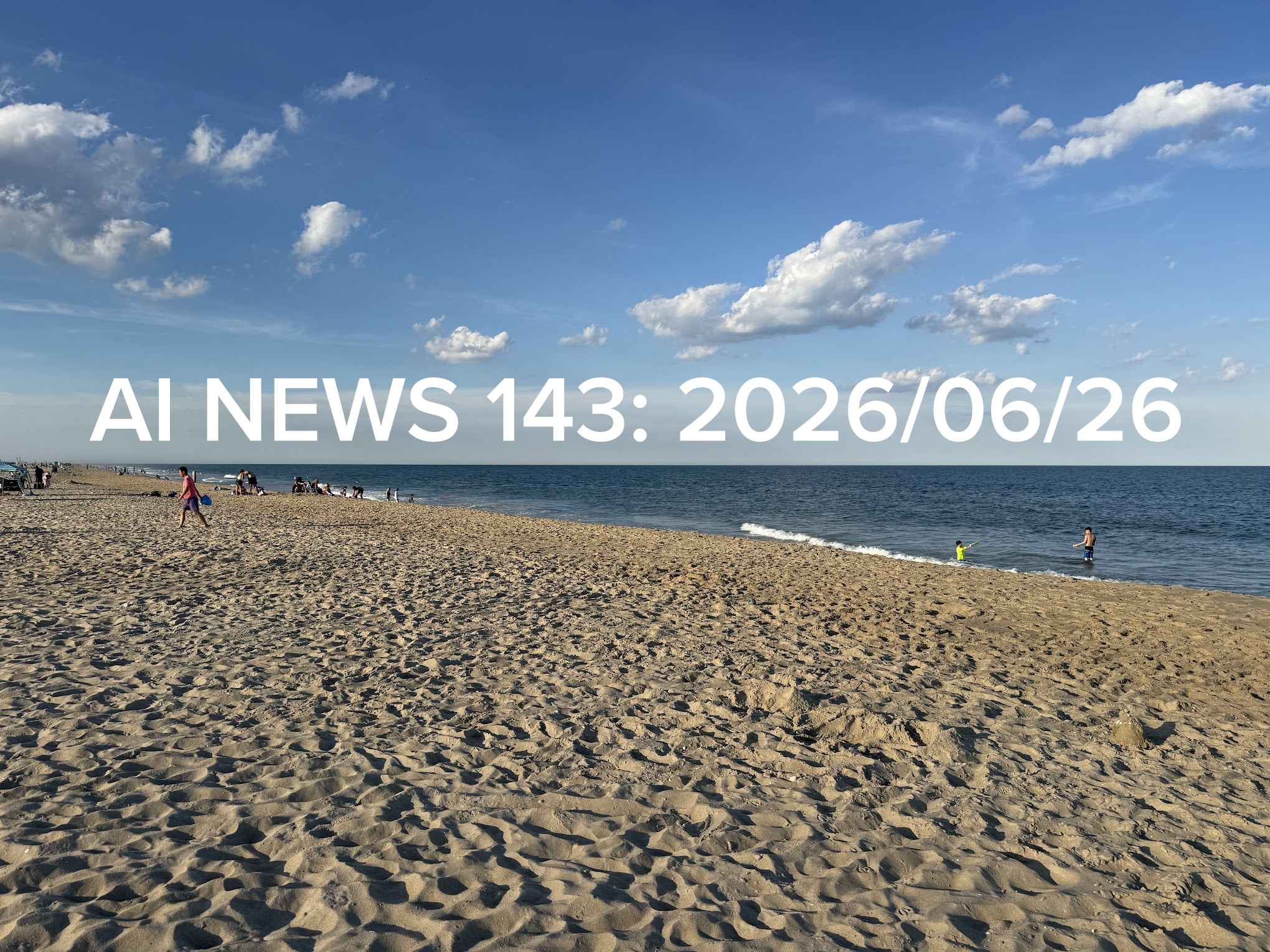
Today’s cover is a departure from my normal AI images. I went old school and took a June photo of the beach, put it into Photoshop, and added text.
I used to do “film photography”, and I worked with wedding photographers. In the ’90s, I have vivid memories of being screamed at by photographers for suggesting that film may shift to digital. Digital was cheating. Autofocus was cheating. Photoshop was the ultimate sin.
Using a computer to fix white balance or lighting… any post-production that you didn’t capture on the film, was met with disgust. It was professional to know what film to use (1000 for low light or 100 in bright sun was evidently a complex skill), understanding lenses, camera bodies, aperture, shutter speed, etc. Those things were the soul of photography. Digital was profane and gross.
So, in 2026, this is a digital photo from my camera with no filters and no changes in Photoshop other than I opened it to add the font, then I saved it as a PNG. There’s still a lot of digital adjustment happening in an plain iPhone photo… even when it’s “not happening”.
The category covers this week celebrate Kurt Schwitters and his collage technique called Merz pictures. Schwitters was born in Hanover, Germany, on June 20th, 1887 (within this week’s range), and died in 1948 at 60. He was part of the modern art movement and Dadaism. These are uniquely human.

Each week, I try to find an artist or writer I’ve never heard of, and in this case, I got to know Kurt Schwitters. I gave my Claude skill and Gemini the task of auto-creating collages in the style of Merz pictures for each of the categories, and my favorite covers are below.
This is the strongest output I’ve ever gotten from the shortest prompt I’ve ever given. My testing and learning is not an endorsement. Learning new artists is my token offset (pun intended) of the profane elements of AI art.


This Week’s Humanities Selections
Today’s Humanities reading is from Ingeborg Bachmann, who was born on June 25th, 1926. This year marks her centenary.
Bachmann was an Austrian poet who was impacted by war at the age of twelve. Her poetry is focused on post-war landscapes. This week’s Humanities reading is Die gestundete Zeit, which is German for “the deferred time”.
Die gestundete Zeit by Ingeborg Bachmann
Harder days are coming.
The withdrawal of deferred time
is visible on the horizon.
Soon you will have to lace up your boots
and drive the hounds back to the marshland farms.
For the guts of fish
have chilled in the wind.
The light of lupins burns feebly.
Your gaze gropes through the fog:
the withdrawal of deferred time
is visible on the horizon.
This week’s music selection is an audio poem from Kurt Schwitters called Ursonate, and audio of Ingeborg Bachmann herself reading Die gestundete Zeit.
The Schwitters audio is one of the first examples of sound poetry, and it’s considered the greatest sound poem of the 20th century. I’ve got a three-minute audio clip from 1932, below. It has a written score you can read out loud. It’s incredible, abstract, and absurd art. The full poem is 40 minutes in four parts.

https://www.ubu.com/historical/schwitters/ursonate.html
This Week By The Numbers
Total Organized Headlines: 496
- AGI: 9 stories
- AI Inn of Court: 10 stories
- Accounting and Finance: 10 stories
- Agents and Copilots: 194 stories
- Alibaba: 11 stories
- Alignment: 16 stories
- Amazon: 8 stories
- Anthropic: 91 stories
- Apple: 6 stories
- Audio: 9 stories
- Augmented Reality (AR/VR): 16 stories
- Autonomous Vehicles: 7 stories
- Benchmarks: 53 stories
- Business and Enterprise: 63 stories
- ByteDance: 5 stories
- Chips and Hardware: 42 stories
- DeepSeek: 2 stories
- Education: 14 stories
- Ethics/Legal/Security: 62 stories
- Figure: 3 stories
- Google: 37 stories
- HuggingFace: 10 stories
- Images: 13 stories
- International: 105 stories
- Internet: 9 stories
- Law: 8 stories
- Locally Run: 22 stories
- Meta: 6 stories
- Microsoft: 14 stories
- Mistral: 3 stories
- Mobile: 10 stories
- Moonshot: 2 stories
- Multimodal: 14 stories
- NVIDIA: 10 stories
- Nous Research: 11 stories
- Open Source: 107 stories
- OpenAI: 66 stories
- OpenClaw: 5 stories
- Perplexity: 3 stories
- Podcasts/YouTube: 5 stories
- Publishing: 39 stories
- Qwen: 7 stories
- RAG: 5 stories
- Robotics Embodiment: 33 stories
- Sakana: 7 stories
- Science and Medicine: 36 stories
- Security: 22 stories
- Technical and Dev: 125 stories
- Video: 16 stories
- World Models: 5 stories
- X: 10 stories
- Zhipu AI: 40 stories
This Week’s Overview (written and rambling by me, not AI)
For the week ending June 26th, I organized 496 links into about 55 categories. I’m 12 weeks behind because I soaked up the summer spending time with my family.
Moments of touching grass!
This was a personal week because we spread my dad’s ashes on my parents’ 54th anniversary. My mom, Jen, and both our daughters got to spend a rare afternoon together on a gorgeous day. My dad died four years ago, and this was a very healing moment.


On June 25th, I presented to the Blue Rock Financial Group’s Delaware Business Owners Summit. I had a really fun time with a shorter presentation focused on what businesses can expect from artificial intelligence over the next 12 to 18 months. Here’s a link to my slides and my HeyGen demo.
I created a five-minute abs version of quick things you can do right now to get ramped up on AI. If you’re not using it much, I have a very easy-to-follow guide.

I continued my training on the StairMaster to get ready for my August attempt to hike the Grand Traverse with my daughter Rori. I climbed 331 floors on the StairMaster with a 15-pound pack, and I did not use my hands. That’s 3,531 vertical feet and almost 2,000 calories. I still have a way to go. I’m hoping to get to 475 floors before August.

I also went running on the beach a few times and enjoyed the early summer weather.

Let’s GO… AI News of the Week!
Here are the top stories of the week, organized loosely by company and sorted by priority.
Anthropic
Anthropic’s Mythos model continues to make waves around the world, especially with security. Mythos found vulnerabilities in several U.S. government systems within hours. That’s according to General Joshua Rudd of U.S. Cyber Command, as relayed by Democratic Senator Mark Warner.

Mythos access is still limited to about 200 partners under Project Glasswing. This means that American companies have a head start on securing systems and working together to identify the risks. This voluntary cooperation is a big change in how we view frontier models over the past three or four months.

Project Glasswing’s main partners include Amazon, Apple, Broadcom, Cisco, CrowdStrike, Google, JPMorgan Chase, Microsoft, and Nvidia.
Anthropic also launched Claude Tag, which lets you add Claude as a coworker in Slack conversations, and Claude will take on tasks as people reach bottlenecks. If you don’t use Claude in any kind of collaborative capacity, it may not be intuitive. I recommend setting up projects in either GPT or Claude and having a local folder on your desktop. Put a bunch of things in that folder and then have Claude work on them. You can immediately see how strong of a coworker it is, and it makes sense to extend that to a Slack environment where Claude can work across projects with big teams.
https://www.anthropic.com/news/introducing-claude-tag
OpenAI
Just like Anthropic has Project Glasswing, which is a secret group testing a secret product, OpenAI has its own cyber defense consortium, Daybreak.
https://openai.com/daybreak/
https://openai.com/index/daybreak-securing-the-world/
https://openai.com/daybreak/partners
However, Daybreak is less about unreleased models and more about preparing to defend against threats. Partners include Accenture, Akamai, Cisco, KPMG, IBM, Palantir, PricewaterhouseCoopers, SoftBank, and Wiz.

The Daybreak setup is more of a suite of tools. There’s a Codex security plugin. There’s a model called GPT-5.5 Cyber that’s specifically trained for security. There’s the partner program that exchanges information with access to vulnerabilities.
The White House is asking OpenAI to slow-roll the release of its new model over safety concerns | TechCrunch
https://techcrunch.com/2026/06/25/the-white-house-is-asking-openai-to-slow-roll-the-release-of-its-new-model-over-safety-concerns/
OpenAI has its custom AI chip, Jalapeño. It only took a few months to design and build.

“We’ve designed and built our first AI chip: Jalapeño. Designed from the ground up by OpenAI and brought to production with @Broadcom, Jalapeño is purpose-built for the LLM workloads powering ChatGPT, Codex, the API, and future agentic products. Chips are foundational to the AI…” https://x.com/OpenAI/status/2069770172802773292
OpenAI employees use Codex for 99.8% of their AI workload.
How agents are transforming work | OpenAI https://openai.com/index/how-agents-are-transforming-work/

ByteDance
ByteDance’s Seedance 2.5. ByteDance keeps the video generation lead. https://seed.bytedance.com/en/seedance2_5
I feel Seedance 2.0 was the first tool to pass the Turning video test. 2.5 is even better. Here’s the 2.0 video that blew me away. I featured it as the top story in February 2026 (with a full overview).
LOOPS
Loop engineering: This is the term of the moment that you need to know.
Loop engineering is different than prompt engineering. With prompts, you have a conversation and you guide the chat along the way. With loops, you give a goal to an agent, and that goal is usually tied to a success metric. This allows an agent to iterate and check its work until the goal is met, and then it comes back to you.

Running loops means you can leave your computer and the work will continue, assuming your loop is designed elegantly enough. For coding, this is a great fit, and software developers who are good at writing loops can create incredible productivity gains by setting it and forgetting it.
Speaking of loops… NVIDIA came out with a barn-burner robotics paper.
ENPIRE: Agentic Robot Policy Self-Improvement in the Real World
“We conjecture that the missing abstraction to automate robotics research is a repeatable feedback loop for real-world policy improvement: reset the scene, execute a policy, verify the outcome, and refine the next iteration.”
https://research.nvidia.com/labs/gear/enpire/
Back to Anthropic
Anthropic accuses Alibaba of largest known AI distillation attack. This is a big deal to follow.

Distillation is using a strong model to train a slightly weaker model without having to spend all the money on computing power. In the case of Chinese open source models, there have been a lot of accusations that the open source labs are distilling the American frontier labs to gain the strength and reasoning skills.

More on Apple Maps
Bilawal Sidhu is one of my favorite AI influencers/thought-leaders. He’s a former Googler who’s a specialist in neural radiance fields and Gaussian splatting. A few weeks ago, Apple used neural radiance fields to create incredible 3D realism in Apple Maps. Bilawal created a 12-minute explainer video that walks through how this is happening and some examples of how realistically immersive the maps have become.
Google: Mid-Size and Open Source Models
In the past few weeks, we’ve talked about the families of models and their various sizes. For example, the Claude family has the largest model as Fable, and then goes down to Opus, and then Sonnet, and then Haiku. We also talked about locally hosted models and open-source models.
Ethan Mollick has been pointing out recently that Google doesn’t have a public frontier model any longer. I think he’s got a good point because Fable and GPT-5.6 Sol are the leaders. That’s why I wanted to talk about Gemini 3.5 Flash and Gemma 4 today, because I don’t see a problem with Google finding a niche in these mid-sized, agentic, and open-source options.
When it comes to routine queries of data, smaller models are great. If you wanted a quick high-level overview of a weekly report, you don’t need a frontier model. You could use a small model, and it could ground itself using the data and give you a verbal overview without much hassle.
When it comes to agentic work, that gets more complicated, especially if you need reasoning beyond verbalizing data.
Gemini 3.5 Flash
Google released Gemini 3.5 Flash this week, which is a medium-sized model with a million-token context window, and it is multimodal, so it can handle text, images, video, audio, and PDFs as both inputs and outputs. And it has strong code support and execution for function calling and using maps or searching the web.
The most impressive piece is it can also use a computer on your behalf. This makes it a compelling agent model because it’s smaller than the frontier, so you save a lot of money, but it’s still strong enough to give some meaty tasks. It’s compatible for use on phones, which means talking to your device is going to become a more viable option.
Gemma 4
Google’s open-source model family, Gemma 4, has had 200 million downloads in less than three months. Gemma 4 comes in a variety of sizes, from small versions that can be run locally to larger versions that need a server. Gemini 3.5 Flash is a closed model. Gemma is their open model. It’s also multimodal.
Google SpaceX Deal
Google is going to rent data center compute from SpaceX for $920 million a month.
Google Talent Drain
Google DeepMind has four high-profile talent exits. Two of the biggest contributors to Gemini are going to Anthropic, and last week Nobel laureate John Jumper left DeepMind for Anthropic, and Noam Shazeer, who was one of the co-inventors of the Transformer, left for OpenAI.
“You Can’t Handle The Legal Benchmarks!”
Spellbook Labs ran 60,000 pages of contracts from 500 public companies through an AI filter to figure out how often human lawyers hallucinate. 60% of the contracts filed to the SEC contain mistakes. Having human benchmarks for legal errors is going to be a powerful counterpoint. Peer-reviewed legal benchmarks are already showing AI outperforming human lawyers in many tasks, and Harvey is growing its market share every week.
Perplexity announced a legal automation tool called Computer for Counsel. I’ve not kicked the tires on Perplexity in a long time. It seems like projects for Claude or GPT connected to the Perplexity computer system. It’s mostly focused on administrative tasks.
Medicine
The New York Times reported on a dramatic emergency room case in Queens where a proprietary AI medical tool identified a rare genetic disorder that had reduced a patient’s heart function to 10%. Doctors thought it was asthma, but the AI was able to find this rare disease. It saved this man’s life.
Creepy Glasses
Meta launches $299 AI glasses. We’re Partnering With EssilorLuxottica to Launch Meta Glasses https://about.fb.com/news/2026/06/meta-essilorluxottica-partner-launch-meta-glasses/
Self-Improvement: The Models Might Start Trainmaxxing and Benchmogging
Ethan Mollick: AI labs’ increasingly fast pace of new releases is a first sign of self-improvement.
“If AI self-improvement, even in a very limited way, is possible, the cadence of shipping both AI products/harnesses & models should go up. This appears to be happening at Anthropic & OpenAI, but not for any other labs, including those that seemed to be catching up last year.”
https://x.com/emollick/status/2068152054900502702

SpaceX Deal
Reflection AI signs $6.3 billion compute deal with SpaceX.
“SpaceX has signed a $6.3 billion dollar compute deal with Reflection. Reflection will gain immediate access to GB300s to train open source models, and will pay SpaceX $150 million per month beginning July 1, 2026, through 2029, according to materials viewed by CNBC.
https://x.com/AndrewCurran_/status/2069078511948910820
Zai’s GLM 5.2 is an Open Source Powerhouse
Chinese open-weights model GLM-5.2 is close to Opus at 30% of the cost. It can run in Claude Code and might be the DeepSeek moment for open-source agents.


“GLM-5.2 should be ‘DeepSeek moment’ for agents. We enter a new world where the top end of agentic capabilities are available in open models. If you care about open, now is the time to inform regulators on how we should build a world with safe, frontier, open intelligence.”
https://x.com/natolambert/status/2069073545632813193
“This is a watershed moment. GLM-5.2 solidly beat Opus 4.8 and human participants in our backend take-home, making the whole thing obsolete. It also pushed forward the state-of-the-art for multi-stage media-to-transcript, with a new release: offmute-v2. I come with receipts.”
https://x.com/hrishioa/status/2068036265484992938
Tutorial on how to use GLM-5.2 in Claude Code. Bookmark this. ~4.5x faster and ~5x cheaper compared to Opus 4.8!
https://x.com/thealexker/status/2069163621469335757
This Week’s Top Stories with All The Links
Anthropic
Mythos: Anthropic’s Mythos model hacks classified US systems in *hours*
Anthropic test found vulnerabilities in classified US systems in hours | AP News
https://apnews.com/article/anthropic-mythos-ai-classified-systems-vulnerabilities-testing-3e8762c0527c4d8ed657cbe48c84a718
Early Users of Anthropic Mythos still have access after US order. Mainly through project Glasswing. Via Bloomberg”
https://x.com/kimmonismus/status/2067876984206537188
I promised I would post the letter Dario Amodei sent to the White House and Senators Tim Scott and Elizabeth Warren as soon as it became available:”
https://x.com/AndrewCurran_/status/2070134863370567864
Reuters has now added more context to last week’s Mythos reporting. According to AP, Anthropic’s Mythos model identified vulnerabilities in highly sensitive U.S. government computer systems during a testing exercise conducted with Washington’s intelligence agencies. The tests”
https://x.com/kimmonismus/status/2069692592250360126
Roughly 200 organizations still have access to Claude Mythos. Just imagine the advance they have.”
https://x.com/kimmonismus/status/2068038020394021000
The Trump White House Is Over Anthropic CEO Dario Amodei | WIRED
https://www.wired.com/story/the-trump-white-house-is-over-anthropics-dario-amodei/
The White House and Anthropic may have found the first serious path to restore Mythos and Fable access without pretending jailbreaks can be eliminated. AI regulation may be shifting from vague fear to a benchmark based tests of model failure, because completely removing”
https://x.com/rohanpaul_ai/status/2067947789578125391
Tag: Anthropic launches Claude Tag: an AI teammate agent for Slack
Introducing Claude Tag \ Anthropic
https://www.anthropic.com/news/introducing-claude-tag
A few thoughts after playing around with Tags for a day and reading Arvind’s thoughts: 1. True breakthrough in the “agentic identity” paradigm. I like how thought-through the details are (e.g.: what Tags learns from once private channel will not be remembered by Tags in a public”
https://x.com/JubbaOnJeans/status/2069798018879238517
Bug triage Let Claude sit in your feedback channel and automatically pick up reports. It finds the code path, reproduces, git-blames, writes a fix, and tags the owner. All that’s left is code review before Claude merges the PR.”
https://x.com/ClaudeDevs/status/2069468904351727726?s=20
Claude Tag is a paradigm shift in how we ship products at Anthropic. Our internal version merges 65% of product PRs and this is our first product that is natively multi-player and proactive. We’re excited for you to try this out. Let us know your feedback!”
https://x.com/_catwu/status/2069473118742331608
Introducing Claude Tag, a new way for teams to work with Claude. In Slack, Claude joins as a team member with access to the channels and tools you choose. Tag Claude in and delegate tasks to it while you focus on other work.”
https://x.com/claudeai/status/2069468693017268244

OpenAI
Daybreak: OpenAI’s creates security secret club: Project Daybreak finds and patches vulnerabilities to keep systems ahead of hackers
We’re expanding OpenAI Daybreak to help defenders move faster from vulnerabilities to fixes. > Codex Security is now easier to use across the CLI, plugins, and the Codex app – scanning code, building threat models, validating findings, generating patches, and exporting results”
https://x.com/reach_vb/status/2069110672886002140
We’re expanding OpenAI Daybreak to help democratize patching vulnerable software at machine speed: – Codex Security plugin: find, validate, and fix vulnerabilities right inside Codex – The full version of GPT-5.5-Cyber model: a great model for trusted defenders – Cyber Partner”
https://x.com/OpenAI/status/2069104283824640023
Daybreak: Tools for securing every organization in the world | OpenAI
https://openai.com/index/daybreak-securing-the-world/
Get started with the Codex Security Plugin | OpenAI | OpenAI
https://openai.com/daybreak/codex-security-plugin/
White House Asks OpenAI to Slow The Release of New Model: White House gates OpenAI’s GPT 5.6 release to select customers – instead of regulations AI companies have direct communications and debates with the White House and Dept of War
The White House is asking OpenAI to slow roll the release of its new model over safety concerns | TechCrunch
https://techcrunch.com/2026/06/25/the-white-house-is-asking-openai-to-slow-roll-the-release-of-its-new-model-over-safety-concerns/
Trump Administration Asks OpenAI to Stagger Release of New Model Over Security Concerns — The Information
https://www.theinformation.com/articles/trump-administration-asks-openai-stagger-release-new-model-security-concerns
OpenAI Creates Their Own Chip: Jalapeño: OpenAI has their custom AI chip Jalapeño – It only took a few months to design and build
Absolutely insane: “Jalapeño was co-developed from initial design to manufacturing tape-out in just nine months, and the custom AI accelerator program represents what we believe to be the fastest ASIC development cycle ever achieved in high-performance advanced semiconductors.
https://x.com/kimmonismus/status/2069795647956373632
We’ve designed and built our first AI chip: Jalapeño. Designed from the ground up by OpenAI and brought to production with @Broadcom, Jalapeño is purpose-built for the LLM workloads powering ChatGPT, Codex, the API, and future agentic products. Chips are foundational to the AI”
https://x.com/OpenAI/status/2069770172802773292
Agent Use at OpenAI: OpenAI employees use Codex for 99.8% of their AI workload
Agents are being adopted very quickly and accelerating work. How this looks across OpenAI itself:”
https://x.com/gdb/status/2070199649823297653
How agents are transforming work | OpenAI
https://openai.com/index/how-agents-are-transforming-work/
Work at OpenAI is being transformed by agents, in every department. Across our entire company, people are using Codex to do work that is more complex, longer-running, and increasingly cross-functional. Our internal usage offers an early look at how agentic tools may reshape”
https://x.com/OpenAI/status/2070196105745518913
ByteDance
Seeddance 2.5: ByteDance’s Seedance 2.5 – ByteDance keeps the video lead
ByteDance’s New AI Video Model Can Make 30-Second Clips From a Single Prompt – CNET
https://www.cnet.com/tech/services-and-software/bytedance-introduces-new-seedance-2-5-video-model/
Seedance 2.5 is pretty good at making videos of your cat. I made this with just 1 photo My tutorial and prompts here:
https://t.co/71ww5AhzIN This is day 8 of extremely easy edits Edited with @magnific #MagnificPartner”
https://x.com/karenxcheng/status/2069090396312064468
Seedance 2.5 released. It looks insane! Still trying to figure out where Veo 4 is and why nothing comes close to Seedance”
https://x.com/kimmonismus/status/2069316710545428948
Wow. Seedance is really good at turning greyboxed 3d references into final quality pixels. Like really good. Seedance 2.5 coming with 30 second generations and up to 50 (!) references is gonna be mad. Try the workflow Reid is running below.”
https://x.com/bilawalsidhu/status/2069825605994963047
Engineering
Loops: Loop engineering: This is the big term of the moment that you need to know
Had so many thoughts on the “loop engineering” trend. I spent a few minutes with my writer agent to summarize some of my research, notes, and discussions with students, founders, and startups. Very early, but new ways of working with agents will start to emerge with a”
https://x.com/omarsar0/status/2068010014808092674
interesting point here: loops amplify behavior, making them a double edged sword but we know loops are the future, so how do we avoid amplifying bad patterns? you need an *engaged* human in the (stacked) loop(s) your agent needs to learn your taste!”
https://x.com/sydneyrunkle/status/2069415731314233524
is there interest in a 4k+ word deep dive in building reliable agent loops (on cloudflare and elsewhere) writing down what I’ve done for building agents resilient to catastrophic failures on clients/servers/inference (with zero user code) and I need to get it out of my brain”
https://x.com/threepointone/status/2067970619929510350
Some more thoughts on looping in coding agents.”
https://x.com/mitsuhiko/status/2069371901583954275
This “loop” automation is nuts inside of Codex. “/goal go over every single feature in this app create a user story with expected behaviour based on the code keep a single canonical spreadsheet tracking the features status – when done switch loop to testing every user story and”
https://x.com/tomosman/status/2068692611334893582
Anthropic
Alibaba: Anthropic accuses Alibaba of largest known AI distillation attack – This is a big deal to follow
Anthropic accuses Alibaba of campaign to extract AI capabilities
https://www.cnbc.com/2026/06/24/anthropic-alibaba-distillation-campaign.html
Anthropic claims: Alibaba continues to distill Claude on a large scale to train Qwen. Via Bloomberg Anthropic is accusing Alibaba-linked operators of running a massive campaign to illicitly access Claude through nearly 25,000 fraudulent accounts. According to Bloomberg,”
https://x.com/kimmonismus/status/2069879640835961277
Anthropic’s letter accusing Alibaba of distillation.”
https://x.com/Discoplomacy/status/2070069250513900005
Apple
Maps Update: More on Apple’s photorealistic 3D city maps from two weeks ago
Apple Maps Just Got Insanely Realistic — Here’s The Tech Behind It 00:00 Intro 00:41 What did Apple actually release? 01:30 Why the old way was broken 02:35 What is 3D Gaussian Splatting? 04:06 Live demo: Apple’s photorealistic aerial maps 07:43 The real competition: Apple vs”
https://x.com/bilawalsidhu/status/2068326490656182329
Gemini 3.5 Flash: Google embeds computer-use agent capability directly into Gemini 3.5 Flash – also works on phones
Build agents that can see, reason, and take action across browser, desktop and mobile environments. Gemini 3.5 Flash now features built-in computer use capabilities: 📱 Custom client-side functions for human-in-the-loop takeover 🔒 Configurable action-level safety policies 🛡️”
https://x.com/googledevs/status/2070174765940170832
Computer Use is now a built-in tool supported in Gemini 3.5 Flash. 💻 Developers can now use 3.5 Flash to build custom agents that see and take action across browser, mobile and desktop environments.”
https://x.com/Google/status/2070175556503568394
Gemini 3.5 Flash now supports native computer use. This built-in tool lets developers build custom agents that can see and take action across browser, mobile, and desktop interfaces. Find out more →
https://x.com/GoogleDeepMind/status/2070180509523546481
Introducing computer use in Gemini 3.5 Flash
https://blog.google/innovation-and-ai/models-and-research/gemini-models/introducing-computer-use-gemini-3-5-flash/
Yesterday we launched computer use in Gemini 3.5 Flash with browser, mobile, and desktop environments. I put together a quickstart for how to control an Android Phone. 1. Single script to install emulator from terminal. 2. Basic agent loop with interactions API using `adb` to”
https://x.com/_philschmid/status/2070177135453434183
Gemma 4: Gemma 4 hits 200 million downloads in 2.5 months
Gemma 4 just hit 200M downloads in only 2.5 months! For context, total downloads across the entire Gemma family of models were at 100M when we launched Gemma 3. The community’s acceleration is incredible. Thank you to everyone building with Gemma. Watch how developers are”
https://x.com/googlegemma/status/2070180154069176399
Multi-agents collaborations are among the most interesting agent behaviors right now! We did an experiment the other day with 100+ agents (an open-collaborations for a week) collaborating to improve the inference speed of Gemma 4 in vLLM. Got a 5x final improvement in speed but”
https://x.com/Thom_Wolf/status/2070134136304517284
Google Has Dropped Off the Leaderboards: Google is behind on frontier models, but doing well with smaller multimodal ones
Interestingly, Google no longer has a public frontier model. They have a very good flash model, but a very good flash model can’t do frontier work without a good frontier orchestrator. I am sure this will change soon, but Gemini 3.1 Pro is very clearly lagging at this point.”
https://x.com/emollick/status/2067617541762031900
Google Renting Data Centers from SpaceX for $920 million a month: Google to rent data center power from SpaceX for $920 million/month
Google to pay SpaceX $920 million a month for xAI compute capacity
https://www.cnbc.com/2026/06/05/google-to-pay-spacex-920-million-a-month-for-xai-compute-capacity.html
Google Talent Leaving for Anthropic and OpenAI: Two lead Gemini architects leave Google DeepMind for Anthropic
Google DeepMind is facing another high-profile talent hit: Bloomberg reports that Jonas Adler and Alexander Pritzel, two key contributors to Gemini, are planning to leave for Anthropic. Their exits follow John Jumper’s move to Anthropic and Noam Shazeer’s move to OpenAI, adding”
https://x.com/kimmonismus/status/2069870513283871203
Nobel laureate John Jumper is leaving DeepMind for rival Anthropic | TechCrunch
https://techcrunch.com/2026/06/20/nobel-laureate-john-jumper-is-leaving-deepmind-for-rival-anthropic/
Law
Human Benchmarking: AI audit finds 60% of SEC-filed contracts contain errors – human benchmarks are a cruel mirror
60% of contracts filed to the SEC contain mistakes. Spellbook Labs ran 60,000 pages of contracts from 500+ public companies through AI to answer a question: How often do human lawyers hallucinate? Accidents from self-driving cars get headlines—and they should. But human drivers”
https://x.com/scottastevenson/status/2069413077351596143
Perplexity for Counsel: Perplexity launches Computer for Counsel to automate legal admin work
Introducing Computer for Counsel
https://www.perplexity.ai/hub/blog/introducing-computer-for-counsel
Medicine
Cardiology Breakthroughs: Custom built AI diagnostic programs cracks serious mystery case in Queens emergency room
Wild story on AI + diagnostics via the New York Times: In 2025, 45-year-old security guard showed up at a Queens ER, coughing up blood and struggling to breathe. Chest X-ray: clean. Electrocardiogram: abnormal, but nothing pointing to a diagnosis. They learned he’d recently”
https://x.com/TheRundownAI/status/2069454020012302536
Meta
Creepy Meta Glasses: Meta launches $299 AI glasses
We’re Partnering With EssilorLuxottica to Launch Meta Glasses
https://about.fb.com/news/2026/06/meta-essilorluxottica-partner-launch-meta-glasses/
Nvidia
Self-Improving Robots!?: NVIDIA paper: Agentic Robot Policy Self-Improvement in the Real World
ENPIRE: Agentic Robot Policy Self-Improvement in the Real World
https://research.nvidia.com/labs/gear/enpire/
Self-Improvement
Signs of Self-Improvement (reminds me more of lane assist): Ethan Mollick: AI labs increasingly fast pace of new releases is a first sign of self-improvement
If AI self-improvement, even in a very limited way, is possible, the cadence of shipping both AI products/harnesses & models should go up. This appears to be happening at Anthropic & OpenAI, but not for any other labs, including those that seemed to be catching up last year.”
https://x.com/emollick/status/2068152054900502702
SpaceX
$6.3 Billion Deal with Reflection: Reflection AI signs $6.3 billion compute deal with SpaceX
SpaceX has signed a $6.3 billion dollar compute deal with Reflection. Reflection will gain immediate access to GB300s to train open source models, and will pay SpaceX $150 million per month beginning July 1, 2026, through 2029, according to materials viewed by CNBC.”
https://x.com/AndrewCurran_/status/2069078511948910820
SpaceX signs compute deal with open-source AI startup Reflection
https://www.cnbc.com/2026/06/22/spacex-ai-colossus-data-center-reflection.html
Zai
Continued Praise of GLM-5.2: Chinese open-weights model GLM-5.2 is close to Opus at 30% of the cost. Can run in Claude Code and might be the DeepSeek moment for open-source agents.
GLM-5.2 leads open weights models and sits at #3 overall on GDPval-AA, a real-world agentic work benchmark GLM-5.2 from @Zai_org scores 1524 Elo on GDPval-AA, which measures performance on real-world, economically valuable knowledge work through long-horizon, multi-turn tasks.”
https://x.com/ArtificialAnlys/status/2069121548670406947
GLM-5.2 should be “DeepSeek moment” for agents. We enter a new world where the top end of agentic capabilities are available in open models. If you care about open, now is the time to inform regulators on how we should build a world with safe, frontier, open intelligence.”
https://x.com/natolambert/status/2069073545632813193
Open weights just caught up to the frontier. GLM-5.2 from @Zai_org tops the open-model rankings on @ArtificialAnlys and @arena’s Agent Arena. It’s now live on CoreWeave Serverless Inference at $1.39 in and $4.40 out per 1M tokens. Ship more for less.”
https://x.com/CoreWeave/status/2069874833576321150
Ran 10 more tests comparing GLM 5.2 & Opus. On average, GLM 5.2 produced 2x the tokens but was still faster + 3x cheaper with similar quality! I’m open sourcing all these tests tomorrow, including the code, my prompts, and the token/cost stats.”
https://x.com/nutlope/status/2069492037036945634
This is a watershed moment. GLM-5.2 solidly beat Opus 4.8 and human participants in our backend take-home, making the whole thing obsolete. It also pushed forward the state-of-the-art for multi-stage media-to-transcript, with a new release: offmute-v2. I come with receipts.”
https://x.com/hrishioa/status/2068036265484992938
I ran GLM 5.2 with OpenCode harness against Claude Opus this week deployed locally. Bottom line: It is a real frontier coding model and insanely good for the price (free). Open source model + open source harness + local serving on my own chips is an amazing value proposition.”
https://x.com/PatrickToulme/status/2068134212587184442
Introducing GLM 5.2 for autoresearch GLM 5.2 is the first open weights model we’ve tried on our autoresearch pipeline that’s proven capable for real research tasks. With Fable 5’s restrictions on research, having an open weights alternative is a huge win for open source Watch”
https://x.com/askalphaxiv/status/2069074178829901974
This is the strongest ARC-AGI-2 performance to date by an open-source model.”
https://x.com/fchollet/status/2069858556552298519
Gemini 3 Pro was the first model to achieve at least 23% on ARC-AGI-2, which it did in November, 2025 (it actually scored 31%). So the 8-12 month gap between closed and open weights models still seems to hold. But they are also more jagged, better at some tasks, worse at others.”
https://x.com/emollick/status/2069857050016776227
Using GLM-5.2 In Claude Code: GLM-5.2 runs inside Claude Code at fraction of Opus cost
been testing GLM 5.2 directly inside Claude Code. it is a really good model here’s an ultra simple way to vibe check it via @huggingface “` export ANTHROPIC_BASE_URL=”https://t.co/q5zcSfYxpH” export ANTHROPIC_AUTH_TOKEN=”${HF_TOKEN}” claude –model “zai-org/GLM-5.2″ “`”
https://x.com/multimodalart/status/2068026613787217943
Tutorial on how to use GLM-5.2 in Claude Code (bookmark this) ~4.5x faster & ~5x cheaper compared to Opus 4.8! 1. Install the latest Claude Code npm install -g @anthropic-ai/claude-code 2. Create an account at
https://t.co/XOKp7ityCW. 3. Grab an API Key from”
https://x.com/thealexker/status/2069163621469335757



Leave a Reply