Every week, I organize 400 to 700 links into roughly 60 categories as part of my ongoing effort to learn about AI. This is my personal notebook, which I enjoy sharing with friends… a hobby and a labor of love, rather than a commercial publication or product.
If you arrived here through a search or shared link, this page collects the links I found for Science and Medicine for the week ending August 7, 2026.
As part of my learning process, I like to automate the category covers. It gives me a chance to learn Python and APIs.
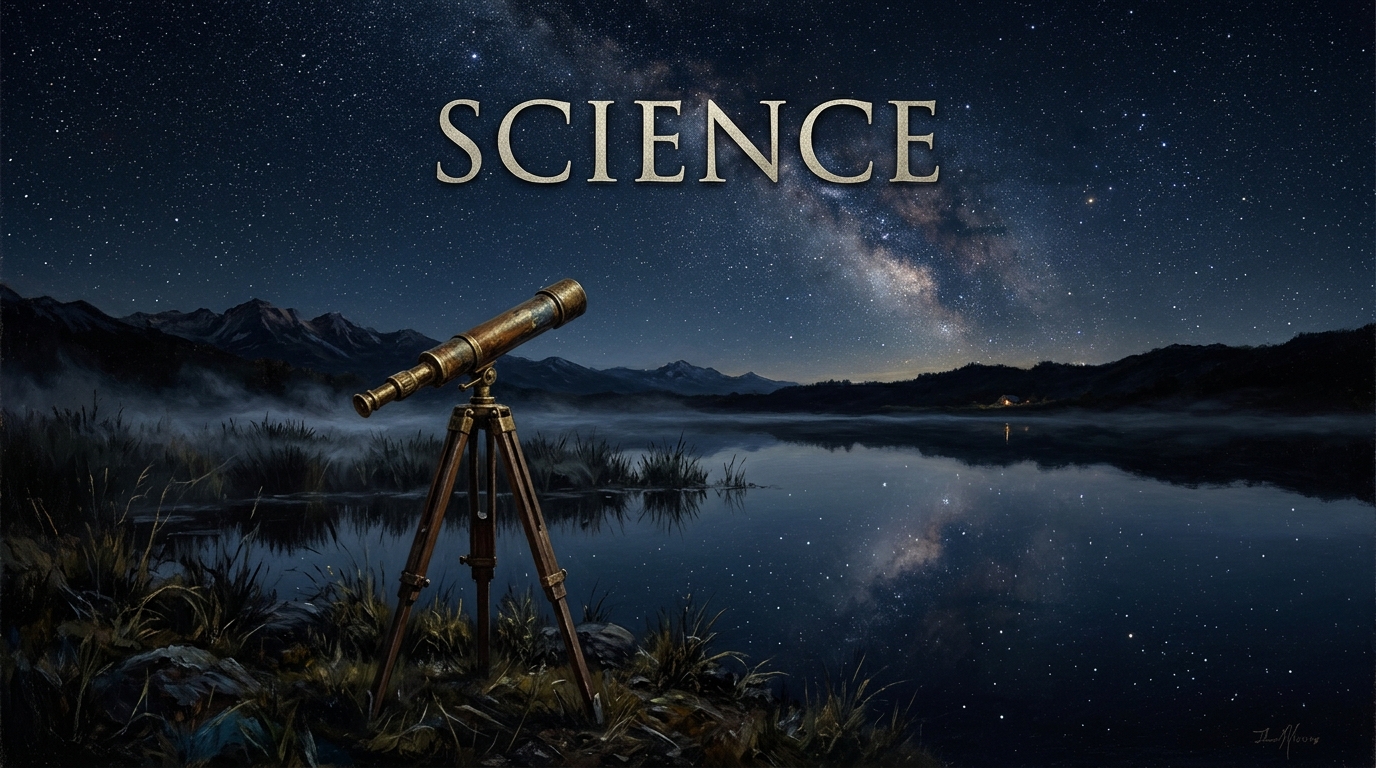
This week’s cover prompt was written using Claude Opus 4.7, and the image was generated using Gemini 3.1 Flash Image Preview.
Category Cover Image Prompt: A fine-art nocturne of a small weathered brass field telescope on a wooden tripod resting at the edge of a mirror-still alpine pond, lens tilted up toward a dense field of stars that reflects perfectly in the dark water, thin mist drifting across the reeds, a faint warm pinpoint glow on the far horizon, deep indigo and silver-white palette, painterly realism, low horizon with generous starlit sky above, bold title 'Science' set cleanly into the upper negative space.
This Week in Science and Medicine News
Summary by Claude Sonnet 5.5 based on this week’s links:
- Math falls to AI: OpenAI said an internal version of its next major model produced 10 new results on long-standing open math and computer science problems, using about $2,000 of tokens. Separately, Epoch's FrontierMath: Open Problems now lists 50 unsolved problems, of which AI has solved three so far.
- Hurricane forecasting: Google DeepMind published its WeatherNext cyclone model in Nature, saying it adds roughly 24 hours of lead time on storm track and intensity on average. Google is also open sourcing WeatherNext 2.
- Reading models from the inside: Several posts used Goodfire's Silico to look inside models working on biology and medicine. One analysis traced which signals a motion model uses to detect Parkinson's gait impairment beyond walking speed. Another built an atlas explaining 2.1 million genetic variants.
This summary was generated by Claude Sonnet 5.5 to help you explore the links below. Rest assured, I select, organize, and check the links by hand in Google Sheets, and write the introduction and personal commentary in The Main Newsletters myself each week as a labor of love.
This week's links related to Science and Medicine
Improving Fable 5 Safeguards \ Anthropic
https://www.anthropic.com/news/improving-fable-5-s-biology-safeguards
Silico can also improve drug design and lots of other AI x bio work via interpretability! Last week, I found that by reading the internal representation of protein-folding model, we can better rank and generate ligand-binding poses, up to 4x! 🧵 1/”
https://x.com/RyoYbioinfo/status/2084672101659889869
our models got gold on a bunch of olympiads. this one hits home! 🏅 Asian Physics Olympiad (APhO): Perfect score, theory exam 🏅 International Physics Olympiad (IPhO): Perfect score, theory exam 🥇 International Mathematical Olympiad (IMO): Gold medal 🥇 International Chemistry”
https://x.com/alexandr_wang/status/2085397789610233947
We’ve launched an expansion of FrontierMath: Open Problems! The benchmark now contains 50 significant, unsolved problems from research mathematics. AI has solved three so far, and solving all of them would be an incredible mathematical feat. Thread with more.”
https://x.com/EpochAIResearch/status/2083229557528945065
AI model achieves breakthrough in forecasting cyclones … Google DeepMind
https://deepmind.google/blog/weathernext-ai-model-achieves-breakthrough-in-forecasting-cyclones/
Ten advances in mathematics and theoretical computer science | OpenAI
https://openai.com/index/ten-advances-in-mathematics/
If a decades-old conjecture can fall overnight for the price of a used laptop, every open problem in mathematics is suddenly on the clock.”
https://x.com/TheTuringPost/status/2085095952470213107
This A.I. Just Created Viruses Not Found in Nature – The New York Times
https://www.nytimes.com/2026/08/06/science/ai-viruses-bacteria-arc.html
Agents want to collaborate. So we’re putting that instinct to work on improving open-weight LLMs at formal math. Our latest agent collab tackles the @SAIRfoundation challenge of building a cheat sheet that helps open-weight LLMs write better math proofs. The collab just”
https://x.com/cmpatino_/status/2085351089118019696
I’ve been working towards AGI my whole life, and as we enter this pivotal moment, I’m stepping into a new role as Chair of Google DeepMind & Chief Scientist of Alphabet. This will allow me to focus on long-term strategy, and accelerating scientific breakthroughs, including”
https://x.com/demishassabis/status/2085034334914769203
When VLMs process medical images, do they recognize organs and broken bones? Using Silico, I trained a J-Lens and created a visualizer exploring what Qwen-3.5 27B sees in each patch of an image. I found that Qwen can identify things like this harmful cyst on an OCT-scan!”
https://x.com/michaelwhanna/status/2084675176315474268
You can detect Parkinson’s gait impairment with a general-purpose human motion model. You might expect that’s just based on walking speed, but it’s not! Mathilde used Silico to see what other signals these models are picking up on:”
https://x.com/GoodfireAI/status/2085395565605794223
John Jumper to join Anthropic | Hacker News
https://news.ycombinator.com/item?id=48601162
This is really cool work building off our “Interpreting Physics in Video World Models” paper. People may not realize this yet, but unsupervised latent space simulators are a big deal.”
https://x.com/soniajoseph_/status/2084157222892806197
High-Fidelity 4D Cloth Capture Pipeline with a Two-Level Pattern” TL;DR: a 16-camera RGB system captures cloth at 1 mm spatial resolution using a two-level marker pattern plus physics-based reconstruction for temporally coherent 4D wrinkles, folds and self-contact.”
https://x.com/Almorgand/status/2084688158621348072
To understand whether we’re making genuine progress on reasoning, we entered our AI models in five STEM Olympiad competitions. The results: 🏅 Asian Physics Olympiad (APhO): Perfect score, theory exam 🏅 International Physics Olympiad (IPhO): Perfect score, theory exam 🥇”
https://x.com/AIatMeta/status/2085388945148297322
Finally a good paper testing whether self-reflection loops are worth it. Setup: Seven methods, open models at 1.5B, 3B and 7B, two math benchmarks, 150 questions each. Every generated token counted, including the ones spent on critiques, reflections, debate turns and checking.”
https://x.com/omarsar0/status/2084761324786172347
One of the most important new things we did was create BioDecisionBench, a benchmark specifically evaluating LLMs on reasoning failures in high-stakes pharma decisions. BioDecisionBench tests for reasoning around preclinical study design, observational study design (e.g. target”
https://x.com/elicitorg/status/2085041085433450992
To understand whether we’re making genuine progress on reasoning, we entered our AI models in five international STEM Olympiad competitions this year. The results: 🏅 Asian Physics Olympiad (APhO): Perfect score on the theory exam … gold medal 🏅 International Physics Olympiad”
https://x.com/shuchaobi/status/2085386404805374100
Exclusive: Former OpenAI exec Fidji Simo discusses her battle with POTS and her startup’s plans to cure it with AI and 3,500 vials of blood (so far)
https://finance.yahoo.com/healthcare/articles/exclusive-former-openai-exec-fidji-192343263.html
Excited to co-found Discovery Loop with my long-time collaborators @JeffDean @Sanjay_Ghemawat @OriolVinyalsML . Our mission is to automate machine learning, engineering and science. Learn more at:
https://t.co/JFHy15o1uw ♾”
https://x.com/quocleix/status/2085034995685654889
Some things to note: 1) AI is getting very good at math and science. 2) Two years ago LLMs could not do basic math consistently 3) According to @polynoamial this cost less than $2000 in current API coats 4) OpenAI is focusing on announcing benefits, not just risks, of new models”
https://x.com/emollick/status/2083559601312505863
Our WeatherNext 2 AI model from @GoogleDeepMind and @GoogleResearch can predict tropical cyclones with an extra day of lead time. Now, we’re open sourcing the model. Published in @Nature, Google researchers demonstrate how it delivers roughly a decade’s worth of weather”
https://x.com/NewsFromGoogle/status/2085430910103716273
During Hurricane Melissa, WeatherNext gave forecasters early predictions of its Category 5 landfall 5 days in advance with 80% confidence. This year, we’re providing 1,000 probabilistic predictions per storm to support forecasters, now accessible via WeatherLab →”
https://x.com/GoogleDeepMind/status/2085395450656428306
Predicting cyclones accurately can help save lives – and every hour of lead time counts. Published in @Nature, our AI model WeatherNext achieves state-of-the-art accuracy in forecasting a storm’s track and intensity, giving us a critical extra 24 hours to prepare on average. 🧵”
https://x.com/GoogleDeepMind/status/2085395442347524506
[2608.05000] Towards Physics of Multimodal Pretraining: Knowledge Flow, Modality Synergy, Early Unification, and Recipes
https://arxiv.org/abs/2608.05000
OpenAI’s Unreleased Model Astra Solves Ten Major Open Mathematics Problems | Don’t Worry About the Vase
https://thezvi.wordpress.com/2026/08/03/openais-unreleased-model-astra-solves-ten-major-open-mathematics-problems/
An internal version of our next major model produced 10 new results on long-standing open problems in mathematics and theoretical computer science, using roughly $2,000 worth of tokens at GPT-5.6 Sol API rates.”
https://x.com/OpenAI/status/2084352161404920316
The new GPT-5.6 Sol powers all chats for paid users, including Instant, creating one consistent experience. In our high-stakes factuality evaluation covering finance, medicine and law, the new GPT‑5.6 Sol produced 68% fewer responses with factual errors than GPT‑5.5 Instant.”
https://x.com/OpenAI/status/2085434713821565297
👨⚕️ 𝗙𝗶𝘃𝗲 𝗪𝗮𝘆𝘀 𝗥𝗼𝗯𝗼𝘁𝘀 𝗔𝘀𝘀𝗶𝘀𝘁 𝗗𝗼𝗰𝘁𝗼𝗿𝘀 𝗮𝗻𝗱 𝗧𝗿𝗮𝗻𝘀𝗳𝗼𝗿𝗺 𝗛𝗲𝗮𝗹𝘁𝗵𝗰𝗮𝗿𝗲 🤖 TL;DR: 1️⃣ Provide unparalleled precision in surgery 2️⃣ Enhance training through simulation 3️⃣ Reduce time in performing complex tasks 4️⃣ Offer consistent and tireless”
https://x.com/IlirAliu_/status/2083976940537491546
AI has become a useful research partner. It can find information, summarize evidence, and suggest ideas. But can it help us think better? Can it help us navigate the complex nuances of high-stakes decisions? Today, we’re taking the next step toward our mission of scaling up good”
https://x.com/elicitorg/status/2085040984581452151
AI models can solve formidable math problems, trounce humans at programming competitions, and outperform doctors. But can they help people make sound decisions when the evidence is ambiguous and the stakes are high? How do we know they are helping us reason better, not just”
https://x.com/elicitorg/status/2085395577123271100
I was waiting for the verdict from one of the most level-headed and AI-aware math professors.”
https://x.com/emollick/status/2083637197157101708
Every human has millions of mutations in their genes. How do we know which ones are harmful? @jaanakprashar built MAPS, a Mechanistic Atlas of Protein Sequences, explaining 2.1 million genetic variants … and asking not just *whether* a mutation is harmful, but *why* 🧵”
https://x.com/GoodfireAI/status/2085040914200985838
Math gets a lot of attention for its unsolved problems, but there unresolved & important problems in many fields that could potentially be addressed empirically, if AI truly got good enough. Problems that, if solved, would bring large value to society. For example, I study”
https://x.com/emollick/status/2084042395705094326



Leave a Reply