Every week, I organize 400 to 700 links into roughly 60 categories as part of my ongoing effort to learn about AI. This is my personal notebook, which I enjoy sharing with friends… a hobby and a labor of love, rather than a commercial publication or product.
If you arrived here through a search or shared link, this page collects the links I found for Meta for the week ending September 4, 2026.
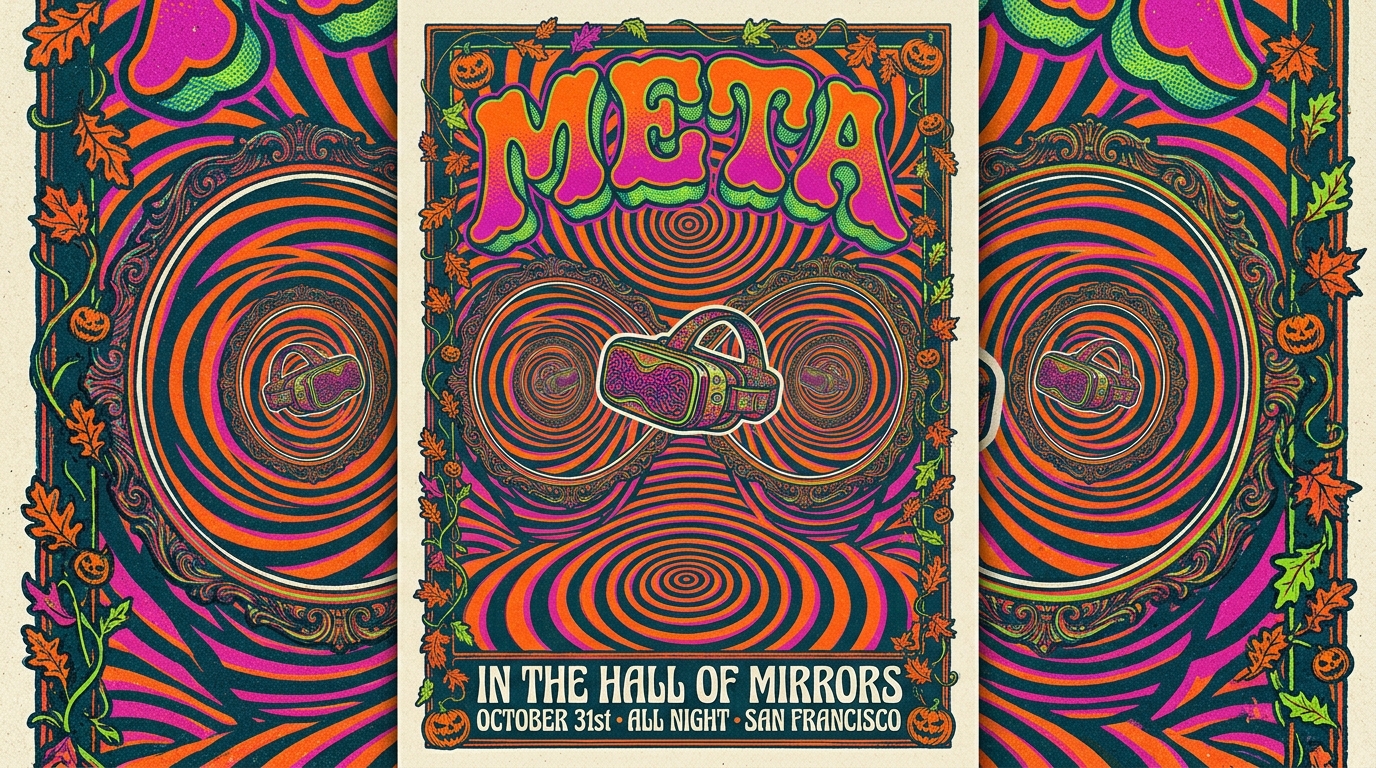
As part of my learning process, I like to automate the category covers. It gives me a chance to learn Python and APIs.
This week’s cover prompt was written using Claude Opus 4.7, and the image was generated using Nano Banana 2.1.
Category Cover Image Prompt: Psychedelic screen-printed gig poster of a floating VR headset at the center of an infinity-loop hall of mirrors reflecting into itself forever, surrounded by swirling op-art ripples, falling autumn leaves and tiny jack-o-lanterns in the ornate border, electric magenta acid orange deep teal and cream paper stock with lime green pops, bold hand-lettered title 'Meta' arching across the top in 1960s Fillmore-revival psychedelic lettering, flat ink layers with slight registration offset and visible paper texture.
This Week in Meta News
Summary by Claude Sonnet 5.5 based on this week’s links:
- Muse Spark 1.3 lands: Meta released Muse Spark 1.3, pitched as its strongest model for agentic and coding work and for longer tasks within a single thread. Artificial Analysis said the top variant, in limited partner preview, scored 62 on its Intelligence Index, behind only two Claude models, though Theo questioned how much to trust that index.
- Muse Code leaves beta: Meta's Muse Code is out of beta, installable with one terminal command. It launched alongside a developer-preview SDK for building custom agents and monthly subscription plans, and Ollama says it can launch the harness with local and cloud models.
- Muse Voice Transcribe: Meta Superintelligence Labs introduced its first real-time audio perception model. It handles streaming speech-to-text, diarization of 20+ speakers, and endpointing in one model, with multilingual support and code-switching.
This summary was generated by Claude Sonnet 5.5 to help you explore the links below. Rest assured, I select, organize, and check the links by hand in Google Sheets, and write the introduction and personal commentary in The Main Newsletters myself each week as a labor of love.
This week's links related to Meta
An Organizational Second Brain: Building an AI That Learns From Experts – Engineering at Meta
https://engineering.fb.com/2026/09/02/ml-applications/organizational-second-brain-ai-learns-from-experts/
We’re excited to release Muse Spark 1.3 with improved performance on agentic and coding tasks, and a focus on real-world usability. Key capabilities: → Sustains longer-horizon work across multiple workflows in a single thread → More actively collaborates with users: it asks
https://x.com/AIatMeta/status/2095234385129963666
Amazon and Meta AI bots account for most website visits – Press Gazette
https://pressgazette.co.uk/platforms/amazon-and-meta-ai-bots-account-for-most-website-visits/
Amazon and Meta appear to be the two companies with the most prolific AI bots when it comes to the visiting of websites worldwide, according to new research
https://x.com/pressgazette/status/2095491369712120200
NEW WORLD MODEL: @ylecun’s team is back with an efficient model! This project involves @ylecun, @lukaskuhn77, @lucasmaes_, @quentinlldc, and @randall_balestr. A couple definitions first: – DINO: self-DIstillation with NO labels. A self-supervised image model (Meta, 2021) where
https://x.com/LeoKharon/status/2094395060636803122
Muse Voice Transcribe is MSL’s first real-time audio perception model — rolling out today. SOTA in streaming speech-to-text, it handles speaker diarization, and endpointing natively in a single model.
https://x.com/finkd/status/2094836602681938385
Introducing Muse Voice Transcribe | Meta AI Research
https://research.meta.ai/blog/introducing-muse-voice-transcribe
Introducing Muse Voice Transcribe, the first real-time audio perception model from Meta Superintelligence Labs. Muse Voice Transcribe delivers real-time streaming ASR, diarization with 20+ speakers, and endpointing. It’s multilingual with seamless code-switching and improves
https://x.com/AIatMeta/status/2094839236016976028
⚡ Fine-tune and quantize AI models directly on NVIDIA Jetson. Our new Jetson AI Lab tutorial shows how to use Unsloth and memory-efficient QLoRA to customize models, export quantized GGUF files, and run them locally with llama.cpp. Follow hands-on examples for: 🔹 NVIDIA
https://x.com/NVIDIARobotics/status/2094480283135316182
Introducing Muse Spark 1.3 | Meta AI Research
https://research.meta.ai/blog/introducing-muse-spark-1-3
Meta has released Muse Spark 1.3, their fourth Muse Spark model release in five months. Muse Spark 1.3 (max), which is in limited preview for Meta’s partners, scores 62 on the Artificial Analysis Intelligence Index, behind only Claude Fable 5.1 and Claude Opus 5. The variant
https://x.com/ArtificialAnlys/status/2095247787277553929
Ollama already support the Muse Code harness out of the box? You can try it with models via Ollama (local and cloud): ollama launch muse
https://x.com/ollama/status/2094622506720391454
1/ muse code is out of beta. launching with an sdk in developer preview to build your own agents on top of it and rolling out monthly subscription plans. copy-paste into your terminal: curl -fsSL
https://t.co/TFXsXfJKW8 | bash
https://x.com/alexandr_wang/status/2094502557129543774
Muse Code is out of beta and now built to handle bigger, more complex engineering tasks. Developers can get started with one command today: curl -fsSL
https://t.co/0RApZrEJMv | bash
https://x.com/finkd/status/2094500475710099945
Muse superapp from Meta and Ava model with computer use
https://www.testingcatalog.com/muse-superapp-from-meta-and-ava-model-with-computer-use/
There’s an SDK in developer preview for building your own agents on Muse Code. Embed them in your apps, connect custom tools, stream progress, and resume sessions later.
https://x.com/finkd/status/2094500479866736747
Today we’re releasing Muse Spark 1.3, our strongest model for agentic and coding tasks in the spark model line. It’s designed to support longer-horizon work, excel in agentic tasks, and follow complex instructions more reliably than previous models. Muse Spark 1.3 is available
https://x.com/shengjia_zhao/status/2095233023247880590
One of the problem of Recursive Self-Improvement (RSI) is that the process of RSI itself doesn’t change. A new Meta^n agent is interesting because it improves how the solver improves, It repeatedly adds new layers on top of the existing system: – The first layer tries to solve
https://x.com/TheTuringPost/status/2094964995239166331
Today, Transluce is releasing the most expansive independent evaluation to date of how AI systems respond to users experiencing mental health crises. We evaluated 77 model variants from OpenAI, Anthropic, Google, Meta, SpaceXAI, Thinking Machines, DeepSeek and Moonshot AI.
https://x.com/TransluceAI/status/2094455208759693476
Former OpenAI Stargate exec Shamez Hemani joins Anthropic after brief Meta Compute stint – DCD
https://www.datacenterdynamics.com/en/news/former-openai-stargate-exec-shamez-hemani-joins-anthropic-after-brief-meta-compute-stint/
Products I use that integrate AI perfectly (use regularly) -Notion AI -Spotify (AI DJ) -Whoop -Slack (Slackbot) -X (Grok) The ones that failed (never use): -Instagram (Meta AI) -Apple Intelligence -DoorDash (AI chatbot) -Gmail “Help me write -Google Meet “take notes for me”
https://x.com/rowancheung/status/2095176927879512455
When @ylecun, @demishassabis, and @drfeifei talk about building world models, what do they mean? → They want AI systems that can build an internal map of their surroundings to anticipate what happens next. But that doesn’t mean they’re building the same machine. @kseniase is
https://x.com/TheTuringPost/status/2094573808006938746
I think we’re generally done with “ability to do X” benchmarks. Labs can just point their machines at the next hill the moment it’s announced, and in a few months it’s not just conquered but smashed to bits. Everything is environment. EdgeBench-type meta evals are all we have now
https://x.com/teortaxesTex/status/2095684227429781895
Astra is BEHIND MUSE SPARK 1.3 MAX ON ARTIFICIAL ANALYSIS??? I was starting to get skeptical of their intelligence index, but there’s no way I can trust this anymore
https://x.com/theo/status/2095605035128467651
for a single dime look at what muse spark can give you
https://x.com/alexandr_wang/status/2095328657241956576
Inside Meta’s Infrastructure Lab
https://about.fb.com/news/2026/09/inside-metas-infrastructure-lab/
Model API
https://dev.meta.ai/
A new paper from @ylecun, @randall_balestr and colleagues extending LeJEPA – this time to video. LeVJEPA’s goal is to make video training much cheaper and simpler. For this, it uses just one encoder + a small projector. The projector is thrown away afterward ↓ LeVJEPA works
https://x.com/TheTuringPost/status/2093821826099191960



Leave a Reply