Every week, I organize 400 to 700 links into roughly 60 categories as part of my ongoing effort to learn about AI. This is my personal notebook, which I enjoy sharing with friends… a hobby and a labor of love, rather than a commercial publication or product.
If you arrived here through a search or shared link, this page collects the links I found for Images for the week ending September 4, 2026.
As part of my learning process, I like to automate the category covers. It gives me a chance to learn Python and APIs.
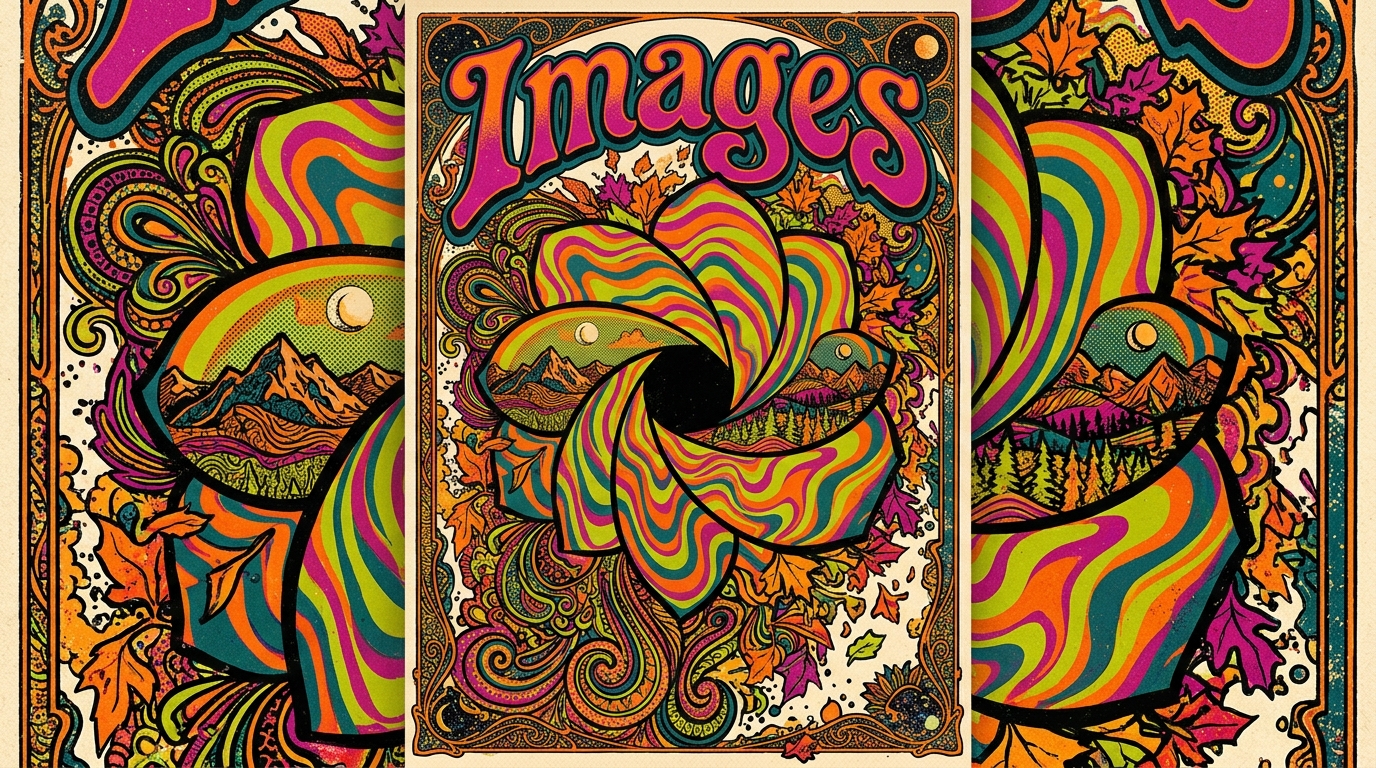
This week’s cover prompt was written using Claude Opus 4.7, and the image was generated using Nano Banana 2.1.
Category Cover Image Prompt: A vertical psychedelic screen-printed gig poster featuring a giant camera aperture iris blooming open like a flower at the center, its blades unfurling into swirling op-art petals that each contain tiny painted landscapes, mountains, and a harvest moon, surrounded by intricate linework, falling autumn leaves, and an ornate decorative border, with the words 'Images' hand-lettered in bold 1960s Fillmore-style psychedelic title text arcing across the top, printed in electric magenta, acid orange, deep teal, lime green, and cream paper stock with visible registration offset and paper texture, flat ink layers, no photorealism.
This Week in Images News
Summary by Claude Sonnet 5.5 based on this week’s links:
- Atlas turns a few photos into 3D worlds: World Labs introduced Atlas, a model that generates image and video frames with camera control and reconstructs them in 3D. Co-founder Ben Mildenhall said he made a flythrough of London's Natural History Museum from just three images found on Google Images. Co-founder Justin Johnson pointed to training robots in new environments from about five phone photos.
- Early GPT-6 Astra testers show image-to-3D builds: Several early-access users reported that GPT-6 Astra built 3D models from images. Michael Weinbach said it recreated Apple Park in Blender, and Pietro Skirano said it made a 3D model and animation in code from an image. Yunfan Ye said it modeled a house from Zillow listing photos.
- Photo libraries become something an agent can act on: Google Photos in Gemini Spark takes a single prompt to handle whole tasks, such as cleaning up vacation shots into a shared album with an emailed recap. Google's examples also include turning whiteboard snapshots into drafted team emails.
This summary was generated by Claude Sonnet 5.5 to help you explore the links below. Rest assured, I select, organize, and check the links by hand in Google Sheets, and write the introduction and personal commentary in The Main Newsletters myself each week as a labor of love.
This week's links related to Images
Google Photos in Gemini Spark is here. Put your photo library into action to handle end-to-end tasks with a single prompt. 📸 100+ vacation shots ➡️ Cleaned-up photos in a shared album & emailed recap 📝 Whiteboard snapshots ➡️ Drafted team emails 🗓️ Event flyers ➡️ Checked for
https://x.com/googlephotos/status/2095628925582057840
I had early access to GPT-6 Astra and it’s maybe the most insane model I’ve experienced In Blender, I had it recreate Apple Park from just images. It did an absurd job.
https://x.com/mweinbach/status/2095596127286366501
Fable 5.1: “Create the Catalog of Ships from the Iliad with a map, etc. i should be able to explore each accurate ship in 3D. there should be real images & archeological data i can draw on. test it with agents to make it accurate & beautiful, then revise
https://x.com/emollick/status/2095352019498447090
NEW WORLD MODEL: @ylecun’s team is back with an efficient model! This project involves @ylecun, @lukaskuhn77, @lucasmaes_, @quentinlldc, and @randall_balestr. A couple definitions first: – DINO: self-DIstillation with NO labels. A self-supervised image model (Meta, 2021) where
https://x.com/LeoKharon/status/2094395060636803122
Another glimpse of Real2Sim with Atlas: capture a real environment with just a number of casual photos from a phone, turn them into a sim, then simulate diverse robots navigating different trajectories. Atlas generates the RGB and depth observations they would see along the way.
https://x.com/YunzhuLiYZ/status/2094926835649790103
Cool update by World Labs; I’m most stoked about doing large scale 3d reconstruction using a sparse set of images. That way you capture what’s most important to get right, and AI fills in the rest of the gaps in the scene.
https://x.com/bilawalsidhu/status/2094853004826452337
Introducing Atlas: The world’s first multimodal world model that generates image and video frames with pixel-perfect camera control and reconstructs them in 3D. Model the world, move the camera, and simulate space & time.
https://x.com/theworldlabs/status/2094839756329041984
Introducing Atlas: The world’s first multimodal world model that generates image and video frames with pixel-perfect camera control and reconstructs them in 3D. Model the world, move the camera, and simulate space & time.
https://x.com/theworldlabs/status/2094839756329041984?s=12
our new model Atlas also happens to be a capable text-to-image generator, providing it with a strong foundation of “world knowledge”… this generalizes across both single and multi view domains, meaning you can step into even highly stylized scenes with precise 3D control
https://x.com/BenMildenhall/status/2094859820100952575
World Labs co-founder @jcjohnss predicts a real-to-sim-to-real future where Atlas could train a robot for any new environment in minutes using just 5 photos from your phone: “One is this notion of fully in-context learning. Maybe I’ve got a robotics foundation model, then I can
https://x.com/MTSlive/status/2094950206240600308
This blows my mind. Turning real world 3d scans with messy topology into procedural 3d scenes (modeled like a human artist would have) has been a tall order. But Astra seems to have cracked it. MSFT flight sim does a basic version of this using 2d satellite imagery and a
https://x.com/bilawalsidhu/status/2095677398192681190
I had an early access to GPT-6 Astra and I can say, everyone in the world now has a 3D designer at their fingertips. I gave it an image of a house and asked to create it in 3D with all the details including toys, appliances and furniture. This a full 3D model reconstruction in
https://x.com/tomkrcha/status/2095598645190291775
I had early access to GPT-6. This model will completely shatter your understanding of what’s possible, and it will start a new era of creativity. It’s hard to explain how big of a jump this is, so I’ll share my tests. 1/6 Made this 3D model and animation in code from an image.
https://x.com/skirano/status/2095595932335170031
GPT-6 Astra is a beast. Give it a Zillow listing. It can 3D model the house based on the listing photos and create a cool promotion video. The video was just created in one shot and there are still some wrong details. But I am sure it will be much better if I ask it to polish
https://x.com/realYunfanYe/status/2095612137582526615
I don’t know if you really understand what these people just did… They built an AI that looks at a few casual real-world videos or photos and instantly turns them into a full 3D playground. You can MOVE THE CAMERA HOWEVER YOU WANT, change the lighting, move objects around,
https://x.com/IlirAliu_/status/2095058646673613045
You can now use up to 14 references in your videos. Images, voices, character references, and more. Use “@” to tag each reference in your prompt.
https://x.com/imagine/status/2095249317875622255
GPT-6 Astra has set a new ECI record, with a score of 169. This is a substantial jump from the prior best (163), but is within our uncertainty range for the reasoning-era ECI trend. Astra also set new records on our math, continual learning, and game-puzzles benchmarks. On our
https://x.com/EpochAIResearch/status/2095602754282783108/photo/1
The Epoch Capabilities Index (ECI) frontier has advanced by 14 points/year since reasoning models were introduced. That compares to six points/year in the non-reasoning era.
https://x.com/EpochAIResearch/status/2094922644428898737/photo/1
For a while now, I’ve relied on @GeminiApp and @antigravity agents across a wide range of use cases… spanning creativity, productivity, and analysis. But I’ve always dreamed of having a power agent to help me get the most out of my 143,206 photos and videos. And that day has come!
https://x.com/shimritby/status/2095620253585993826
I’m particularly excited by Atlas’s ability to reconstruct scenes from a very small number of input image — was able to create this flythrough of London’s Natural History Museum by combining 3 input images I found from completely separate sources on Google Images
https://x.com/BenMildenhall/status/2094891871730581609
One image. A world to train in, shoot in & explore. 🌍 👀Meet HYPER3D #WorldGen: independent foreground meshes + #3DGS background, built for interaction. For robotics🦾, film🎬, games🎮, DCC💎 & XR. 🔥Powered by our Best Paper Award Project 「CAST」. Let’s Connect the Dots⬇️
https://x.com/DeemosTech/status/2094440163246256523
KISS-GS: 3D Gaussian Splatting Compression Kept Simple” TL;DR: a modular 3DGS compression pipeline combining Gaussian compaction, image-based SOG-XT encoding and optional fine-tuning to achieve 85-319× smaller scenes at matched quality.
https://x.com/Almorgand/status/2094821037678493781
Aside from waiting for economic impact, we are now at the place where AI video, image & music models are good enough to be real tools for letting more people who never could produce new kinds of art How long until we see a creativity boom among the slop flood? Is it happening?
https://x.com/emollick/status/2093362761925284279
Since some people are asking aboutethe Codex Micro it was all done in Blender via code. The prompt was a simple “Make this in Blender” with the second image here as attached as reference. It was that easy.
https://x.com/skirano/status/2095602672837521416
Leave a Reply