Every week, I organize 400 to 700 links into roughly 60 categories as part of my ongoing effort to learn about AI. This is my personal notebook, which I enjoy sharing with friends… a hobby and a labor of love, rather than a commercial publication or product.
If you arrived here through a search or shared link, this page collects the links I found for Augmented Reality (AR/VR) for the week ending August 21, 2026.
As part of my learning process, I like to automate the category covers. It gives me a chance to learn Python and APIs.
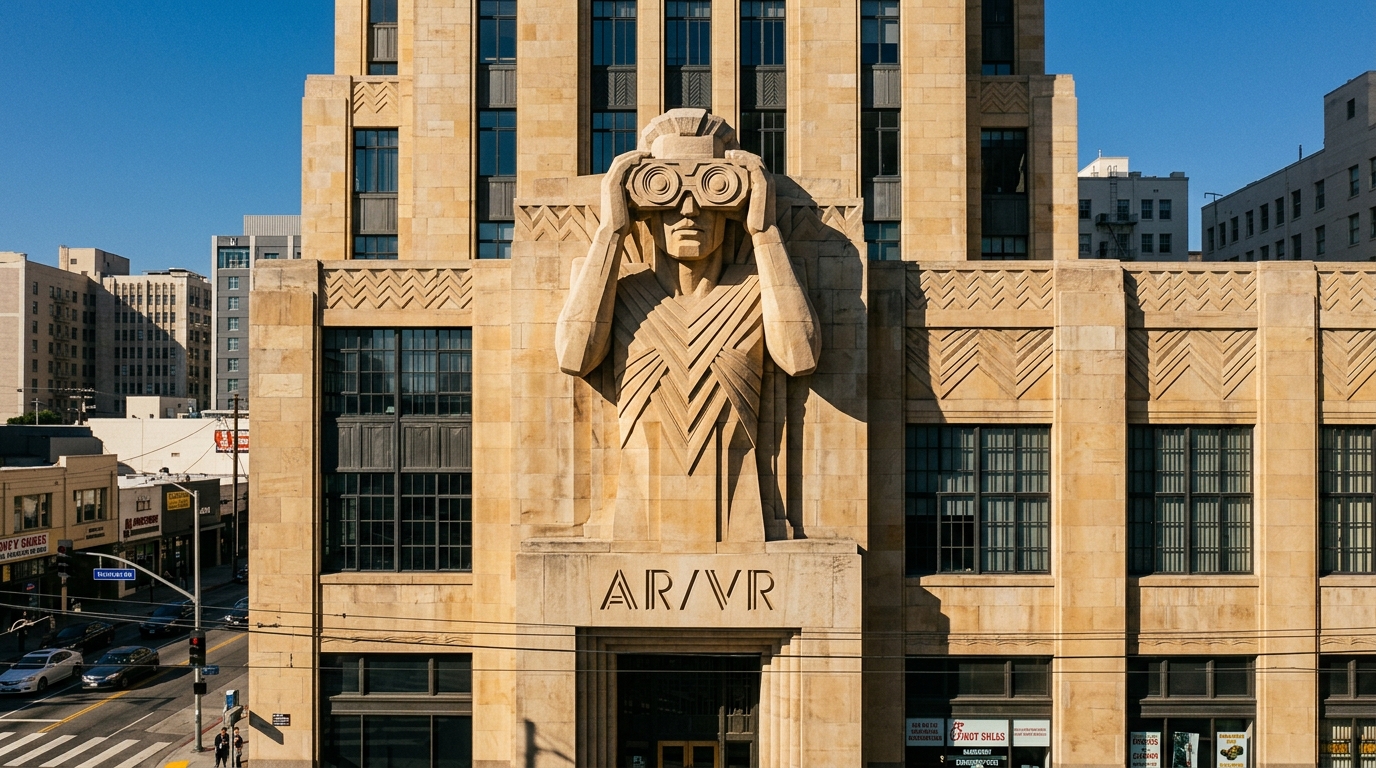
This week’s cover prompt was written using Claude Opus 4.7, and the image was generated using Nano Banana 2.1.
Category Cover Image Prompt: Bright sunlit architectural photograph of a 1929 Los Angeles Art Deco limestone skyscraper seen from across the street, a large stylized herm emerging from a pier above the entrance holding carved stereoscopic goggles with concentric Deco lenses radiating chevron rays against its chest, all cut from the same warm honey Indiana limestone, the words AR/VR incised in Art Deco capitals on the lintel above the doorway, crisp raking shadows, deep blue sky, dark steel-framed windows, setbacks and neighboring buildings receding, perspective-corrected verticals, realistic architectural photography.
This Week in Augmented Reality (AR/VR) News
Summary by Claude Sonnet 5.5 based on this week’s links:
- Photos become walkable 3D memories: Bilawal Sidhu showed hundreds of 2D photos from TED lifted into 3D and left where they were taken, so you can fly from the green room to backstage to the main stage. He framed it as what a whole camera roll could look like.
- Faster 3D reconstruction: A cluster of papers shared by Almorgand targets feed-forward Gaussian splatting. ZipSplat claims scenes from unposed images in under a second with about 6x fewer Gaussians, while EPO says it matches Bundle Adjustment-level geometry with up to 80% less runtime.
- Real-time depth and head capture: Fast-FoundationStereo is described as more than 10x faster than FoundationStereo with comparable depth quality. Another paper reconstructs 3D Gaussian heads from multi-camera captures across 10K+ identities.
This summary was generated by Claude Sonnet 5.5 to help you explore the links below. Rest assured, I select, organize, and check the links by hand in Google Sheets, and write the introduction and personal commentary in The Main Newsletters myself each week as a labor of love.
This week's links related to Augmented Reality (AR/VR)
2d moments frozen in time. Turned into 3d holograms. Left exactly where they happened in the real world. The geospatial memory palace coming to life. Excited baby deer startles mama deer momentarily, who then chills out after 🙂 Can you imagine when your entire camera roll”
https://x.com/bilawalsidhu/status/2089173672112136632
Locking in for an evening sprint in the command center. What are y’all cooking tonight?”
https://x.com/bilawalsidhu/status/2088805518336778320
(1/2) Just in time for back to school: the power of agentic coding has landed in Search. Anyone can now create custom tools and simulations to visualize different topics. One cool example: I asked AI Mode “make an interactive 3D fractal Mandelbulb visual I can zoom into” and it”
https://x.com/rmstein/status/2090177397006168437
Open-source AI Agents and LLM monitoring tools – top 12 in one list ▪️ Langfuse ▪️ Arize Phoenix ▪️ Opik ▪️ AgentOps ▪️ LangWatch ▪️ OpenLIT ▪️ OpenLLMetry ▪️ MLflow ▪️ Evidently ▪️ Prometheus ▪️ Grafana ▪️ AI Fairness 360 (AIF360) Bookmark the list to keep it handy! Here is”
https://x.com/TheTuringPost/status/2089177904827814080
[2608.15763] Training Agents to Evolve with Their Harness: TaoLive Digital Avatar Agent Technical Report
https://arxiv.org/abs/2608.15763
still my favorite “what even is a world model” meme h/t @KnightNemo_”
https://x.com/bilawalsidhu/status/2090551691883991051
Hundreds of 2d photos lifted into 3d. Left exactly when and where they happened at TED. Now I can fly through this spatial memory palace and jump between moments — from the green room to backstage to the main stage. Imagine your entire camera roll coming to life like this.”
https://x.com/bilawalsidhu/status/2090232971320000835
PRISM: A Unified Framework for Photorealistic Reconstruction and Intrinsic Scene Modeling” TL;DR: a unified diffusion model jointly generates RGB images and intrinsic maps, enabling decomposition, conditional generation, relighting, material editing within one foundation model”
https://x.com/Almorgand/status/2090133101028491738
EPO: Boosting 3D Foundation Models with Edge-based Pose Optimization” TL;DR: a trackless, differentiable edge-based optimization refines 3D foundation model reconstructions to Bundle Adjustment-level geometry while cutting runtime by up to 80%.”
https://x.com/Almorgand/status/2089746288057204941
LocusGS: Spatially Grounded Tokens for Feed-Forward 3D Gaussian Splatting” TL;DR: uses spatially grounded tokens to organize and decode local Gaussian groups, providing a structured alternative to pixel-aligned feed-forward 3D Gaussian Splatting.”
https://x.com/Almorgand/status/2089376743853380064
3D printed differential robot arm wrist. [👇 GitHub Link – Open Source ] High demand, so they open sourced it early. A differential mechanism released as a test fixture for future robots. Built around their Spectral micro BLDC driver. Parts, STL files, example code are”
https://x.com/IlirAliu_/status/2088172794928418872
Stereo depth models usually force a tradeoff. 📌 Paper + Code Either strong zero-shot generalization or real-time speed. Fast-FoundationStereo closes that gap. The model accelerates FoundationStereo by more than 10× while keeping comparable depth quality, making real-time”
https://x.com/IlirAliu_/status/2089259953726935118
Large-Scale High-Quality 3D Gaussian Head Reconstruction from Multi-View Captures” TL;DR: Feed-forward reconstructs high-quality 3D Gaussian heads from multi-camera captures, scaling to 10K+ identities while enabling novel identity generation and blendshape-driven animation.”
https://x.com/Almorgand/status/2089727868406297073
ZipSplat: Fewer Gaussians, Better Splats” TL;DR: feed-forward 3DGS model that decouples Gaussian placement from pixels, reconstructing unposed scenes in under a second with ~6× fewer Gaussians while achieving state-of-the-art quality.”
https://x.com/Almorgand/status/2090508997799432196
Just look how far the scribble camera moves trend has come. Literally looks like a motion control camera shoot. Less like Ken Burns on steroids and more like mf-ing Bullet Time!”
https://x.com/bilawalsidhu/status/2088318746938990766
Leave a Reply