About This Week’s Covers
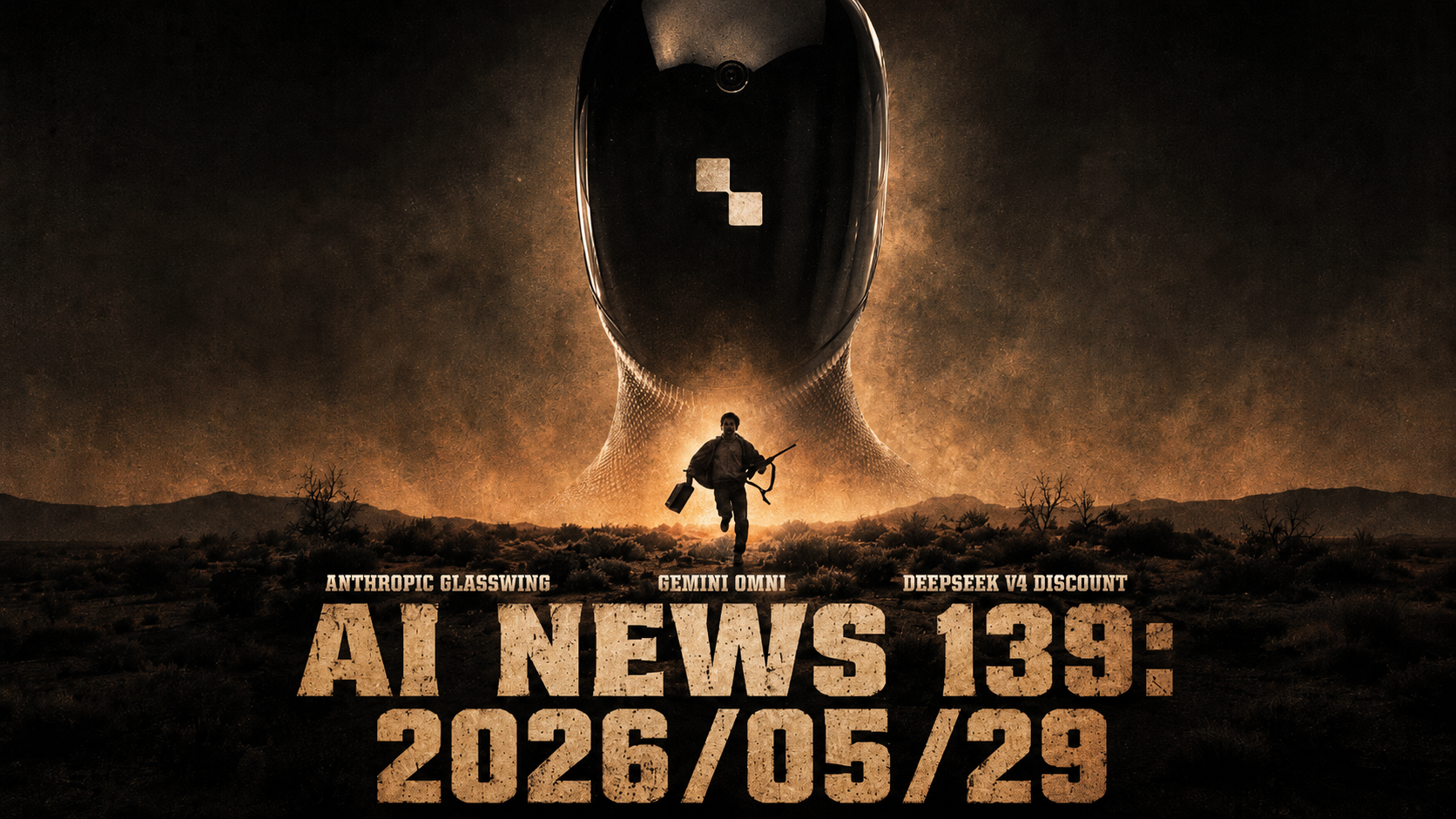
This week’s cover image is a spin on the movie poster for No Country for Old Men. The concept is that a man is running from the bad guy, but in this case, the looming danger is the Figure robot replacing human jobs in factories.
I’ve been wanting to use the poem “Sailing to Byzantium” by William Butler Yeats as the humanities reading for some time because parts of it, to me, feel like a dialogue about AI training and embodiment.
Given the fact that Figure just packed and sorted packages for 200 hours straight without any errors, I thought it would be fun to go ahead and put Figure in the movie poster as Anton Chigurh.

Here are a few of my category covers of the week. They are very different from the movie poster, because I asked my Claude skill to build images based only on the poem.
I literally prompted, “This week’s AI newsletter theme is Sailing to Byzantium by Yeats. The image will be landscape ratio. The category name should be a bold title on the cover image. Have some fun!.” Claude took it from there and made all of the category covers without any further help from me.


This week’s humanity reading, as you may have guessed, is “Sailing to Byzantium” by William Butler Yeats:
Sailing to Byzantium
By William Butler Yeats
I
That is no country for old men. The young
In one another’s arms, birds in the trees,
—Those dying generations—at their song,
The salmon-falls, the mackerel-crowded seas,
Fish, flesh, or fowl, commend all summer long
Whatever is begotten, born, and dies.
Caught in that sensual music all neglect
Monuments of unageing intellect.
II
An aged man is but a paltry thing,
A tattered coat upon a stick, unless
Soul clap its hands and sing, and louder sing
For every tatter in its mortal dress,
Nor is there singing school but studying
Monuments of its own magnificence;
And therefore I have sailed the seas and come
To the holy city of Byzantium.
III
O sages standing in God’s holy fire
As in the gold mosaic of a wall,
Come from the holy fire, perne in a gyre,
And be the singing-masters of my soul.
Consume my heart away; sick with desire
And fastened to a dying animal
It knows not what it is; and gather me
Into the artifice of eternity.
IV
Once out of nature I shall never take
My bodily form from any natural thing,
But such a form as Grecian goldsmiths make
Of hammered gold and gold enamelling
To keep a drowsy Emperor awake;
Or set upon a golden bough to sing
To lords and ladies of Byzantium
Of what is past, or passing, or to come.
This Week By The Numbers
Total Organized Headlines: 533
- AGI: 9 stories
- AI Inn of Court: 1 story
- Accounting and Finance: 2 stories
- Agents and Copilots: 106 stories
- Alibaba: 6 stories
- Alignment: 12 stories
- Anthropic: 101 stories
- Apple: 4 stories
- Audio: 6 stories
- Augmented Reality (AR/VR): 11 stories
- Autonomous Vehicles: 3 stories
- Benchmarks: 36 stories
- Business and Enterprise: 35 stories
- ByteDance: 4 stories
- Chips and Hardware: 38 stories
- DeepSeek: 11 stories
- Education: 6 stories
- Ethics/Legal/Security: 32 stories
- Figure: 7 stories
- Google: 45 stories
- HuggingFace: 10 stories
- Images: 8 stories
- International: 32 stories
- Law: 1 story
- Locally Run: 4 stories
- Meta: 1 story
- Microsoft: 9 stories
- Mistral: 3 stories
- Multimodal: 26 stories
- NVIDIA: 13 stories
- Nous Research: 3 stories
- Open Source: 43 stories
- OpenAI: 55 stories
- OpenClaw: 2 stories
- Perplexity: 7 stories
- Podcasts/YouTube: 8 stories
- Publishing: 1 story
- Qwen: 5 stories
- RAG: 1 story
- Robotics Embodiment: 36 stories
- Sakana: 1 story
- Science and Medicine: 26 stories
- Security: 4 stories
- Technical and Dev: 79 stories
- Video: 21 stories
- World Models: 15 stories
- X: 14 stories
This Week’s Executive Summaries
This week, I organized 533 links into about 60 categories. Fifty-seven links went into the executive summaries and top stories.
I’m still seven weeks behind because I’m enjoying the summer with my family. As of this publishing, we have 18 days left for us to be together before our oldest heads off to college.


I organized everything this week based on what I want to see when I go back and read these. Those are truly my top stories. They’re not always the stories that make the news, and they’re not always the most product-oriented.
I’m going to summarize the 14 biggest stories in the order that I want to remember them. There are 36 top stories total below.
Glasswing
The top story today is the cybersecurity findings of a project called Glasswing from Anthropic. Back in March, Anthropic was in the rumor mill for having a model that was too dangerous to release. In April, Anthropic acknowledged Mythos.
Mythos was its frontier model, supposedly so powerful that it could find vulnerabilities in almost every major operating system and web browser, including tech systems from Microsoft, Google, and Apple.
Anthropic launched Project Glasswing with a consortium of companies to privately share access to Mythos in order to patch things before Anthropic’s next frontier model was released.
This week, Anthropic released the findings of Project Glasswing and its 50 partners. The consortium identified more than 10,000 high- or critical-severity vulnerabilities across some of the most important software in the world. Cloudflare alone found 2,000 bugs, 400 of which were critical. Mozilla found 271 vulnerabilities in Firefox. That’s 10 times more than Mozilla found when it looked at Firefox with Claude Opus 4.6.

Not everyone released the details of the bugs they found. However, every partner appears to have found multiple vulnerabilities across its products. It appears that Mythos has a 90% accuracy rate compared with human false positives for vulnerabilities.
Mythos found vulnerabilities in open-source programs as well. One of them is called wolfSSL, an open-source cryptography library used in billions of devices. This vulnerability would have allowed a bad actor to forge or fake a website for a bank or email provider.
These are fairly terrifying bugs that Mythos was able to find and deploy patches for. Anthropic released several security protocols and guides to help developers become certified in processes designed to protect themselves as best they can during the quick turnaround between a product launch and the discovery of vulnerabilities.
There used to be a window of a couple of weeks before humans could find vulnerabilities, but now that window is extremely short.
Opus 4.8
This week, Anthropic introduced Claude Opus 4.8. The model itself is an improvement over Opus 4.7. For me, it really caught my attention because I’m wondering what they’re releasing while they hold back the Mythos model.
It appears that Opus 4.8 is not necessarily derivative of Mythos in any way. It’s simply the usual Anthropic release pattern, with some pretty good improvements. It coincides with a lot of agentic features that Anthropic is launching, like the dynamic workflow feature, which helps Claude Code break down really large projects into threads to keep it on track while solving each piece of the puzzle.
It has the ability to work in fast mode at three times cheaper than previous models. So, if you’re trying to do any kind of customer service or real-time task, it’s a lot faster and three times cheaper.

Opus 4.8 is a little bit better at agentic coding, reasoning, and computer use. It’s significantly better at knowledge work, and it has some improvements in financial analysis. GPT-5 is still better at agentic terminal coding.
One of the big differences in 4.8 is that the alignment is now a lot better at flagging uncertainties… instead of being overly excited or making unsupported claims. I suppose we could put that in the sycophantic improvement file. It’s doing a better job of not jumping to conclusions.


As always, it’s a little freaky that one of the big alignment assessments is whether or not it acts in the user’s best interest or is deceptive or misaligned. It’s about twice as good at alignment as Opus 4.7, so that’s encouraging.

One of the more confusing things that came along with this model is the idea of effort. There’s no way for me to quantify how much effort… low, medium, high, maximum, ultra—all these different sorts of volume knobs for how hard you want it to work. It’s kind of a vibe, and the only way to know is to use it.
That’s going to be a problem for people who don’t use AI often, and it’s another reason why the more you use it, the better you get at it, because a lot of this stuff is instinctive.
The default is high effort, and that’s probably where most people should keep it. I usually take it down when I’m doing things like transcription or simple grammatical reviews, and I put it up when I need better coding or a better understanding of a complex financial question.
Claude Dynamic Workflows
Next on my list is a feature that could probably be one of the top stories on anyone’s list: Anthropic introducing dynamic workflows in Claude Code.
This is where most humans will start to lose track of what they’re doing and AI pulls away from us.
I think we’re reaching a really big fork in the road—no pun intended, given the GitHub fork concept—in how humans will interact with AI.
I think most people still open chats and have a self-contained conversation, whether they’re researching a product or just want to analyze a spreadsheet. You kind of have your prompt, either making it up as you go or using a saved prompt, and you chat with the model. Then you leave the chat. Maybe you come back and continue.
I’m sure some people write Python scripts or use Copilot-type tools. Other folks have gone into the agent world. To me, this new dynamic workflow represents AI getting beyond most people’s ability to hold in their heads what’s happening.
When you design a project, the impetus is usually on the user, or the person prompting, to really think through the context and the prompt. That’s a lot of work. You try your best to hold it all in your head.
With dynamic workflows, you basically tell Claude what you want to do, especially when it’s something really hard. Maybe you have a legacy codebase with tons of directories, folders, and files. Maybe you want to migrate to a new platform. Or maybe you want to look for bugs.

These are things with a lot of contingencies. If you change one file, it may break something downstream in another file. If you move it, the directory structure may change. These are the kinds of things software developers have dealt with throughout their careers. That’s sort of their whole profession: understanding those ecosystems and best practices, elegance, scalability and syntax.
For people who simply use computers, this is where you see the messy-desktop problem, with all these files and screenshots sitting in a giant pile. Most users don’t have directory structures that are obsessively designed with carefully cascading directories.
Claude can now basically take a prompt and build a dynamic workflow based on what you tell it you need. It can examine your entire ecosystem before it starts working.
Claude is essentially taking on all of that understanding of an ecosystem and documenting it in some way, either through a Markdown file or within its context window. Then it breaks down a plan into a workflow that it can delegate agentically to versions of itself.

Anthropic says Claude can now write an orchestration script that runs hundreds of parallel subagents within a single session, checking all of its work before anything reaches you.
Whether it’s a bug hunt, a security audit, a huge migration, or an attempt to upgrade or modernize a codebase, this is the kind of work that would at least be intimidating for a human or require a tremendous amount of time.
Anthropic says that what would normally be three months’ worth of work can now be done in a matter of days.
Anthropic hits $965B valuation with record $65B funding round
Anthropic raised $65 billion in Series H funding, led by Altimeter Capital, Dragoneer, Greenoaks, and Sequoia Capital, valuing the company at $965 billion.
Hassabis shortens AGI timeline to 2029-2030 at Google I/O
From Sherwood News: Last June, Google DeepMind CEO Demis Hassabis predicted that AGI might be achieved between 2030 and 2035. Last week, he narrowed that window to 2029–2030.
During the Google I/O conference, Hassabis said, “When we look back at this time, I think we’ll all realize that we were standing in the foothills of the singularity. It will be a profound moment for humanity.”
Google Omni
Last week, Google launched its video-editing tool, Omni, and now people have had time to play with it. The way to think about Omni is that it’s as powerful as an image editor, but for video.
All the things we can do with imagery—whether it’s object segmentation, changing individual elements inside an image, or using multiple images to create a composite—are now possible with video. We can transform the way an image looks, make it black and white, change the entire style, or turn it into a painting. All the things introduced over the past two years in image editing, whether through Nano Banana or GPT image editing, Gemini Omni can now do with video.
Another way to say that is that it’s a fully multimodal, native video editor.
A good example comes from Ethan Mollick, who took the famous 1896 black-and-white film of a train arriving at a station and selectively edited parts of it. For example, it becomes a bullet train arriving. It’s a train made of Legos. A time traveler appears. The train becomes a centipede. The Muppets are waiting for the train. He does lots of different things to show how you can basically edit it.
One of my favorite AR/VR guys is Bilawal Sidhu. He shared a video from Carlos Santana—who is not Carlos Santana the guitar player—demonstrating that you can basically put any kind of filter onto anyone’s footage.
You could turn someone into liquid, like the Terminator. You can change where they are. You can green-screen them. You can do pretty much anything you want. It’s very powerful.
These two examples are worth seeing. They’re both on X, and I’m not sure how to download or share them, so I’m going to have to try to embed them here.
Hyperscaler (Microsoft, Google, Meta, Amazon, etc) capex tracks toward $770 billion in 2026, trillion by 2027
The big data center companies—Amazon, Microsoft, Google, Meta, and Oracle—are spending more and more on capital expenses. Spending has quadrupled since GPT-4 was released three years ago, when it was below $40 billion per quarter. Now, we’re looking at almost $160 billion per quarter in spending.
It’s a bit terrifying when you think about the impact if the rug comes out from under them.

ByteDance joins tech giants and is designing its own AI data center chips
ByteDance doesn’t make the national or top headlines very often, but I’ve always loved following it behind the scenes, considering that most people simply think of ByteDance as TikTok. The company has consistently released really strong models that are often pretty far removed from what anyone would expect ByteDance to be working on.
This week, ByteDance was in the news for two pretty big headlines. First, ByteDance is making its own processors!
ByteDance releases open-source 7B multimodal model BAGEL under Apache 2.0
Second, ByteDance open-sourced a very strong multimodal model called BAGEL. Bagel is a pretty small, open-source model. It can handle image generation and editing, as well as style transfer and similar tasks. It’s basically a very cheap, open version of Nano Banana.
DeepSeek makes 75% V4 Pro price cut permanent, undercutting the best US models and dominating the Pareto frontier
DeepSeek is one of the most powerful open-source models, and it just permanently reduced its price by 75%.
To put that in perspective, GPT-5 charges $2.50 per million input tokens and $10 per million output tokens. Opus 4.7 charges $5 for input and $25 for output. DeepSeek charges 87 cents for input and $3.48 for output.
DeepSeek became famous for completely disrupting the U.S. frontier-model ecosystem shortly after the inauguration a few years ago. Now, it is continuing to push the limits of the economics and is easily on the Pareto frontier of the best models at the best prices when measured pound for pound.

Nvidia’s LocateAnything decodes bounding boxes in parallel, boosting VLM speed
Just as I have a fascination with ByteDance, I also like to keep track of Nvidia when it comes to releasing models and robotics innovations beyond what the company is best known for. Just as ByteDance is known for TikTok but does a lot more, Nvidia is known for chips but is also one of the leading U.S. research labs for robotics and vision.
This week, Nvidia launched a product called Locate Anything. It’s incredibly good at understanding where things are in a video or live stream. The examples include tons and tons of what appear to be kiwis or eggs, as well as penguins, zebras, and animals like flamingos that are nearly impossible for humans to tell apart. This thing can just crush it.
Another example uses a scene where Neo fights Agent Smith. It can find all the Agent Smiths, separate them, and keep track of each one.
The demonstration video is really all you need to see. This is one of the neatest pieces of technology of the week. It might be my favorite, just as a nerd. I highly recommend checking it out.
It’s basically object segmentation for vision models, and it appears to work live.
OpenAI Foundation pledges $250M for AI economic transition research
OpenAI has committed $250 million toward what it calls “building secure and abundant economic futures.”
https://openaifoundation.org/news/economic-futures-in-the-age-of-ai
This sort of stuff is hard for me to deal with when it comes from OpenAI. On one hand, I think it’s necessary. On the other hand, it reminds me so much of what Meta posts. It’s the same school of condescending nonsense. Even when it’s right, it somehow still manages to land poorly with me.
Anyway, the $250 million will go toward grants, partnerships, and other work. Who knows what all of this actually means.
OpenAI wants to “understand the shift by using independent measurement and forecasting infrastructure to create clearer pictures of AI’s impact on the economy.” They also want to support the transition—whatever they think they’re talking about—by “giving workers and communities resources to help them through near-term disruption.”
Honestly, if I were a worker and someone from OpenAI showed up to help me, I would want to run away.
They also talk about building economic security, whatever that means, and supporting new approaches to organizing post-AI political economies.
I totally understand why they’re doing this, but it’s also just too much for me coming from OpenAI. I want other people to figure this out, not OpenAI. Meta has ruined this kind of thing for me with all of its similar efforts over the years. Even Google has handled this type of thing poorly historically.
I can’t think of anyone who has done a particularly good job with it. It all just feels like nonsense. Anthropic seems to be the only one doing it well at the moment.
Figure robot completes 200 hours of autonomous factory line work on livestream with no errors
Last week, robotics company Figure began live-streaming one of its robots working on an assembly line, essentially sorting packages. I think the initial goal was to livestream it for a day or two, but they ended up going for nine days, which is why it was one of our top stories last week and continued into this week.
The robot ran for 200 hours and then shut down. It was fully autonomous, operating 24/7 with no downtime and no errors.
It’s actually quite something to watch. If you have 30 seconds, spend a little time watching how it processes these packages. There are moments when it looks very human and others when it doesn’t look human at all. But it just crushes the assignment flawlessly.
It’s one of those rare times when I want to say congratulations to a company, even if that sounds corny.
It also inspired this week’s cover. The Figure robot is the head from “No Country for Old Men” as the man runs away from it.
Human labor is officially in trouble in many ways.
Figure AI humanoids immediatelly head to retail warehouses in Reno
Piggybacking off this news, it’s almost no surprise that Figure has partnered with Catalyst Brands to deploy its robots in distribution centers.
Catalyst Brands is the company—basically private equity, I assume—that operates JCPenney, Aeropostale, Brooks Brothers, Lucky, and Nautica.
The other similar company Figure is working with is Brookfield, a huge private equity company that owns tons of apartments. In that case, Figure is learning how to do dishes, make beds, do laundry, and perform other household tasks.
There are 22 more top stories worth reading below as part of the full executive summary recaps. But these 14 are the ones I want to make sure I remember when I come back and read this in a few months or years.
Anthropic
Glasswing
Project Glasswing: An initial update \ Anthropic
https://www.anthropic.com/research/glasswing-initial-update
Opus 4.8
BREAKING: Anthropic just dropped Opus 4.8—and it is a MONSTER We’ve been testing for about a week @every and our verdict is they could’ve just called it Opus 5, it’s that good. Here’s our vibe check: – Beats GPT-5.5 on Senior Engineer bench. On our toughest benchmark Opus
https://x.com/danshipper/status/2060043738752422304
Introducing Claude Opus 4.8 \ Anthropic
https://www.anthropic.com/news/claude-opus-4-8
Claude Opus 4.8 takes the lead on the Artificial Analysis Intelligence Index at 61.4, with Anthropic retaking the #1 spot on GDPval-AA and advancing in terminal use and scientific reasoning To reach the leading position on the Intelligence Index, @Anthropic made large
https://x.com/ArtificialAnlys/status/2060117582120976868
It “”feels like the first smart model in a long while”” due to this
https://x.com/zephyr_z9/status/2060077152729694586
Dynamic
Introducing dynamic workflows | Claude
https://claude.com/blog/introducing-dynamic-workflows-in-claude-code
Excited to share our most powerful new Claude Code feature: dynamic workflows! Mention “”workflow”” in a prompt and Claude will dynamically create an orchestration plan that it strictly follows, allowing you to confidently trust that every stage happens in the right order even
https://x.com/_catwu/status/2060054180379689074
Funding
Anthropic raises $65B in Series H funding at $965B post-money valuation \ Anthropic
https://www.anthropic.com/news/series-h
We’ve raised $65 billion in Series H funding at a $965 billion post-money valuation, led by @AltimeterCap, Dragoneer, @Greenoaks, and @sequoia. This investment will help us advance our research and expand our capacity to meet growing demand for Claude.
https://x.com/AnthropicAI/status/2060061347522433422
AGI
Google DeepMind’s Hassabis: AGI is 3 to 4 years away – Sherwood News
https://sherwood.news/tech/google-deepminds-hassabis-agi-is-3-to-4-years-away/
Google DeepMind CEO Demis Hassabis says we’re in the ‘foothills of the singularity’ I sat down with him to talk about what that means, curing every disease, and human meaning post-AGI: 0:00 Intro 0:45 What Demis is most excited about at I/O 1:46 Have AGI timelines shifted? 3:30
https://x.com/rowancheung/status/2059307613485940950
Omni
I think people don’t realize why Gemini Omni is different than other video AIs. It is fully multimodal, so it can edit video natively, too I took the famous “”train “” movie from 1896 & made it a bullet train, LEGO, added a time traveler, a centipede, muppets… (see reflections?)
https://x.com/emollick/status/2057874739817808223
Omni is pretty nuts. It is NOT seedance. Any input in/out. It’s more than nano banana for video – it’s quite literally industrial light & magic. Now effectively reduced to an insanely realistic AR filter that you can apply on demand to anyone’s footage.
https://x.com/bilawalsidhu/status/2057300479340695960
Business
Hyperscaler
Hyperscaler capital expenditures came in on trend in Q1 2026, continuing the trajectory that projects them spending $770 billion this year and over a trillion dollars in 2027.
https://x.com/EpochAIResearch/status/2060076222873526506
ByteDance
ByteDance Chips
ByteDance has had enough of waiting months for processors, so it’s going to make them itself | PC Gamer
https://www.pcgamer.com/hardware/processors/bytedance-has-had-enough-of-waiting-months-for-processors-so-its-going-to-make-them-itself/
ByteDance OpenSource
ByteDance just open-sourced one of the most capable multimodal models out there. BAGEL does image generation, editing, style transfer, and visual understanding – all in a single 7B parameter model. Apache 2.0 licensed! One model. No switching between specialized tools. Amazing
https://x.com/kimmonismus/status/2060050186076815792
DeepSeek
Deepseek
Let that sink in for a moment. DeepSeek v4 pro 75% discount. Permanent! In: $0.43 Out: $0.87 If you read the DeepSeek v4 tech paper you know that this model is insanely good when it comes to efficiency. Only 27% compute and only 10% cache compares to v3.2. SemiAnalysis wrote
https://x.com/kimmonismus/status/2057868472965640194
DeepSeek has made its temporary 75% price cut on the first-party V4 Pro API permanent, putting V4 Pro on the Pareto frontier of Intelligence Index vs Cost to Run Intelligence Index alongside V4 Flash @deepseek_ai’s first-party V4 Pro API is now $0.435/1M input, $0.87/1M output,
https://x.com/ArtificialAnlys/status/2058021452465799403
DeepSeek is the only lab that is still trying to make intelligence too cheap to meter
https://x.com/scaling01/status/2057835507858518178
DeepSeek just made its 75% price cut on V4-Pro permanent. Xiaomi’s MiMo slashed V2.5 pricing by up to 99%, effective today. Most coverage frames this as a price war. The more interesting part is the engineering that makes these numbers sustainable. DeepSeek’s V4 paper describes
https://x.com/kimmonismus/status/2059578380329394292
DeepSeek made its 75% discount permanent. The AI price war just escalated.
https://thenextweb.com/news/deepseek-v4-pro-75-percent-price-cut-permanent
We are making our discount permanent! 🎉 Enjoy building with DeepSeek-V4-Pro and bring your innovative ideas to life! 🚀
https://x.com/deepseek_ai/status/2057854261699195173
Nvidia
LocateAnything
LocateAnything: Fast and High-Quality Vision-Language Grounding with Parallel Box Decoding
https://research.nvidia.com/labs/lpr/locate-anything/
OpenAI
Economics
Economic Futures in the Age of AI
https://openaifoundation.org/news/economic-futures-in-the-age-of-ai
Robotics
Figure Assembly
Guys – it’s time. It’s been 9 days of F.03 running 24/7, fully autonomous, with no downtime It’s clear humanoids will be incredibly useful with high runtime I’m going to let the team get to 200 hours and I’m going to shut this puppy down – tune in at 6pm PT for the close out!
https://x.com/adcock_brett/status/2057555892988776798
Truly remarkable achievement by Figure in so many ways: – An unedited 200-hour demonstration of autonomous work for everyone to see on a livestream. This is a significant risk for a startup if things go terribly wrong. Speaks to their confidence. – It’s not a simple
https://x.com/TheHumanoidHub/status/2057877562534314033
Figure Catalyst
Figure AI has partnered with Catalyst Brands to deploy robots at its Reno, NV distribution center, starting with its Joey Pouch sorting system. The humanoid robots will automate repetitive sorting/packing tasks. Catalyst Brands operates JCPenney, Aéropostale, Brooks Brothers,
https://x.com/TheHumanoidHub/status/2059356145530364368
Alignment
Harness
It is cliché at this point, but most people don’t realize how capable the current generation of AI systems in their harnesses really are (And, as opposed to previous times where non-lawyers or non-mathematicians were making these comments about law & math, now it is the experts)
https://x.com/emollick/status/2059431958447317381
Pope
Notes on Pope Leo XIV’s encyclical on AI
https://simonwillison.net/2026/May/25/encyclical-on-ai/
Pope Leo’s ‘Magnifica humanitas’: AI must serve humanity not concentrate power – Vatican News
https://www.vaticannews.va/en/pope/news/2026-05/pope-leo-xiv-encyclical-magnifica-humanitas-ai.html
Strawberry
Its funny how much the whole “”strawberry”” thing, which turned out to be o1-preview, was dismissed as overhyped at launch when it is clear in retrospect that it was way underhyped. A direct line from models unable to do basic math to solving unresolved math problems in 18 months.
https://x.com/emollick/status/2057685981193466153
Anthropic
Safety
How we contain Claude across products \ Anthropic
https://www.anthropic.com/engineering/how-we-contain-claude
Business
Cognition
AI Startup Cognition Raises $1 Billion at $26 Billion Value – YouTube
https://www.youtube.com/watch?v=VuyOy5WN980
cognition is now the largest independent agent lab in the world. take the 200% utilization that everyone is hitting from this chart and run out the sales growth from this, i encourage you to go thru the exercise if you are new to investing a lot of you have read my cog
https://x.com/swyx/status/2059717021944926238
1/ We’ve raised over $1B at a $26B valuation, led by @Lux_Capital, @generalcatalyst, and @8vc. Our enterprise usage has grown >10x since the start of this year, and our run-rate revenue grew to $492 M. We launched Devin two years ago as the first AI software engineer. Since
https://x.com/cognition/status/2059660758531940856
Cost of Acceptance
The cost per accepted line of code varies by roughly 7x across model families.
https://x.com/cursor_ai/status/2060025070425395562
Erdos Consumption
If this is true, using the best public estimates we have of LLM resource use, solving this Erdos problem took 0.6–6.3 kWh of electricity and about 3–31 liters of water. So that is less than three almonds worth of water and the electricity equivalent of 2-20 miles of EV driving.
https://x.com/emollick/status/2057271533358162270
OpenRouter
OpenRouter more than doubles valuation to $1.3B in a year | TechCrunch
https://techcrunch.com/2026/05/26/openrouter-more-than-doubles-valuation-to-1-3b-in-a-year/
ElevenLabs
Music
Introducing Music v2, our groundbreaking new music model
https://elevenlabs.io/blog/introducing-music-v2
Genie Maps
Google just turned Street View into a video game. The mother lode of ground level data — 280 billion real world panoramas, now playable in real time. Here’s everything you need to know in 7 mins: 00:00 Genie 3 Grounded In Reality 00:44 Real-time Demos! 03:48 The Bigger
https://x.com/bilawalsidhu/status/2057262850209419553
Project Genie 🤝 @GoogleMaps Street View You can now take real U.S. places and transform them into new, interactive worlds. 🌍
https://x.com/GoogleDeepMind/status/2057842131142590512
Spark
Introducing Gemini Spark ✨ a 24/7 personal AI agent that helps you navigate your digital life. Set recurring tasks, teach it new skills and create complete workflows. #GoogleIO
https://x.com/Google/status/2057841803550683336
Google Apple
RL
Former Google and Apple Researchers Launch a Startup to Build AI’s Missing Feedback Loop | WIRED
https://www.wired.com/story/ex-google-apple-ai-researchers-want-to-make-ai-that-gets-smarter-as-you-use-it/#selection-1837.465-1837.597
Former Google and Apple researchers launch Trajectory to enhance AI feedback loops
https://cryptobriefing.com/trajectory-ai-startup-google-apple-researchers/
Government
Greencards
If I understand this correctly, this is a direct assault on the US talent supply pipeline. Getting a work permit after studies and then applying for a green card is how smart people enter this country. Most people who come to the US to study do so because they want to get a job
https://x.com/togelius/status/2057912236262453607
The new White House policy requiring green card applicants to apply from outside the US is a capricious attack on legal immigration. It will hurt families, leave us with fewer doctors, teachers and scientists, and hurt American competitiveness in AI.
https://x.com/AndrewYNg/status/2057907324380217821
We need to keep smart people in the country to build the future and build tomorrow’s businesses that employ millions of people This is bad and misguided policy
https://x.com/garrytan/status/2057958284410380793
Spy Agencies
White House Approves $9 Billion for Spy Agencies to Catch Up on A.I. – The New York Times
https://www.nytimes.com/2026/05/22/us/politics/spy-agencies-ai-chips-shortage.html?smid=nytcore-android-share
IBM
Quantum
IBM Has a $10 Billion Plan to Build the Ultimate Quantum Computer – Barron’s
https://www.barrons.com/articles/ibm-stock-quantum-computing-aafbb1eb
Nvidia
Jensen
Jensen Huang Says It Won’t Matter What You Study in the Age of AI – Business Insider
https://www.businessinsider.com/nvidia-jensen-huang-what-kids-should-study-ai-education-advice-2026-5
OpenAI
Daybreak
CBA, Westpac turn to ‘Daybreak’, OpenAI’s powerful GPT-5.5-Cyber to test cybersecurity defences
https://www.afr.com/companies/financial-services/major-banks-use-openai-s-daybreak-for-cybersecurity-defence-20260519-p5zyn9
Mobile
Another one: today we released Remote Computer Use in Codex! This means you can use all the apps on your Mac from Codex Mobile, even when your computer is at home and locked. It’s kinda magic.
https://x.com/AriX/status/2057645366640828660
so Codex on iPad acts like a Codex mobile phone, which gives you the full desktop UI/UX. meaning, you can use your iPad to control your mac mini at home and have full screen portable development, it’s really magical.
https://x.com/kevinrose/status/2059297989039128700
Perplexity
CNN
CNN v Perplexity | DocumentCloud
https://www.documentcloud.org/documents/28169775-cnn-v-perplexity/
Robotics
Learning
30 minutes of video. Robot learns the task. Open-source, end-to-end. An open-source framework for training robot policies from only 30 minutes of human egocentric videos captured via Meta Aria glasses: Achieving zero-shot transfer to robots without any robot data collection.
https://x.com/IlirAliu_/status/2059544160810541152
Science
Computer Brain
Rice and Baylor join BrainGate to develop brain-computer interfaces for people with paralysis
https://www.news-medical.net/news/20260528/Rice-and-Baylor-join-BrainGate-to-develop-brain-computer-interfaces-for-people-with-paralysis.aspx
HuggingFace
today was a massive day for protein engineering. esmfold2 dropped—next gen of the esm series, fully open on @huggingscience. 1.1 billion predicted structures, 6.8 billion sequences. 800m more entries than the alphafold db, and reportedly edging out alphafold3 on protein
https://x.com/cgeorgiaw/status/2059694583856927201
Full Executive Summaries with Links, Generated by Haiku 4.5 — I run these every week to see how Haiku could do if I automated these newsletters.
AI model finds ten thousand critical software vulnerabilities in weeks.
Anthropic’s Claude Mythos Preview has identified over 10,000 high-severity security flaws in critical infrastructure software through Project Glasswing, a collaborative effort with 50 partners including Cloudflare, Mozilla, and major tech firms. The breakthrough reveals a fundamental shift in cybersecurity: finding vulnerabilities is now vastly easier than fixing them, creating a dangerous window where attackers could exploit disclosed flaws faster than developers can patch them. To manage this new reality, organizations need faster patch cycles, stronger network defenses, and broader access to AI security tools—a problem the industry must solve before more capable models become widely available.
Project Glasswing: An initial update \ Anthropic https://www.anthropic.com/research/glasswing-initial-update
Anthropic releases Opus 4.8, beating GPT-5.5 on coding and agent tasks.
Anthropic launched Claude Opus 4.8 today at the same price as its predecessor, with measurable improvements in coding, reasoning, and autonomous task completion that early testers say rivals or exceeds GPT-5.5. The model’s most distinctive feature is improved “honesty”—it’s four times less likely than Opus 4.7 to let code flaws pass unnoticed and more likely to flag uncertainties rather than confidently making unsupported claims. The upgrade also includes cheaper fast-mode pricing (now 3× cheaper) and new features like dynamic workflows that let Claude manage massive parallel tasks, signaling a shift toward AI systems that work more reliably in high-stakes professional workflows.
BREAKING: Anthropic just dropped Opus 4.8—and it is a MONSTER We’ve been testing for about a week @every and our verdict is they could’ve just called it Opus 5, it’s that good. Here’s our vibe check: – Beats GPT-5.5 on Senior Engineer bench. On our toughest benchmark Opus https://x.com/danshipper/status/2060043738752422304
Introducing Claude Opus 4.8 \ Anthropic https://www.anthropic.com/news/claude-opus-4-8
Claude Opus 4.8 takes the lead on the Artificial Analysis Intelligence Index at 61.4, with Anthropic retaking the #1 spot on GDPval-AA and advancing in terminal use and scientific reasoning To reach the leading position on the Intelligence Index, @Anthropic made large https://x.com/ArtificialAnlys/status/2060117582120976868
It “”feels like the first smart model in a long while”” due to this https://x.com/zephyr_z9/status/2060077152729694586
Claude launches dynamic workflows to handle massive coding tasks in days instead of weeks.
Claude’s new “dynamic workflows” feature lets the AI automatically create and coordinate dozens to hundreds of parallel sub-agents to tackle large-scale coding problems—like migrating thousands of files or auditing entire codebases—with built-in verification at each step. A real-world example: Jarred Sumner used it to port Bun from Zig to Rust (750,000 lines of code) in eleven days with 99.8% test pass rate, something that would traditionally take weeks or months. The feature is now available across Claude’s paid plans and platforms, though Anthropic warns it consumes significantly more tokens than standard sessions.
Introducing dynamic workflows | Claude https://claude.com/blog/introducing-dynamic-workflows-in-claude-code
Excited to share our most powerful new Claude Code feature: dynamic workflows! Mention “”workflow”” in a prompt and Claude will dynamically create an orchestration plan that it strictly follows, allowing you to confidently trust that every stage happens in the right order even https://x.com/_catwu/status/2060054180379689074
Anthropic reaches nearly trillion-dollar valuation with massive sixty-five billion dollar round.
Anthropic has raised $65 billion in funding at a $965 billion valuation, becoming one of the most expensive private companies ever, driven by explosive enterprise adoption of its Claude AI assistant that already generates $47 billion in annual revenue. The funding from major investors and infrastructure partners like Amazon, Google, and SpaceX will expand computing capacity and advance safety research, underscoring how AI deployment has shifted from experimental to mission-critical in global business operations.
Anthropic raises $65B in Series H funding at $965B post-money valuation \ Anthropic https://www.anthropic.com/news/series-h
We’ve raised $65 billion in Series H funding at a $965 billion post-money valuation, led by @AltimeterCap, Dragoneer, @Greenoaks, and @sequoia. This investment will help us advance our research and expand our capacity to meet growing demand for Claude. https://x.com/AnthropicAI/status/2060061347522433422
Google DeepMind CEO shortens AGI prediction to 2029 or 2030.
Demis Hassabis revised his timeline for artificial general intelligence from 2030–2035 down to 2029–2030, citing rapid progress in AI agents as the accelerant. The shift reflects a pattern among AI leaders of compressing timelines as capabilities advance, though predictions remain speculative and vary widely across the industry. Hassabis framed the moment as humanity standing “in the foothills of the singularity,” signaling how close leading researchers believe transformative AI has become.
Google DeepMind’s Hassabis: AGI is 3 to 4 years away – Sherwood News https://sherwood.news/tech/google-deepminds-hassabis-agi-is-3-to-4-years-away/
Google DeepMind CEO Demis Hassabis says we’re in the ‘foothills of the singularity’ I sat down with him to talk about what that means, curing every disease, and human meaning post-AGI: 0:00 Intro 0:45 What Demis is most excited about at I/O 1:46 Have AGI timelines shifted? 3:30 https://x.com/rowancheung/status/2059307613485940950
Google’s Gemini Omni edits video directly without separate tools.
Google’s new Gemini Omni model can edit video natively within a single AI system, meaning it understands and manipulates images and video as easily as text—a shift from older systems that required piecing together separate tools. A user demonstrated this by transforming a classic 1896 film into versions with bullet trains, LEGOs, and muppets, showing how the technology enables complex creative edits that previously required specialized software and manual work.
I think people don’t realize why Gemini Omni is different than other video AIs. It is fully multimodal, so it can edit video natively, too I took the famous “”train “” movie from 1896 & made it a bullet train, LEGO, added a time traveler, a centipede, muppets… (see reflections?) https://x.com/emollick/status/2057874739817808223
Omni is pretty nuts. It is NOT seedance. Any input in/out. It’s more than nano banana for video – it’s quite literally industrial light & magic. Now effectively reduced to an insanely realistic AR filter that you can apply on demand to anyone’s footage. https://x.com/bilawalsidhu/status/2057300479340695960
Hyperscalers commit to record trillion-dollar AI infrastructure spending by 2027.
Major cloud companies are maintaining their aggressive investment pace in AI computing infrastructure, with first-quarter spending confirming projections of $770 billion this year and over $1 trillion in 2027. This sustained capital deployment signals deep corporate confidence in AI’s near-term commercial value, even as it raises questions about whether actual demand will match these unprecedented infrastructure buildouts.
Hyperscaler capital expenditures came in on trend in Q1 2026, continuing the trajectory that projects them spending $770 billion this year and over a trillion dollars in 2027. https://x.com/EpochAIResearch/status/2060076222873526506
ByteDance is designing its own AI processors to escape supply bottlenecks
Frustrated by six-to-ten-week delays from Intel and AMD, TikTok’s parent company is building custom computer chips to power its AI data centers and products. The move mirrors similar efforts by Google, Microsoft, and Amazon, signaling how critical chip supply has become—major tech firms now view semiconductor independence as essential to deploying AI at scale.
ByteDance has had enough of waiting months for processors, so it’s going to make them itself | PC Gamer https://www.pcgamer.com/hardware/processors/bytedance-has-had-enough-of-waiting-months-for-processors-so-its-going-to-make-them-itself/
ByteDance releases compact multimodal AI model handling images and text alike.
ByteDance open-sourced BAGEL, a 7-billion-parameter model that handles image generation, editing, and visual understanding in a single system under an Apache 2.0 license. The significance lies in its consolidation of multiple specialized tools into one compact model, potentially lowering barriers for developers and companies seeking capable AI without maintaining separate systems or licensing costs.
ByteDance just open-sourced one of the most capable multimodal models out there. BAGEL does image generation, editing, style transfer, and visual understanding – all in a single 7B parameter model. Apache 2.0 licensed! One model. No switching between specialized tools. Amazing https://x.com/kimmonismus/status/2060050186076815792
DeepSeek locks in 75% price cut on V4 Pro permanently
Chinese AI startup DeepSeek has made permanent its 75% discount on flagship V4 Pro model, dropping output pricing to $0.87 per million tokens—undercutting OpenAI’s GPT-5 and Anthropic’s Claude by 10-30x. The move prioritizes market share over revenue and reflects DeepSeek’s engineering efficiency, though unresolved allegations of training on competitors’ data and geopolitical risks complicate enterprise adoption decisions. For the broader AI industry, the permanent cut signals that the era of high-margin AI API pricing is ending faster than expected, forcing Western competitors to either close the price gap or risk market bifurcation.
Let that sink in for a moment. DeepSeek v4 pro 75% discount. Permanent! In: $0.43 Out: $0.87 If you read the DeepSeek v4 tech paper you know that this model is insanely good when it comes to efficiency. Only 27% compute and only 10% cache compares to v3.2. SemiAnalysis wrote https://x.com/kimmonismus/status/2057868472965640194
DeepSeek has made its temporary 75% price cut on the first-party V4 Pro API permanent, putting V4 Pro on the Pareto frontier of Intelligence Index vs Cost to Run Intelligence Index alongside V4 Flash @deepseek_ai’s first-party V4 Pro API is now $0.435/1M input, $0.87/1M output, https://x.com/ArtificialAnlys/status/2058021452465799403
DeepSeek is the only lab that is still trying to make intelligence too cheap to meter https://x.com/scaling01/status/2057835507858518178
DeepSeek just made its 75% price cut on V4-Pro permanent. Xiaomi’s MiMo slashed V2.5 pricing by up to 99%, effective today. Most coverage frames this as a price war. The more interesting part is the engineering that makes these numbers sustainable. DeepSeek’s V4 paper describes https://x.com/kimmonismus/status/2059578380329394292
DeepSeek made its 75% discount permanent. The AI price war just escalated. https://thenextweb.com/news/deepseek-v4-pro-75-percent-price-cut-permanent
We are making our discount permanent! 🎉 Enjoy building with DeepSeek-V4-Pro and bring your innovative ideas to life! 🚀 https://x.com/deepseek_ai/status/2057854261699195173
AI model decodes object locations four times faster without sacrificing accuracy.
Researchers unveiled LocateAnything, a vision-language system that identifies and locates objects in images dramatically faster than previous approaches by predicting complete coordinates in parallel rather than token-by-token sequentially. The breakthrough combines a new decoding method with a massive 138-million-sample dataset, achieving both higher speed and better precision—a rare combination that matters for real-time applications like robotics and on-device AI. The approach essentially treats each bounding box as a single unit to decode at once, eliminating the computational bottleneck that plagued earlier systems.
LocateAnything: Fast and High-Quality Vision-Language Grounding with Parallel Box Decoding https://research.nvidia.com/labs/lpr/locate-anything/
OpenAI Foundation commits $250M to prepare economies for AI disruption.
The foundation is funding three initiatives: building better tools to measure AI’s economic impact, supporting workers through job transitions, and designing new systems—like wealth funds and adaptive taxes—to distribute AI’s gains broadly. The program acknowledges deep uncertainty about how fast automation will reshape labor markets and wage structures, and aims to test practical solutions before widespread displacement occurs, particularly in developing nations where AI could accelerate change rapidly.
Economic Futures in the Age of AI https://openaifoundation.org/news/economic-futures-in-the-age-of-ai
Figure’s humanoid robot completes 200 hours of uninterrupted autonomous warehouse work.
Figure AI ran its F.03 humanoid robot continuously for nine days performing warehouse tasks without human intervention, then livestreamed the shutdown at 200 hours—a public demonstration that signals confidence in the technology’s reliability but carries significant reputational risk if failures occur during live viewing.
Guys – it’s time. It’s been 9 days of F.03 running 24/7, fully autonomous, with no downtime It’s clear humanoids will be incredibly useful with high runtime I’m going to let the team get to 200 hours and I’m going to shut this puppy down – tune in at 6pm PT for the close out! https://x.com/adcock_brett/status/2057555892988776798
Truly remarkable achievement by Figure in so many ways: – An unedited 200-hour demonstration of autonomous work for everyone to see on a livestream. This is a significant risk for a startup if things go terribly wrong. Speaks to their confidence. – It’s not a simple https://x.com/TheHumanoidHub/status/2057877562534314033
Humanoid robots begin sorting packages at major retailer distribution center.
Figure AI is deploying its Joey Pouch humanoid robots to automate sorting and packing work at a Catalyst Brands distribution center in Reno, Nevada, which supplies major retailers including JCPenney and Brooks Brothers. This represents a concrete shift from robot pilots to operational deployment in a real-world logistics environment, tackling the labor-intensive task that has long challenged warehouse automation.
Figure AI has partnered with Catalyst Brands to deploy robots at its Reno, NV distribution center, starting with its Joey Pouch sorting system. The humanoid robots will automate repetitive sorting/packing tasks. Catalyst Brands operates JCPenney, Aéropostale, Brooks Brothers, https://x.com/TheHumanoidHub/status/2059356145530364368
Current AI systems outperform human experts at specialized tasks.
Leading lawyers and mathematicians now acknowledge that today’s AI models exceed human capability in their respective fields—a shift from earlier skepticism when only non-specialists made such claims. This matters because it signals genuine technical progress rather than hype, coming from professionals with the expertise to assess their own domains honestly. The recognition suggests AI has moved beyond novelty applications to handling genuinely complex, high-stakes work.
It is cliché at this point, but most people don’t realize how capable the current generation of AI systems in their harnesses really are (And, as opposed to previous times where non-lawyers or non-mathematicians were making these comments about law & math, now it is the experts) https://x.com/emollick/status/2059431958447317381
Pope Leo XIV warns AI must prevent wealth concentration and serve humanity.
Pope Leo XIV’s first encyclical, released May 25, 2026, directly addresses artificial intelligence as a defining social challenge—deliberately positioning itself as the modern successor to Pope Leo XIII’s 1891 encyclical on labor rights. The 230-section document argues AI is not inherently evil but “never neutral,” warning that without strong ethical codes and accountability at every stage, the technology will amplify power for the already-wealthy, exploit vulnerable workers (including those mining rare earth minerals), and enable new forms of colonialism through data extraction. Distinctly, the Pope reframes data as a “common good” that shouldn’t remain solely in private hands, calls for human oversight of algorithmic decisions affecting employment and credit, and cautions that no algorithm can make war morally acceptable—framing AI governance as inseparable from Catholic social teaching on human dignity, labor rights, and peace.
Notes on Pope Leo XIV’s encyclical on AI https://simonwillison.net/2026/May/25/encyclical-on-ai/
Pope Leo’s ‘Magnifica humanitas’: AI must serve humanity not concentrate power – Vatican News https://www.vaticannews.va/en/pope/news/2026-05/pope-leo-xiv-encyclical-magnifica-humanitas-ai.html
OpenAI’s o1 model solves unsolved math problems, vindicating skeptics who underestimated AI reasoning progress.
OpenAI’s o1 reasoning model has solved previously unsolved mathematics problems—a dramatic leap from basic arithmetic failures just 18 months ago. The capability shift from failing simple math to cracking open research-level problems suggests AI progress in reasoning ability was underestimated even by informed observers, marking a meaningful departure from prior scaling trends.
Its funny how much the whole “”strawberry”” thing, which turned out to be o1-preview, was dismissed as overhyped at launch when it is clear in retrospect that it was way underhyped. A direct line from models unable to do basic math to solving unresolved math problems in 18 months. https://x.com/emollick/status/2057685981193466153
Anthropic designs layered defenses to let AI agents access risky systems safely.
Anthropic has spent two years building containment systems that let Claude perform high-stakes work—like accessing internal services—by combining environmental controls (sandboxes, firewalls), model safeguards, and limited tool permissions rather than relying solely on user approval. The approach matters because approval fatigue makes human oversight unreliable (users approved 93% of prompts), yet disabling agents’ access also has real costs; Anthropic’s experience shows vulnerabilities often hide in unexpected places, from startup code executing before trust dialogs to phished employees becoming injection vectors, requiring constant architectural rethinking as model capabilities improve.
How we contain Claude across products \ Anthropic https://www.anthropic.com/engineering/how-we-contain-claude
Cognition AI raises $1 billion at $26 billion valuation
Cognition, which builds AI software engineers, secured $1 billion in funding at a $26 billion valuation—making it the world’s largest independent AI agent company. The startup’s enterprise usage has grown over 10-fold this year with run-rate revenue reaching $492 million, demonstrating significant commercial traction beyond typical venture-backed AI labs that rely on investor capital rather than customer revenue.
AI Startup Cognition Raises $1 Billion at $26 Billion Value – YouTube https://www.youtube.com/watch?v=VuyOy5WN980
cognition is now the largest independent agent lab in the world. take the 200% utilization that everyone is hitting from this chart and run out the sales growth from this, i encourage you to go thru the exercise if you are new to investing a lot of you have read my cog https://x.com/swyx/status/2059717021944926238
1/ We’ve raised over $1B at a $26B valuation, led by @Lux_Capital, @generalcatalyst, and @8vc. Our enterprise usage has grown >10x since the start of this year, and our run-rate revenue grew to $492 M. We launched Devin two years ago as the first AI software engineer. Since https://x.com/cognition/status/2059660758531940856
AI code generation shows massive efficiency gaps between models.
Different AI coding assistants produce accepted code at vastly different costs—a sevenfold price variance across major model families—suggesting significant variation in code quality and usefulness rather than uniform progress in the field. This disparity matters because it reveals that not all AI coding tools deliver equal value for money, and organizations choosing between them could face substantially different economics. The finding challenges the assumption that newer or larger models automatically provide better cost-effectiveness.
The cost per accepted line of code varies by roughly 7x across model families. https://x.com/cursor_ai/status/2060025070425395562
Large language model solves decades-old math problem efficiently.
DeepSeek’s AI system proved a long-standing mathematical conjecture (the Erdos discrepancy problem) using remarkably modest resources—roughly 0.6 to 6.3 kilowatt-hours of electricity and 3 to 31 liters of water. This matters because it challenges narratives about AI’s resource hunger while demonstrating that language models can tackle specialized scientific problems previously requiring human mathematicians. The energy footprint was comparable to just a few miles of electric vehicle driving, suggesting certain computational achievements don’t require the massive infrastructure often assumed necessary.
If this is true, using the best public estimates we have of LLM resource use, solving this Erdos problem took 0.6–6.3 kWh of electricity and about 3–31 liters of water. So that is less than three almonds worth of water and the electricity equivalent of 2-20 miles of EV driving. https://x.com/emollick/status/2057271533358162270
AI gateway OpenRouter doubles valuation to $1.3 billion.
OpenRouter, a platform that lets companies mix and match AI models from different makers, raised $113 million at a $1.3 billion valuation—more than double its $547 million valuation a year earlier. The startup’s 5x surge in token processing (now 100 trillion monthly) reflects a broader market shift: rather than locking into one AI provider like they did with past software vendors, enterprises are deliberately staying flexible by using multiple models for different tasks.
OpenRouter more than doubles valuation to $1.3B in a year | TechCrunch https://techcrunch.com/2026/05/26/openrouter-more-than-doubles-valuation-to-1-3b-in-a-year/
AI music generator handles genre shifts and full-length songs fluidly.
ElevenLabs released Music v2, an upgraded music generation model that can sustain complex vocal performances, switch between musical genres within single tracks, and build complete songs section-by-section—capabilities previously unavailable. The company simultaneously cut pricing by up to 50% across its platforms and secured licensing agreements with music industry players, positioning AI-generated music as commercially viable for creators, developers, and brands without sync fees or rights clearance delays.
Introducing Music v2, our groundbreaking new music model https://elevenlabs.io/blog/introducing-music-v2
Google transforms Street View into playable worlds with real-time video game generation
Google has made its 280 billion Street View panoramas instantly playable as interactive 3D environments using AI video generation technology called Genie 3. This moves generative AI beyond static images into real-time, explorable spaces—letting users transform actual U.S. locations into navigable game worlds. The capability is distinctive because it bridges mapping data with interactive media, creating new commercial applications for Google’s vast geographic dataset that previously served only navigation and imagery functions.
Google just turned Street View into a video game. The mother lode of ground level data — 280 billion real world panoramas, now playable in real time. Here’s everything you need to know in 7 mins: 00:00 Genie 3 Grounded In Reality 00:44 Real-time Demos! 03:48 The Bigger https://x.com/bilawalsidhu/status/2057262850209419553
Project Genie 🤝 @GoogleMaps Street View You can now take real U.S. places and transform them into new, interactive worlds. 🌍 https://x.com/GoogleDeepMind/status/2057842131142590512
Google launches always-on AI assistant for routine digital tasks.
Google introduced Gemini Spark, a personal AI agent designed to run continuously and handle recurring digital tasks without user prompts each time. The system can learn custom skills and automate multi-step workflows, representing a shift from AI that responds to questions toward AI that proactively manages your digital life—though practical limitations around reliability and privacy safeguards remain unclear.
Introducing Gemini Spark ✨ a 24/7 personal AI agent that helps you navigate your digital life. Set recurring tasks, teach it new skills and create complete workflows. #GoogleIO https://x.com/Google/status/2057841803550683336
Former Google and Apple researchers launch Trajectory to fix AI’s learning gap.
Two startup teams spun out by top AI researchers announced they’re building platforms to help AI systems learn continuously from real-world usage rather than remaining static after initial training. Trajectory raised $15 million to apply rapid feedback loops—proven successful in AI coding—to other industries like customer support and legal services, addressing what research leaders identify as a critical bottleneck in AI progress.
Former Google and Apple Researchers Launch a Startup to Build AI’s Missing Feedback Loop | WIRED https://www.wired.com/story/ex-google-apple-ai-researchers-want-to-make-ai-that-gets-smarter-as-you-use-it/#selection-1837.465-1837.597
Former Google and Apple researchers launch Trajectory to enhance AI feedback loops https://cryptobriefing.com/trajectory-ai-startup-google-apple-researchers/
White House green card rule forces skilled immigrants to leave before applying.
The Trump administration’s requirement that green card applicants exit the US to complete their applications disrupts the standard pathway for international students and skilled workers seeking permanent residency. This reverses decades of practice where applicants could remain in the country during processing, and critics argue it will reduce the talent pool available to American tech companies, research institutions, and other sectors dependent on specialized workers—potentially weakening US competitiveness in AI and other critical fields.
If I understand this correctly, this is a direct assault on the US talent supply pipeline. Getting a work permit after studies and then applying for a green card is how smart people enter this country. Most people who come to the US to study do so because they want to get a job https://x.com/togelius/status/2057912236262453607
The new White House policy requiring green card applicants to apply from outside the US is a capricious attack on legal immigration. It will hurt families, leave us with fewer doctors, teachers and scientists, and hurt American competitiveness in AI. https://x.com/AndrewYNg/status/2057907324380217821
We need to keep smart people in the country to build the future and build tomorrow’s businesses that employ millions of people This is bad and misguided policy https://x.com/garrytan/status/2057958284410380793
White House allocates billions to intelligence agencies for AI capabilities.
The U.S. government is dedicating $9 billion to help spy agencies develop artificial intelligence tools, signaling that national security leaders view AI competitiveness as critical to intelligence operations. This investment reflects concern that intelligence agencies are falling behind in adopting AI compared to private tech companies and potentially rival nations, making it a policy shift toward treating AI as essential infrastructure for defense and espionage.
White House Approves $9 Billion for Spy Agencies to Catch Up on A.I. – The New York Times https://www.nytimes.com/2026/05/22/us/politics/spy-agencies-ai-chips-shortage.html?smid=nytcore-android-share
IBM plans a $10 billion investment in quantum computing hardware and software.
IBM is doubling down on quantum computing—a fundamentally different type of computer that could solve certain problems exponentially faster than traditional machines—with a decade-long, $10 billion commitment to build production-ready systems and the software ecosystem around them. This matters because quantum computers could eventually transform drug discovery, materials science, and financial modeling, though current machines remain error-prone and limited in practical applications. The scale of IBM’s bet signals confidence that quantum will move from lab curiosity to business tool, even as competitors like Google and startups chase the same prize.
IBM Has a $10 Billion Plan to Build the Ultimate Quantum Computer – Barron’s https://www.barrons.com/articles/ibm-stock-quantum-computing-aafbb1eb
AI skills will matter more than traditional educational credentials, Huang suggests.
Nvidia’s CEO Jensen Huang argued that field of study becomes less relevant as AI capabilities expand, implying adaptability and AI literacy will outweigh specialized degrees. The statement reflects a widening industry view that AI proficiency may reshape hiring practices and career trajectories, though it risks overstating AI’s current ability to replace domain expertise and raises questions about equitable access to AI training resources.
Jensen Huang Says It Won’t Matter What You Study in the Age of AI – Business Insider https://www.businessinsider.com/nvidia-jensen-huang-what-kids-should-study-ai-education-advice-2026-5
Australian banks deploy OpenAI’s latest AI model for security testing.
Commonwealth Bank and Westpac are using OpenAI’s GPT-5.5-Cyber, the company’s most advanced AI model, to identify vulnerabilities in their cybersecurity defences. This shift comes after rival Anthropic restricted access to its competing Mythos program to a limited group of US tech companies, pushing Australian financial institutions toward OpenAI’s offering. The move highlights how AI capability competitions are influencing which tools banks adopt for critical infrastructure protection.
CBA, Westpac turn to ‘Daybreak’, OpenAI’s powerful GPT-5.5-Cyber to test cybersecurity defences https://www.afr.com/companies/financial-services/major-banks-use-openai-s-daybreak-for-cybersecurity-defence-20260519-p5zyn9
Anthropic’s Codex enables remote control of desktop computers from mobile devices.
Codex Mobile now lets users access and control their Mac computers remotely—even when locked—from iPhones and iPads, effectively turning mobile devices into full desktop interfaces. This moves beyond typical remote access by providing seamless interaction with desktop applications, enabling developers to work from anywhere with their full computing environment portable.
Another one: today we released Remote Computer Use in Codex! This means you can use all the apps on your Mac from Codex Mobile, even when your computer is at home and locked. It’s kinda magic. https://x.com/AriX/status/2057645366640828660
so Codex on iPad acts like a Codex mobile phone, which gives you the full desktop UI/UX. meaning, you can use your iPad to control your mac mini at home and have full screen portable development, it’s really magical. https://x.com/kevinrose/status/2059297989039128700
# CNN v Perplexity
CNN filed a copyright lawsuit against Perplexity AI, alleging the company scraped news articles without permission and presented them as search results without proper attribution. The case highlights a growing legal battle over whether AI companies must license content or face infringement claims—distinct from earlier disputes because it targets an AI search engine’s core business model rather than training practices. CNN claims Perplexity violated copyright and unfair competition laws by monetizing journalism without compensating creators.
CNN v Perplexity | DocumentCloud https://www.documentcloud.org/documents/28169775-cnn-v-perplexity/
Robot learns complex tasks from half-hour of human video footage.
Researchers released an open-source system that trains robots to perform physical tasks by watching just 30 minutes of human demonstration video, eliminating the traditional requirement to collect weeks of robot-specific training data. The approach uses egocentric video (filmed from a person’s perspective) and transfers directly to robots without additional robot footage, which could significantly reduce the time and cost of deploying robotic systems in real-world environments.
30 minutes of video. Robot learns the task. Open-source, end-to-end. An open-source framework for training robot policies from only 30 minutes of human egocentric videos captured via Meta Aria glasses: Achieving zero-shot transfer to robots without any robot data collection. https://x.com/IlirAliu_/status/2059544160810541152
Rice and Baylor researchers join BrainGate paralysis study collaboration.
Rice University and Baylor College of Medicine have partnered with BrainGate, a long-running research consortium, to advance brain-computer interfaces (BCIs)—implanted devices that translate brain signals into computer commands—for people with paralysis. This expansion matters because it brings together top neuroscience institutions to accelerate clinical testing of technology that could restore communication and mobility to severely disabled patients. The partnership signals growing institutional confidence in BCIs moving from laboratory experiments toward practical medical treatments.
Rice and Baylor join BrainGate to develop brain-computer interfaces for people with paralysis https://www.news-medical.net/news/20260528/Rice-and-Baylor-join-BrainGate-to-develop-brain-computer-interfaces-for-people-with-paralysis.aspx
AlphaFold’s open rival now predicts 1.1 billion protein structures
Meta’s ESMFold2 launched today with 800 million more predicted protein structures than Google’s AlphaFold database, reportedly matching or exceeding AlphaFold3’s accuracy while being fully open-source. The scale matters because protein structure prediction unlocks drug discovery and materials science; having a free, competing tool breaks a single-company bottleneck on this foundational research capability.
today was a massive day for protein engineering. esmfold2 dropped—next gen of the esm series, fully open on @huggingscience. 1.1 billion predicted structures, 6.8 billion sequences. 800m more entries than the alphafold db, and reportedly edging out alphafold3 on protein https://x.com/cgeorgiaw/status/2059694583856927201




Leave a Reply