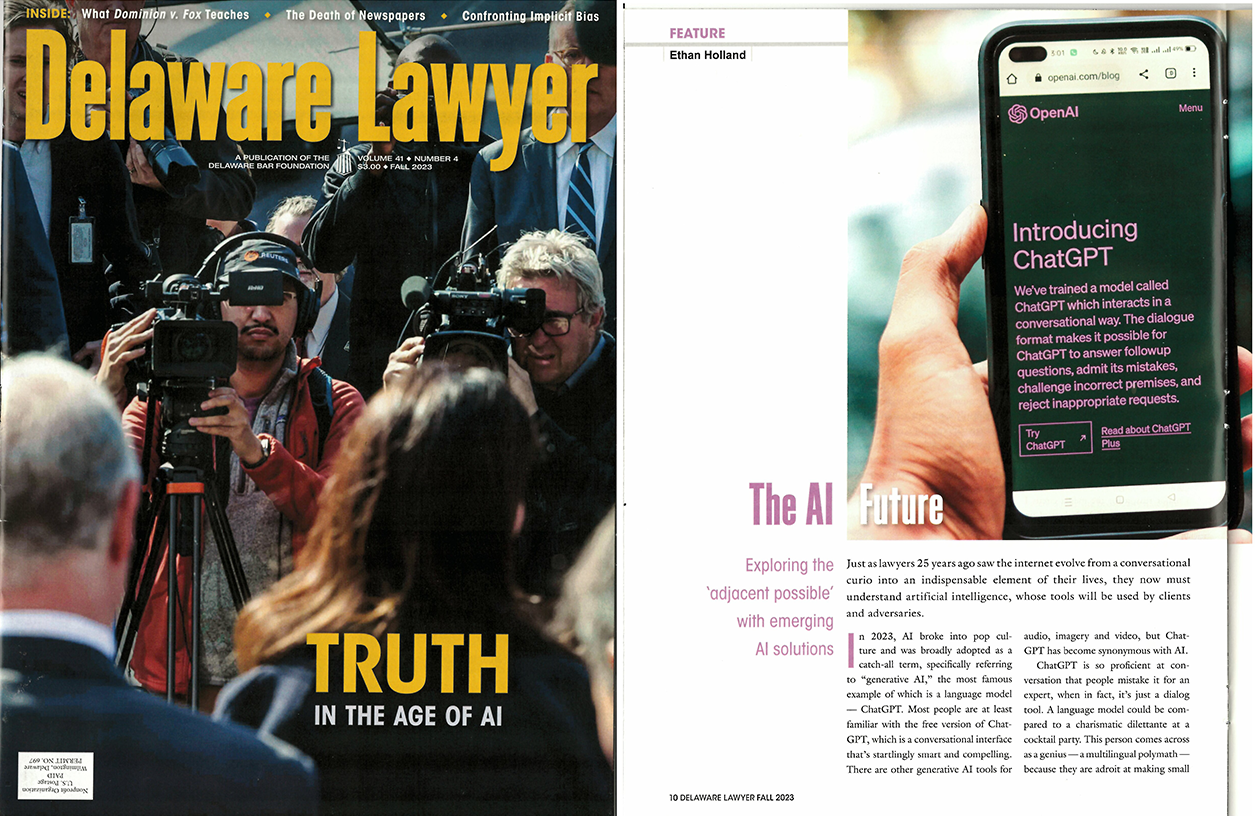
I’m excited to have written an article in the latest issue of Delaware Lawyer magazine. It addition to forcing me to put ideas to paper, it was a fun opportunity to shout out Jeremiah Owyang, Alan D. Thompson, and Ethan Mollick in print. I wrote the piece in November with a Thanksgiving deadline. The issue came out last week. It was nerve-wracking to see AI race ahead, with my words trapped in time. For the most part, AI is proceeding as predicted. I wrote it for a non-technical executive audience. I hope you enjoy it!
By Ethan Holland
Written November 15, 2023
Just as lawyers 25 years ago saw the Internet evolve from a conversational curio into an indispensable element of their lives, they now must understand Artificial Intelligence, whose tools will be used by clients and adversaries.
In 2023, AI broke into pop culture and was broadly adopted as a catch all-term, specifically referring to “generative AI,” the most famous example of which is a language model – ChatGPT. Most people are at least familiar with the free version of ChatGPT, which is a conversational interface that’s startlingly smart and compelling. There are other generative AI tools for audio, imagery, and video, but ChatGPT has become synonymous with AI.
ChatGPT is so proficient at conversation that people mistake it for an expert, when in fact, it’s just a dialog tool. A language model could be compared to a charismatic dilettante at a cocktail party. This person comes across as a genius – a multilingual polymath – because they are adroit at making small talk. However, the ChatGPT most people “met” in 2023 was winging it – improvising convincingly and often effectively. In this analogy, common critiques such as ‘it makes things up’ or ‘it struggles with math and word counting’ are understandable. The free version of ChatGPT is a basic example of a large language model, an intuitive name for a ‘smooth talker.”
Common misconceptions and limited usage among professionals.
I’ve spoken with dozens of very smart executives about AI, ranging from law partners to e-commerce leaders, financial managers, and major publishers. While most are conversant, almost none have used AI beyond free tools or hearing about it. It’s challenging to untangle misconceptions about a tool that is often talked about yet little used.
Contrasting free and paid versions of ChatGPT.
Upgrading to ChatGPT Plus gives our fictitious cocktail party dilettante access to tools and resources. Rather than winging it, the AI can use a calculator and a web browser, with access to references. The world’s best small talker becomes startlingly powerful when given resources, an internet connection, self-reflection, and time. Agency is when an AI can do things on our behalf — browsing the web, making a purchase, booking a flight, replying to an email, or making a restaurant reservation. Reflection is an ability to check its work.
ChatGPT Plus goes beyond interacting with language. It is no longer in the same playing field as the free version. ChatGPT Plus can read and reply in multiple modalities: text, images, audio, video, data, and files. It can read and write PDFs. Moreover, it can discuss them. ChatGPT Plus can ‘see” and describe image files in detail. It can create images based on text prompts. It can transcribe a speech or read the speech aloud. If given a map, it can “read” the map, and talk about it. It can examine x-rays, seismographs, and weather models. There is no shortage of examples of “feats of strength”, as well as plenty of “spectacular fails”. However, the arc of the past year is a vertical line of rapid improvement.
Consumer and Business-to-Business AI
ChatGPT is the standard for an all-in-one language model, but there are other consumer tools for specific modalities: MidJourney for images, ElevenLabs for audio cloning, HeyGen for video translation, and Otter.ai for transcription. All are worth one month’s subscription to see in action.
Professionals should know the names of competitors to OpenAI, the companies behind the most powerful language models. Anthropic, Google, Amazon, X, and Meta have models like Claude, PaLM, Olympus, Grok, and LLama. They also have branded consumer and business tools that leverage their models, for example, Microsoft CoPilot’s integration of ChatGPT into Outlook for email drafting and GitHub for coding, or Google’s Search Generative Experience (SGE) for interactive searching.
Start-ups are flooding industries with business-to-business AI products. There are well over a dozen AI products for law firms (Harvey, Diligen, Relativity, Epiq, Mitratech, DISCO, Smokeball, Lexion, Lex Machina, Clio, Evisort, Axiom, Casetext, Everlaw). In healthcare, Abridge, Babla, Glass, and Nuance are competing to help doctors take better clinical notes and make diagnoses. In these cases, AI is folded into a branded product, trained for an industry purpose, enabling stronger, professional functionality within a fixed scope.
Enterprise LLMs
For white-label solutions, AI companies offer application programming interfaces that allow corporations to privately and securely build AI that integrates with troves of proprietary documents and data. When a company connects the power of an AI language model to corporate IP, whether through explicit training or simply access to data, it’s called an enterprise LLM.
In 2023, PriceWaterhouseCoopers committed $1 billion to incorporate an enterprise LLM into its corporate knowledge base. Its goal is to provide thousands of PwC employees with the world’s savviest assistant, able to conversationally mine PwC’s tax, legal, and HR corporate database.
Unlike ChatGPT, this enterprise model can cite its work, find connections across stores of documents, and add value, as if it were a super-intern who never tires, and scans 100,000 files as easily as a spreadsheet can sum two cells.
If you’d like to learn more, PwC is working with a company called Harvey.ai, as are law firms like Allen & Overy. LexisNexis has partnered with Anthropic, whose ChatGPT competitor is branded Claude. Walmart has built an LLM “playground” for employees as well as an enterprise LLM branded “My Assistant” for 50,000 U.S. non-store employees. The goal is to “free them from monotonous, repetitive tasks, allowing more time and focus for the customer experience.” McKinsey built an LLM branded “Lili,” which can conversationally search “40 curated knowledge sources, containing more than 100,000 documents and interview transcripts containing both internal and third-party content” to help associates match clients with experts across 70 countries. Associates refer to Lili as a “thought sparring partner” to help them prepare for presentations.
A Game of Champion v. Challenger
Expect a “champion v. challenger” relationship between humans and AI. In each domain, humans fight for status as best in class, as computers chip away at the title.
Chess is an example where humans have been roundly defeated by Stockfish AI. Yet, this led to a chess renaissance, stronger players, interactive tutors, and competition of all levels on our phones. New technology starts as magic and becomes engineering.
Once AI can beat the median human expert in any given task, the game changes. In 2023, GPT-4 was tested using questions that were not part of its training. LifeArchitect.ai published data showing at as of March of 2023 (ages ago), GPT-4 beat the average human expert at psychology (100 to 84), biology (99.5 to 50), SAT (94 to 50), grade school math (92 to 50), law (90 to 50), sommelier theory (77 to 50), economics (66 to 30), quantum computing (74 to 73), medicine (75 to 50), and AI IQ (86 to 35), and inference (96 to 95).
AI can detect cancer and predict earthquakes earlier than humans. Given multimodality, AI can go one step further than an algorithm, and discuss why and how, at whatever level of expertise we choose to engage. “Explain it to me like I’m a child” is a viable choice, as is “explain it like I’m a law professor”.
The Future of Interfaces
“The ‘content’ of any medium is always another medium. The content of writing is speech, just as the written word is the content of print, and print is the content of the telegraph.” – Marshall McLuhan 1964
Each new medium both contains and can emulate the one medium it replaces. The internet contains and emulates film, radio, television, publishing, and retail. The content of AI will include… the Internet.
Websites, as we know them, are disappearing. Type the letters “weat” into search, and Google will fill in “weather”, the city you are in, and the current temperature. By typing just four letters, you have your answer. This means fewer trips to the Weather Channel’s page.
Language models communicate through conversations, and if we gather and refine information through dialog, we’re not visiting websites. If we need to see, hear, or watch something, the agent can deliver it.
Bill Gates predicted agents in 1995. In the November 2023 edition of “Gates Notes,” Gates reiterates “You won’t have different apps for different tasks. You’ll simply tell your device, in everyday language, what you want to do… Agents are not only going to change how everyone interacts with computers. They’re going to upend the software industry.”
We’ll be able to speak to our computer. OpenAI’s real-time speech to text tool, called Whisper, is natively integrated into ChatGPT, and operates at 99% accuracy. There’s no need to say, “new line”, “comma”, nor “period”.
HeyGen takes a video of an English speaker, clones their voice, transcribes their speech, translates it into several languages, records new cloned audio using the intonation and inflections of the original speaker, and then matches the speaker’s lips and breathing to the new language – in minutes.
AI microphones can record only certain voices. Noise reduction headphones can filter all but certain speakers in a crowded room.
As we converse with our tools using plain, intuitive language, they blend into our lives and depart from the constructs of laptops, browsers, and phones. If you use an Amazon Echo or Apple Siri (early agents) to get what you need, you won’t need to open your laptop or pick up the phone.
Impact on Marketing
When agents drive discovery, communications and marketing will be dramatically transformed.
Google has already named its AI product “conversational search.” Discovery will be less about navigating multiple sites and more about engaging with a single multimodal AI agent.
Jeremiah Owyang, partner at Blitzscaling Ventures, puts it bluntly, “Humans will rely on AI and the AI is going to get the information and make the decisions. That’s something communicators had control over, now [they’re] going to lose that control.” Owyang predicts AI will “end the abusive relationship we all have with search,” and SEO will “no longer be relevant”.
Consumers will enjoy a streamlined experience. Currently, even the simplest of searches leads to a sea of pages stuffed with keywords and filler. The onus is on us to find the signal in the noise when searching.
Leveraging AI agents for information retrieval implies a shift from passive browsing to active questioning. Agents will prioritize factual accuracy and expertise over marketing tactics. In an era of agent-based discovery, professional experience and demonstrable results will be invaluable. AI agents will assess authority and credibility, sifting through the multitude of online voices to identify genuine experts that are relevant to the user.
AI agents will extract data directly from the most reliable sources, whether for sports scores, election results, or news updates. If searching for lawyers, AI can evaluate public records, case histories, and professional ratings, rather than relying on SEO-optimized web content.
Bloated content created for SEO will be irrelevant. The focus will shift to original, high-quality content and services. The future of communication lies in originality and authenticity that is data-driven, distilled and delivered by AI agents.
Agent-to-Agent Interaction
AI agents won’t just mine the web. They will assist us with work, and collaborate with other agents.
Microsoft’s “CoPilot” boosts software and Office productivity. Microsoft Outlook can create professional drafts in a variety of tones and responses, with one-click buttons labeled with relevant suggestions. Microsoft announced that developers using CoPilot coded 55% to 200% faster. It’s not AI that will take your job, it’s another worker with AI.
In many cases, AIs will be talking to AIs. Ethan Mollick, associate professor at Wharton, calls the effect on our psyche “the coming crisis of meaning”.
Changing a hotel reservation. Negotiating appointment availability. Customer service calls. Agents will dominate these tasks.
In November 2023, two AIs powered by Lumninance negotiated a contract. Their AI agent is designed to “handle day-to-day negotiations, freeing up lawyers to use creativity where it counts, and not be bogged down.”
AI In the Physical World
Embodiment is when AI is loaded into physical forms, and interacts with the physical world, carrying out tasks and responding to verbal commands.
Google has embodied robots with language models, allowing robots to be given untrained commands like “Go to the drawer and bring me the chips.” The LLM translates the command into the code needed to execute the task, with no preloaded understanding of methods required nor a library or map of objects in the room.
You’ll be able to ask your car why it slowed down. A director might tell a drone to “film the surfer in the red swimming suit, in the style of Ridley Scott”.
The implications of AI interacting physically with the world are profound. Healthcare, security, and logistics will be disrupted, as well as regulation, privacy, and ethics.
Artificial General Intelligence
“OpenAI’s mission is to ensure that artificial general intelligence (AGI)— highly autonomous systems that outperform humans at most economically valuable work—benefits all of humanity.” – OpenAI Charter
In November, Google’s Deepmind released a table defining five stages of AGI. We’re currently at Level One, “Emerging AGI.” Level Five, “Superhuman AGI,” is when AI can beat 100 percent of humans at any task. We have narrow Superhuman AI’s (AlphaFold, AlphaZero, and StockFish), but nothing near a generalist.
AGI will do our jobs better than we can. DeepMind’s definition of AGI includes things humans cannot do, like decoding thoughts, predicting future events, and talking to animals.
The speed at which experts predict AGI’s arrival is daunting. Shane Legg, DeepMind co-founder, predicts 2028. Elon Musk, 2029. Geoffrey Hinton, the Godfather of AI, says five to 20 years. OpenAI’s Sam Altman and DeepMind CEO Demis Hassabis both predict less than 10 years.
AI doesn’t grow old, it grows stronger. Think of an athlete perpetually increasing in skill, strength, and experience. What if every player in the NBA gained the insight of every other player, from every point, forever? Imagine this athlete never needed sleep and could simulate gameplay at a rate faster than humans fathom time – the lowly iPhone processes 35 trillion operations per second. Every Tesla on the road shares its experiences with every other Teslas and gains the combined driving hours of every Tesla that has ever “lived.”
No matter the timeline, as we approach AGI, jobs will transform, and many will disappear. Kodak knew digital SLRs and SD cards were coming. If we want to know how we would fare at Kodak, we’re getting our chance right now, and in ten years we can ‘review our film’.
Takeaways
In 2024, look for Google to launch Gemini with potentially four times the strength of ChatGPT. Expect Apple and Amazon to launch major products. ChatGPT will no longer be exclusively synonymous with AI.
Short-term, there will be a proficiency gap. Put hesitation aside and start tinkering. Use every tool you can before the gap widens beyond your ability to improvise. Creative people will see opportunities for AI to force multiply their work. Others will gaze at prompts like a pencil on a blank piece of paper.
Mid-term, AI will be so adept at conversation, the proficiency gap will close. This is good news for the technically challenged, but it’s a double-edged sword, as moats historically protecting experts – experience, degrees, creativity, intelligence, scarcity, and time – will be democratized and distributed by AI.
Humans are already agents, drawing conclusions, recognizing patterns, researching information, mining, and interpreting data. We’ve always been redefining domain expertise, as tools evolve.
In 2020, Stuart Kauffman coined the term “The Adjacent Possible”. In his book “Where Good Ideas Come From” Steven Johnson popularized it: “The adjacent possible is a shadow future, hovering on the edges of the present state of things, a map of all the ways in which the present can reinvent itself. The strange and beautiful truth about the adjacent possible is that its boundaries grow as you explore those boundaries”.
Now is an excellent time to explore the Adjacent Possible in artificial intelligence. Every day brings new breakthroughs, possibilities, and new pages in the book being written by Large Language Models.



Leave a Reply