Every week, I organize 400 to 700 links into roughly 60 categories as part of my ongoing effort to learn about AI. This is my personal notebook, which I enjoy sharing with friends… a hobby and a labor of love, rather than a commercial publication or product.
If you arrived here through a search or shared link, this page collects the links I found for Law for the week ending July 24, 2026.
As part of my learning process, I like to automate the category covers. It gives me a chance to learn Python and APIs.
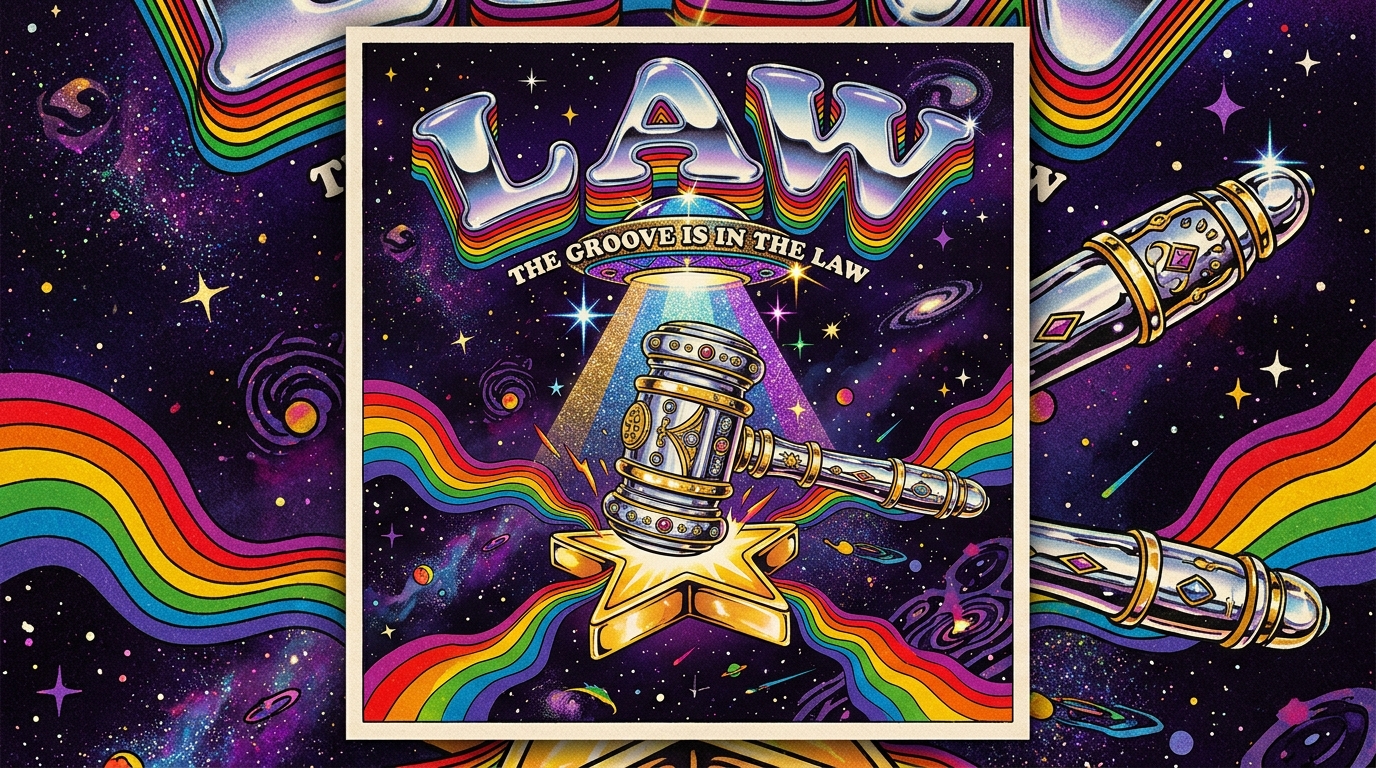
This week’s cover prompt was written using Claude Opus 4.7, and the image was generated using Gemini 3.1 Flash Image Preview.
Category cover image prompt:
A single oversized chrome and gold gavel striking a star-shaped sound block at the center of a square 1970s psychedelic funk poster, rainbow ribbons rippling outward like visible soundwaves against a deep cosmic purple-black sky, mothership light beaming down from above with glitter sparkle and starbursts, the word 'Law' arcing boldly above in fat chrome bubble letters with stacked multicolor drop shadows, Afrofuturist, maximum saturation, one clear central subject with generous negative space.
This Week in Law News
Here’s a quick AI-generated summary by Claude Sonnet 5.5, based on the headlines and excerpts accompanying this week’s links:
Reuters reported that a US judge approved Anthropic's $1.5 billion settlement of the copyright lawsuit against it. The excerpt gives no further detail on the terms.
Most of the other links dispute the idea that distilling a model, meaning training one model on another's outputs, counts as IP theft. Aviskowron pointed to the US Copyright Office's position that raw LLM outputs are not protected by copyright, and noted that copyright in model weights is not guaranteed either. Kevin Bankston asked what IP is actually being stolen, arguing that reverse engineering has long been treated as fair use and that a trade secret claim is a stretch when the model discloses the information itself. Suhail added that distillation chains cannot be prevented, and that original models trained on huge amounts of copyrighted data without facing court.
Separately, MacRumors reported that Apple sent legal letters to dozens of OpenAI employees.
This summary was generated by Claude Sonnet 5.5 to help you explore the links below. Rest assured, I select, organize, and check the links by hand in Google Sheets, and write the introduction and personal commentary in The Main Newsletters myself each week as a labor of love.
This week's links related to Law
US judge approves Anthropic’s $1.5 billion settlement of copyright lawsuit | Reuters
https://www.reuters.com/world/us-judge-approves-anthropics-15-billion-settlement-copyright-lawsuit-2026-07-20/
Report: Apple Sends Legal Letters to Dozens of OpenAI Employees – MacRumors
https://www.macrumors.com/2026/07/17/apple-sends-legal-letters-openai/
Unfortunately for the “distillation = IP theft” theory, raw LLM outputs are not protected by copyright according to the US Copyright Office. Or is this saying that K3 is an infringing copy of Fable? On what basis? (Copyright protection of model weights is not guaranteed either.)”
https://x.com/aviskowron/status/2080000721580364166
I’d be curious to understand what IP is being stolen? According to your (C) office, LLM outputs aren’t copyrightable, and courts have long held reverse engineering to be a fair use; trade secret is a stretch since the company’s model is directly disclosing the info. Easy to say”
https://x.com/KevinBankston/status/2079977461874340050
If I distill from a model that distilled from a model that distilled from another model, what’s going to happen? Nothing. You cannot prevent any of this. It’s also BS to try when the original model trained on metric tons of copyright data it will never be taken to court for.”
https://x.com/Suhail/status/2080340893035618638

Leave a Reply