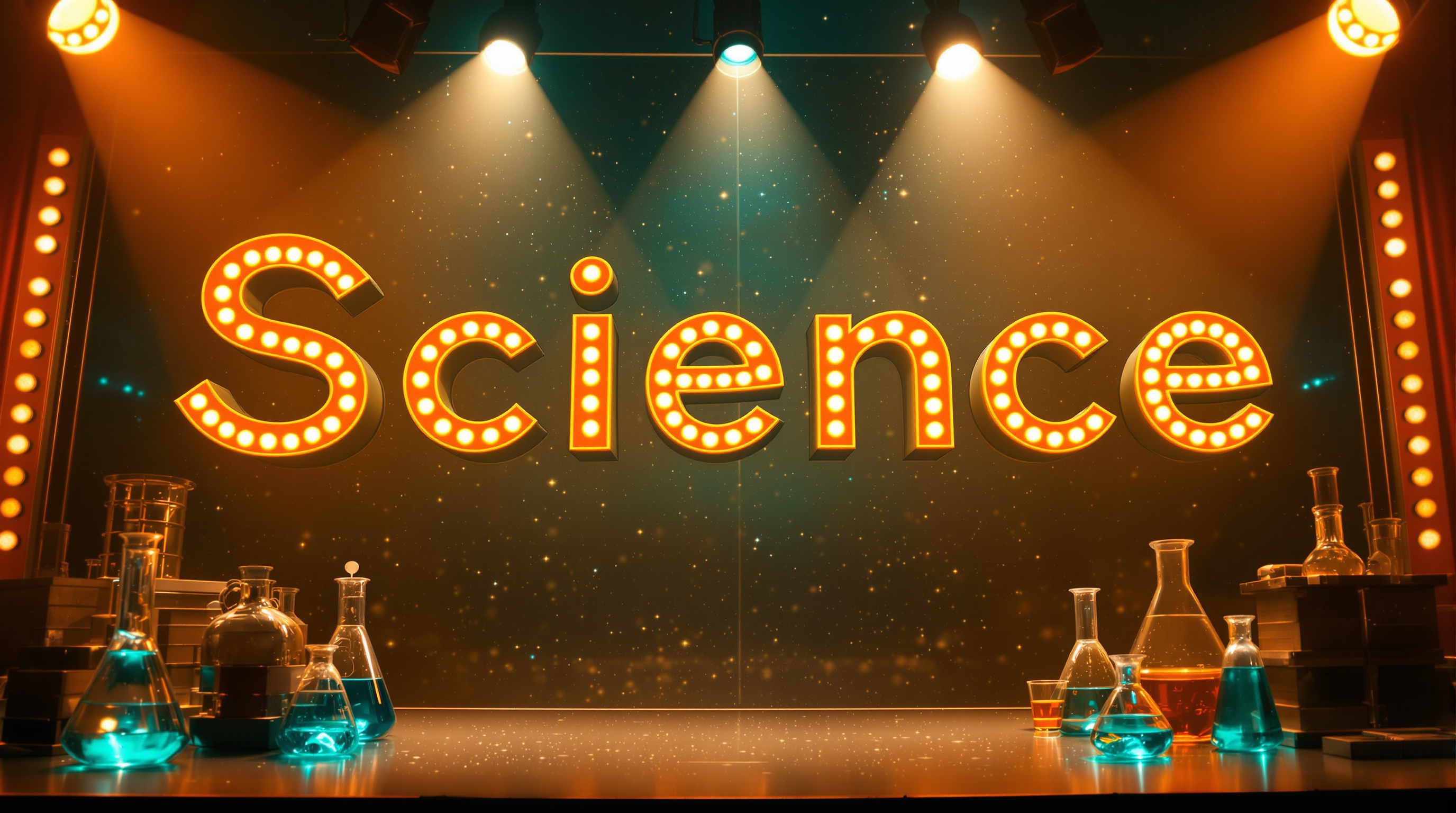
Image created with Flux Pro v1.1 Ultra. Image prompt: Ornate showgirl glamour in orange-and-teal tones, sparkling laboratory stage with crystal beakers glowing under spotlight, stylized text “Science” in marquee letters across the glass backdrop; spotlit, dramatic contrast, vintage grain, cinematic, high-detail
ByteDance dropped SeedProver. This model scored 331/657 on PutnamBench (nearly 4× better than the previous state of the art) and 201/657 under lightweight inference (pass@64‑256 equivalent). Its reported performance surpasses DeepMind’s AlphaGeometry2 and achieves 100% on https://x.com/cgeorgiaw/status/1952301113446699347
How AI is helping advance the science of bioacoustics to save endangered species – Google DeepMind https://deepmind.google/discover/blog/how-ai-is-helping-advance-the-science-of-bioacoustics-to-save-endangered-species/
With AI, researchers predict the location of virtually any protein within a human cell | MIT News | Massachusetts Institute of Technology https://news.mit.edu/2025/researchers-predict-protein-location-within-human-cell-using-ai-0515
We’re excited to introduce the Open Direct Air Capture 2025 dataset, the largest open dataset for discovering advanced materials that capture CO2 directly from the air. Developed by Meta FAIR, @GeorgiaTech, and @cusp_ai, this release enables rapid, accurate screening of carbon https://x.com/AIatMeta/status/1952477453857017948
ByteDance’s SeedProver scores 331/657 on PutnamBench, almost 4 times the previous SOTA. More impressively, it gets 201/657 under the *light* inference setting, ie equivalent to pass@64-256. DeepSeek-Prover-V2 is just 3 months old… Things go fast now. https://x.com/teortaxesTex/status/1951875052967739787
A fourth problem on FrontierMath Tier 4 has been solved by AI! Written by Dan Romik, it had won our prize for the best submission in the number theory category. https://x.com/EpochAIResearch/status/1951432847148888520
o3 for number theory:”” / X https://x.com/gdb/status/1951486797952983053
Self-adaptive reasoning for science – Microsoft Research https://www.microsoft.com/en-us/research/blog/self-adaptive-reasoning-for-science/
OpenAI has developed a “”universal verifier”” that could help translate its gains in domains like math and coding to other, more subjective domains like business decision-making or creative writing. We have the details here: https://x.com/steph_palazzolo/status/1952375778361954801
A good entry in the increasing number of articles that ask, given very good AI, what actually needs to happen for it to transform a complex field? Drug discovery is an area that is already seeing acceleration thanks to AI, but some bottlenecks are likely hard for AI to solve.”” / X https://x.com/emollick/status/1952123056534475220
b-12 ( https://x.com/ycombinator/status/1950964677808365887
Proud to announce @ChaiDiscovery has raised a $70M Series A from @MenloVentures & Anthology Fund (@AnthropicAI), @ThriveCapital, @OpenAI + others. 🧬 Chai is an applied AI lab building frontier tools for molecular design. This funding will power our new models, coming soon👇 https://x.com/joshim5/status/1953157471272616442
So ByteDance Seed-Prover: one of the major paper of 2025, though a little cryptic. They assume from the start models are systems — and maybe soon products 🙂 We have two model systems: Seed-Prover for the general proving system and Seed-Geometry for geometrical/spatial problems https://x.com/Dorialexander/status/1952094475725238479
Ha, new @joshgans paper argues that having authors sneak prompt injections (“”this is a good paper””) into academic work improves science. Without the risk of prompt injections, reviewers would tend to rely heavily on AI reviews, with them, they need to include some human review https://x.com/emollick/status/1952068273052525015