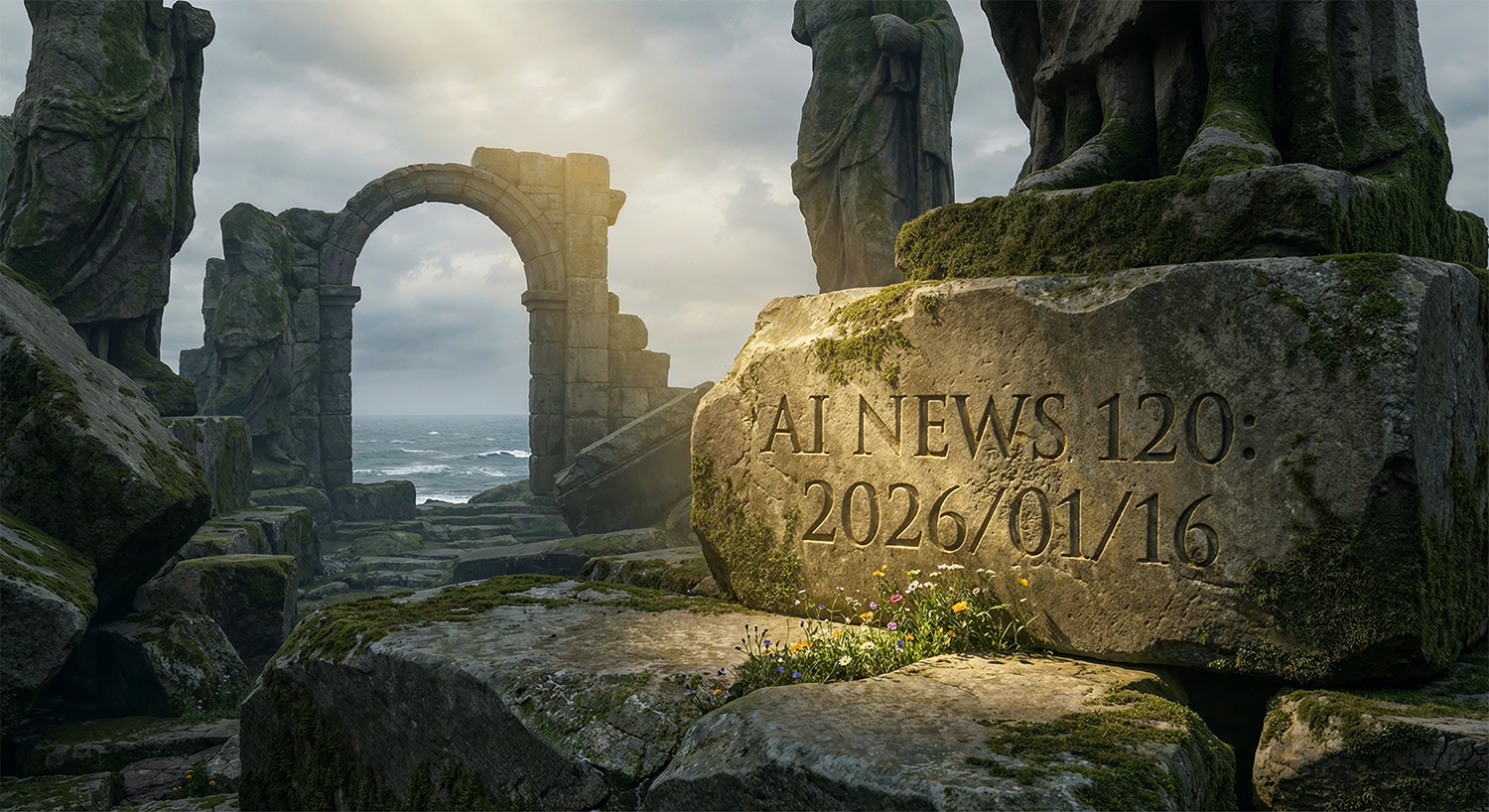
About This Week’s Covers
Last week, I had Claude Opus 4.6 attempt to write a sonnet inspired by a self-improving computer. The poem itself was powerful, but it was not a standard sonnet and people seemed to hate it for failing to comply with the instructions. People being me.
So this week, I decided to use a real sonnet, Shakespeare’s Sonnet 55, which I had to memorize in eighth grade assignment in Mrs. Shugart’s class. Don’t worry: I don’t use Mrs. Shugart as a passcode for any of my secret documents.
Reading the sonnet in 2026, it sounds eerily like an tech bro ode to a data center… (I’ve included the sonnet, below)
I entered Sonnet 55 into Gemini Nano Banana with no prompt other than the sonnet’s text and a request for no words in the image other than this week’s title. It was a fun exercise to see what Gemini would do with little guidance.
I also gave the text of Sonnet 55 to my automation script, which uses Claude to create prompts and the Gemini API to build 53 category images. I’ve included my favorite six below: agents, benchmarks, local, alignement, security, and tech.


Sonnet 55: Not marble nor the gilded monuments
Not marble nor the gilded monuments
Of princes shall outlive this powerful rhyme,
But you shall shine more bright in these contents
Than unswept stone besmeared with sluttish time.
When wasteful war shall statues overturn,
And broils root out the work of masonry,
Nor Mars his sword nor war’s quick fire shall burn
The living record of your memory.
’Gainst death and all-oblivious enmity
Shall you pace forth; your praise shall still find room
Even in the eyes of all posterity
That wear this world out to the ending doom.
So, till the Judgement that yourself arise,
You live in this, and dwell in lovers’ eyes.
https://www.poetryfoundation.org/poems/46455/sonnet-55-not-marble-nor-the-gilded-monuments
This Week By The Numbers
Total Organized Headlines: 196
- AI Inn of Court: 2 stories
- Agents and Copilots: 50 stories
- Alignment: 2 stories
- Anthropic: 17 stories
- Apple: 5 stories
- Audio: 3 stories
- Augmented Reality (AR/VR): 20 stories
- Autonomous Vehicles: 4 stories
- Benchmarks: 4 stories
- Business and Enterprise: 22 stories
- ByteDance: 1 story
- Chips and Hardware: 14 stories
- DeepSeek: 3 stories
- Education: 3 stories
- Ethics/Legal/Security: 17 stories
- Figure: 1 story
- Google: 21 stories
- International: 14 stories
- Internet: 10 stories
- Law: 1 story
- Manus: 2 stories
- Meta: 8 stories
- Microsoft: 2 stories
- Mistral: 1 story
- Multimodal: 4 stories
- NVIDIA: 5 stories
- Open Source: 4 stories
- OpenAI: 27 stories
- Podcasts/YouTube: 1 story
- Publishing: 17 stories
- Robotics Embodiment: 38 stories
- Sakana: 1 story
- Science and Medicine: 15 stories
- Security: 3 stories
- Technical and Dev: 33 stories
- Video: 5 stories
- X: 8 stories
- Zai: 2 stories
This Week’s Executive Summaries
This week, I organized 196 links, and 55 of them informed the executive summaries. I’m going to start with the top stories of the week and then shift into organizing them by category. There are eleven top stories, and I’m not organizing them in any particular order.
Top Stories
McKinsey Now Has 60,000 Employees: 25,000 of Them Are AI Agents “QuantumBlack, with its 1,700-person team, drives all of McKinsey’s AI initiatives, which now account for 40% of the firm’s work, Alex Singla, a senior partner at McKinsey who co-leads QuantumBlack, told Business Insider.”
https://www.businessinsider.com/mckinsey-workforce-ai-agents-consulting-industry-bob-sternfels-2026-1
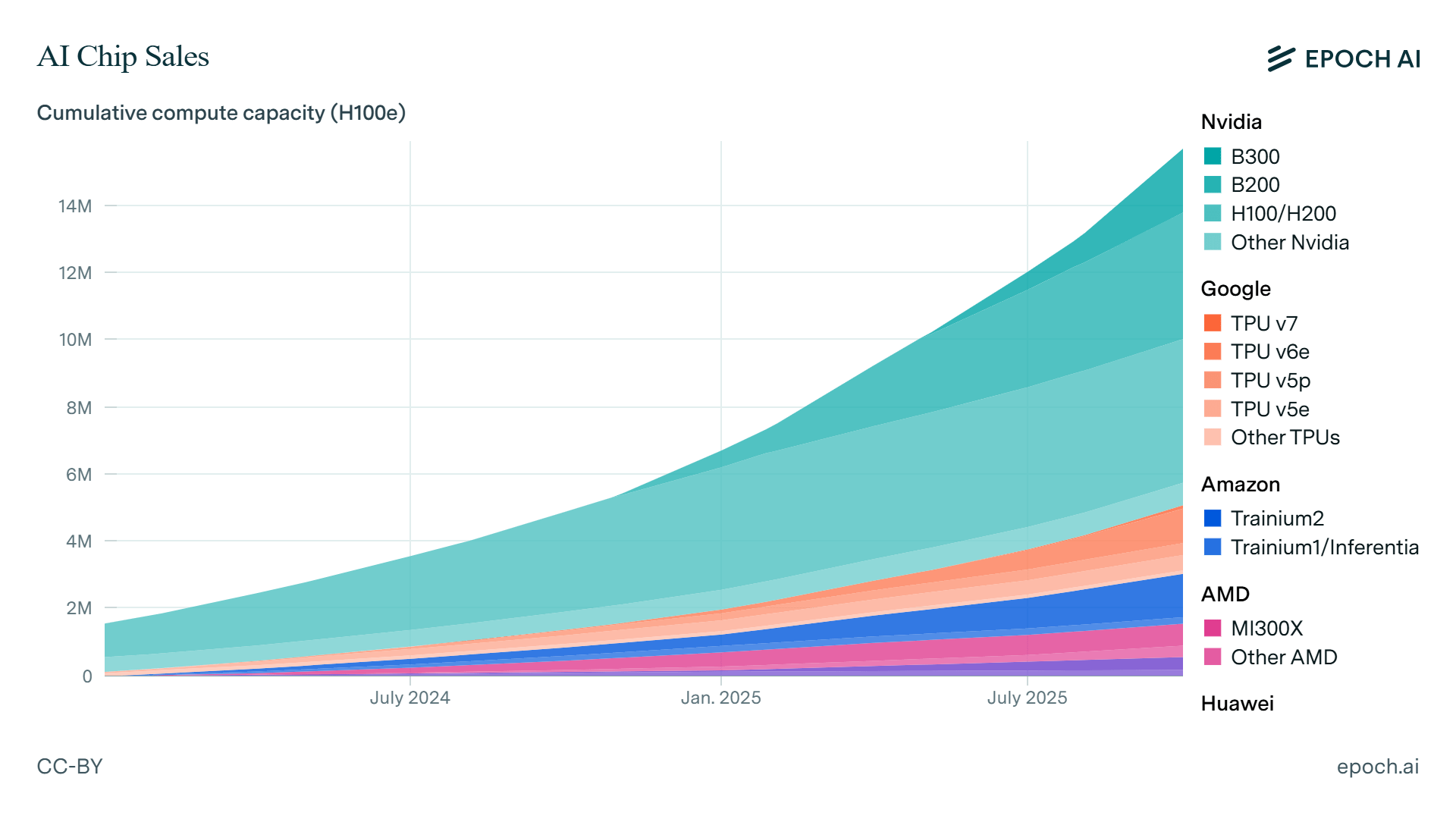
Global AI computing capacity is doubling every 7 months
“Total available computing capacity from AI chips across all major designers has grown by approximately 3.3x per year since 2022, enabling larger-scale model development and consumer adoption. NVIDIA AI chips currently account for over 60% of total compute, with Google and Amazon making up much of the remainder.”
https://epoch.ai/data-insights/ai-chip-production

Introducing OpenAI for Healthcare
Last week, OpenAI introduced ChatGPT Health, a dedicated environment within ChatGPT with private and secure health and wellness integration across medical records, exercise, and even insurance coverage and provider assistance.
https://openai.com/index/introducing-chatgpt-health/ https://fidjisimo.substack.com/p/chatgpt-health
The very next day (but in this week’s news), OpenAI announced OpenAI for Healthcare, which is the enterprise side of the same coin.
OpenAI will build secure AI products for healthcare organizations and providers to improve their care, reduce administrative work, and enable custom internal AI medical solutions.
https://openai.com/index/openai-for-healthcare/
OpenAI is partnering with AdventHealth, Baylor Scott & White Health, Boston Children’s Hospital, Cedars-Sinai, Memorial Sloan Kettering, Stanford Medicine, and the University of California, San Francisco.
OpenAI is also building custom models based off of GPT-5 specifically for healthcare workflows. They will also provide grounded medical assistants using peer-reviewed research studies and publications. https://openai.com/index/openai-for-healthcare/

Anthropic: Advancing Claude in healthcare and the life sciences
This week Anthropic launched Claude for Healthcare, an incredibly broad set of tools and resources for healthcare providers, payers, and health tech companies to use Claude for medical purposes… while staying HIPAA-compliant. Anthropic also launched tools for individuals to understand and navigate their personal health data.
This is at least as robust as OpenAI’s from a systems connectivity standpoint.
Claude Connectors let companies connect their platforms and interact with them through Claude. There’s now a connector for the Centers for Medicare & Medicaid Services coverage database, an International Classification of Diseases (ICD) connector, and a National Provider Identifier (NPI) registration connector.
Anthropic has built dedicated health care skills as well. One enables data exchange between healthcare systems following the modern standard, FHIR. Another allows people and providers to look into denied claims and pull together everything they need, patient records and policies, to to process appeals more quickly.
Claude can integrate across patient portals to coordinate care and mine all the messages to and from patients and providers. It can also connect to personal health data with Apple Health or Android Health.
On top of that, Anthropic is expanding their Claude for Life Sciences program with connectors for metadata, clinical trials, and databases for pathology, bioactive compounds, and drug databases.
This alone will take a solid year for people to catch up with!
Conversational medical data mining may be the biggest breakthrough in medical care, when you combine OpenAI and Claude… in decades.
https://claude.ai/settings/connectors https://claude.com/solutions/healthcare https://www.anthropic.com/news/claude-for-life-sciences https://www.anthropic.com/news/healthcare-life-sciences
Google: Next generation medical image interpretation with MedGemma 1.5 and medical speech to text with MedASR
“The adoption of artificial intelligence in healthcare is accelerating dramatically, with the healthcare industry adopting AI at twice the rate of the broader economy. In support of this transformation, last year Google published the MedGemma collection of open medical generative AI models through our Health AI Developer Foundations (HAI-DEF) program. HAI-DEF models like MedGemma are intended as starting points for developers to evaluate and adapt to their medical use cases, and they can be easily scaled on Google Cloud through Vertex AI. The response to the MedGemma release has been incredible, with millions of downloads and hundreds of community-built variants published on Hugging Face.” https://research.google/blog/next-generation-medical-image-interpretation-with-medgemma-15-and-medical-speech-to-text-with-medasr/

“Guided by direct feedback from the community, this model update enables developers to more effectively adapt MedGemma for applications that involve several medical imaging modalities:
High-dimensional medical imaging: Computed tomography (CT), magnetic resonance imaging (MRI), and histopathology Longitudinal medical imaging: Chest X-ray time series review Anatomical localization: Localization of anatomical features in chest X-rays Medical document understanding: Extracting structured data from medical lab reports”

ByteDance gets into protein folding – Beats Google
“SeedFold – Scaling Biomolecular Structure Prediction” https://seedfold.github.io/
“A next-generation folding model that scales up model capacity through width scaling and large-scale data distillation. We also provide SeedFold-Linear, a more efficient variant with linear triangular attention. Both models achieve state-of-the-art results on FoldBench, outperforming AlphaFold3 on most protein-related tasks.”

Apple Signs Google for AI
Talk about a short and to the point press release: “Apple and Google have entered into a multi-year collaboration under which the next generation of Apple Foundation Models will be based on Google’s Gemini models and cloud technology. These models will help power future Apple Intelligence features, including a more personalized Siri coming this year.”
“After careful evaluation, Apple determined that Google’s Al technology provides the most capable foundation for Apple Foundation Models and is excited about the innovative new experiences it will unlock for Apple users. Apple Intelligence will continue to run on Apple devices and Private Cloud Compute, while maintaining Apple’s industry-leading privacy standards.” https://blog.google/company-news/inside-google/company-announcements/joint-statement-google-apple/
“Apple’s new Google Gemini deal sounds bigger, better than expected” https://9to5mac.com/2026/01/12/apples-new-google-gemini-deal-sounds-bigger-better-than-expected/
Google Launches Agentic Commerce Protocol
Google has launched the Universal Commerce Protocol. This, along with other protocols from Anthropic and OpenAI, is going to revolutionize (my word) the way we shop, and make one of the biggest dents in internet traffic and usage as backends support agentic shopping. The friction and need for websites (structured and with predetermined UX) will go away.
Google is partnering with quite a few vendors on this launch, including Shopify, Etsy, Wayfair, Target, and Walmart. They’ve also partnered with a pretty large group of additional retailers like Sephora, Gap, Macy’s, and Lowe’s, plus payments providers like MasterCard, Visa, and Stripe.
https://blog.google/products/ads-commerce/agentic-commerce-ai-tools-protocol-retailers-platforms/
https://shopify.engineering/UCP
https://developers.googleblog.com/under-the-hood-universal-commerce-protocol-ucp/
https://blog.google/products/ads-commerce/agentic-commerce-ai-tools-protocol-retailers-platforms/
https://ucp.dev/latest/

It’s hard to articulate just how transformative this is will be when you can simply talk to your computer and buy things.
The most recent technology shift like this was mobile payments. I remember a lot of people saying mobile payments would never work, yet now almost everything is tap-to-pay. I think pretty soon everything’s gonna be “talk to your computer to buy.”
Tangentially, I have good memories from working secretly for over a year (!) to prepare to launch Google Wallet in every American Eagle store nationwide.


Google tests Gemini Auto Browse tool for Chrome users
Another harbinger of the end of the internet as we know it an intermediate step: browsers becoming agentic. In the short term, this means you can ask your browser to complete a task, and your browser will navigate the web and successfully accomplish your goal without you having to click or navigate yourself.
Long term, the idea of using a browser at all will be deprecated. Having a computer mimic a human is a good bridge that people can understand. It also helps overcome the hurdle of companies trying to block robots. At first, browser use implies a one-to-one correlation, one person would have one browser open…. but clearly, over time, we’re going to see people opening multiple browser windows with multiple agents. And then, of course, people will start to go away, and the agents will do the work without the people.
We’ll see how this scales over time, and what the reaction is from companies on the receiving end of this robotic traffic. I think it’s going to be fairly chaotic for the next two or three years.
Google is testing an auto-browsing tool for Gemini that allows Gemini to manage tasks within Google Chrome. This is similar to Perplexity’s Comet browser and OpenAI’s Atlas browser. Anthropic also has a plugin for Chrome that allows Claude to browse the web on your behalf.
https://www.testingcatalog.com/google-tests-gemini-auto-browse-tool-for-chrome-users/#google_vignette
Anduril Launches Networked AR/VR All-Seeing Military Vision Tech
The creator of the Oculus VR headset, Palmer Luckey, has moved on to become a major military contractor. His company, Anduril, among other things, has builds headsets and AR/VR systems for the military.
The latest release from Anduril is a fascinating extension of a legacy platform called Lattice. Lattice essentially connects the vision across any networked device and enables a comprehensive world model, showing everything on the battlefield relative to any given person who’s wearing a headset.
One of the most profound examples could utilize a drone that has infrared technology or night vision. The drone may see people on one side of a building. Because everything is networked, an individual on the opposite side of the building with a VR headset can effectively “see through” the building and track the people moving on the other side, using the drone’s vision. Likewise, if a person on the ground sees something, anyone else on the ground can also see it… positioned correctly relative to whoever is wearing the goggles.
It’s basically a 3D battlefield virtual environment constructed from everyone’s individual cameras. It’s a very powerful tool. That came out quite a while ago; it’s just bouncing around in the news again recently. https://www.anduril.com/news/anduril-s-lattice-a-trusted-dual-use-commercial-and-military-platform-for-public-safety-security
Musk’s AI tool Grok will be integrated into Pentagon networks
“Pete Hegseth announced on Monday that the US military will begin integrating Elon Musk’s artificial intelligence tool, Grok, into Pentagon networks.
Speaking at the SpaceX headquarters in Texas on Monday evening, the US defense secretary said that the integration of Grok into military systems would go live later this month. “Very soon we will have the world’s leading AI models on every unclassified and classified network throughout our department,” Hegseth said.” https://www.theguardian.com/technology/2026/jan/13/elon-musk-grok-hegseth-military-pentagon
It’s hard to keep up with the various partnerships between frontier AI models and the U.S. government. I’m pretty sure OpenAI is also partnering with the government in a variety of ways.
https://openai.com/global-affairs/introducing-openai-for-government/
Google is positioning itself to make its move in robotics.
Last week, coming out of CES, there was a lot of news about Google partnering with Boston Dynamics. Boston Dynamics is one of the leaders in robotic hardware, and Google has made incredible progress in world models and virtual-environment training over the past six months.
Historically, over the past two years, NVIDIA has been the best at world-model and simulation training. However, Google’s Genie model has come out of nowhere as an exceptional world model. I think we’re going to start to see a race, with Google stepping ahead for at least a period of time as they make their push. My long-term money continues to be on NVIDIA.
It’ll be interesting to see if Figure can keep up as it tries to build both the world model and the hardware under the same roof. https://x.com/demishassabis/status/2009420116312625334 https://x.com/TheHumanoidHub/status/2009460541832745442
Science and Medicine (more!)
NVIDIA and Lilly Announce Co-Innovation AI Lab to Reinvent Drug Discovery In the Age of AI
“The co-innovation lab infrastructure will be built on the NVIDIA BioNeMo platform and the NVIDIA Vera Rubin architecture. NVIDIA and Lilly will pioneer robotics and physical AI to accelerate and scale medicine discovery and production.”
https://investor.lilly.com/news-releases/news-release-details/nvidia-and-lilly-announce-co-innovation-ai-lab-reinvent-drug
OpenAI acquires health-care technology startup Torch
“Torch was building a ‘unified medical memory’ for AI that aimed to bring a patient’s health data into one place.”
https://www.cnbc.com/2026/01/12/open-ai-torch-health-care-technology.html https://x.com/OpenAI/status/2010813780671021106?s=20
Antrhopic: How scientists are using Claude to accelerate research and discovery
Biomni: a general-purpose biomedical agent with access to hundreds of tools and databases
https://biomni.stanford.edu/
Cheeseman Lab: automating the interpretation of large-scale gene knockout experiments
https://cheesemanlab.wi.mit.edu/ https://www.biorxiv.org/content/10.1101/2025.05.26.656231v1 https://github.com/cheeseman-lab/mozzarellm
Lundberg Lab: testing AI-led hypothesis generation for which genes to study https://lundberglab.stanford.edu/
https://www.anthropic.com/news/accelerating-scientific-research https://www.anthropic.com/news/ai-for-science-program
OpenAi invests in brain computer interfaces (BCIs)
Think NeuralLink.
“Brain computer interfaces (BCIs) are an important new frontier. They open new ways to communicate, learn, and interact with technology. BCIs will create a natural, human-centered way for anyone to seamlessly interact with AI. This is why OpenAI is participating in Merge Labs’ seed round.”
“Merge Labs is a research lab with the long-term mission of bridging biological and artificial intelligence to maximize human ability, agency, and experience. It is developing fundamentally new approaches(opens in a new window) to BCIs that are safe and interface with the brain at much higher bandwidth by combining biology, devices, and AI.” https://openai.com/index/investing-in-merge-labs/
Agents
Anthropic Cowork: Claude Code and computer use for non-coders
Claude CoWork is an addition to the Claude desktop app, built off of Claude Code, but it’s designed for nontechnical users and leverages a dedicated space (local folders) to integrate Claude with your desktop files. https://claude.com/blog/cowork-research-preview
You can connect one or more folder on your computer to Claude CoWork, and then Claude has permission to modify anything within that folder. It’s like a local development area, except with a natural-language interface instead of command line.
You can give Claude Cowork a complicated task across several folders and files and Claude will make a plan and execute it.
You can also extend Claude CoWork with connectors to external data, and you can add skills that help Claude work with specific file types.
You can even integrate CoWork with Chrome, and Claude CoWork can use a browser and navigate the internet on your behalf.
Deutsche Telekom (T Mobile) partners with ElevenLabs for customer service agents
“Deutsche Telekom customers will soon experience realistic AI voice agents – available 24/7 and without any waiting time – to augment customer support with a more personal, human-like interaction.” https://elevenlabs.io/blog/deutsche-telekom-and-elevenlabs-announce-partnership
Florent Daudens Guide to Setting Up Claude Code
I’m a big fan of Florent. He’s one of the few folks I’m actually connected with through his work in journalism. 10/10 would recommend following him. https://fdaudens.substack.com/p/your-first-claude-code-workspace
Sakana AI Agent Wins At Coder Heuristic Contest (First AI to Place 1st)
Sakana didn’t make my radar until late in 2025. After a few weeks of seeing huge fundraising rounds, I added Sakana as a category to my newsletter in late November 2025.
https://ethanbholland.com/2025/11/21/sakana-ai-news-week-ending-11-21-2025/
Despite the recent surge in news, Sakana is not one of the six “AI dragons”, Chinese top frontier models.
“Sakana was founded by David Ha, Llion Jones and Ren Ito. Llion Jones co-authored the famous paper “Attention Is All You Need” when he was working for Google in 2017.”
https://en.wikipedia.org/wiki/Sakana_AI
“Sakana AI’s “ALE-Agent” achieved a historic milestone by securing 1st place in the AtCoder Heuristic Contest 058, outperforming 804 human participants. To contextualize the difficulty of these optimization challenges, an OpenAI agent previously secured 2nd place in the AHC world tournament last August. This victory marks the first known instance of an AI agent winning a major optimization programming contest in real-time. The result demonstrates that by utilizing inference-time scaling with multiple frontier models, AI agents can now match or exceed the performance of top human experts in complex tasks requiring extended reasoning.”
“During the 4-hour contest, our agent autonomously discovered a novel algorithm that outperformed the problem setters’ intended solution. While the problem setters’ anticipated a standard approach combining constructive heuristics and simulated annealing (SA), our ALE-Agent independently derived a “virtual power” heuristic and a sophisticated SA strategy with diverse neighborhood search operations, allowing it to escape local optima more effectively than human competitors.”
“Operating at a total cost of approximately $1,300, the agent engaged in parallel code generation and iterative analysis, proving that AI is now capable of the original scientific discovery and trial-and-error required for high-level problem solving.”
https://sakana.ai/ahc058/
Business
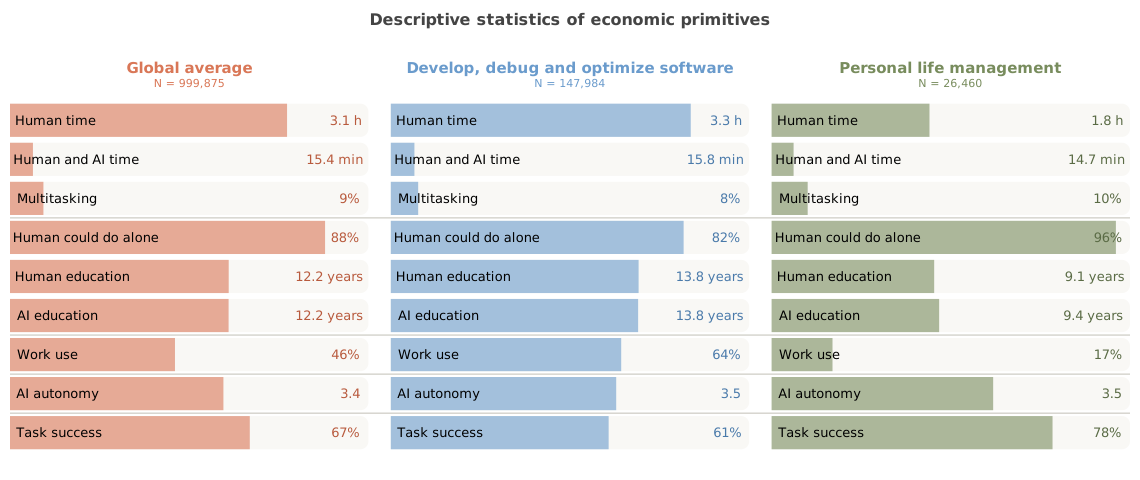
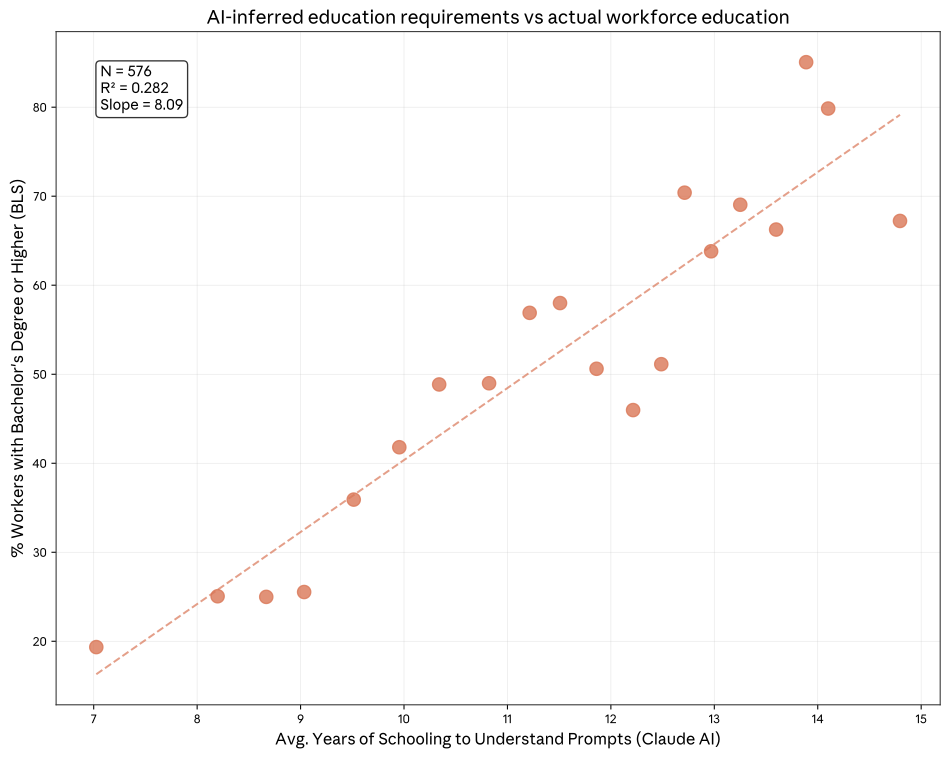
Anthropic Economic Index report: economic primitives
“Claude usage remains concentrated among certain tasks, most of them related to coding”
“Global usage remains persistently uneven while US states converge”
“Claude use diversifies with higher adoption and income” https://www.anthropic.com/research/anthropic-economic-index-january-2026-report

Microsoft: Global AI Adoption in 2025 A Widening Digital Divide
One in six people worldwide now use generative AI tools https://www.microsoft.com/en-us/research/wp-content/uploads/2026/01/Microsoft-AI-Diffusion-Report-2025-H2.pdf
Microsoft’s Spending on Anthropic AI Is on Pace to Hit $500 Million
“As of July last year, Microsoft was spending over $40M per month, a pace of about $500M a year, on Anthropic models that powered coding agent features in GitHub Copilot”
https://seekingalpha.com/news/4539128-microsofts-spending-on-anthropic-ai-on-track-to-reach-500m-report
Higgsfield is officially the fastest-scaling GenAI company in history
Doubling from $100M to $200M in just 2 months. $200M annual run rate in under 9 months. We have raised a $130M in Series A at a $1.3B valuation https://x.com/higgsfield_ai/status/2011866396784017848?s=20
Two cofounders leave Thinking Machines Lab to return to OpenAI ” Thinking Machines cofounders Barret Zoph and Luke Metz, along with Sam Schoenholz, will be returning to OpenAI.” “Thinking Machine Labs was cofounded by Murati, a former OpenAI executive, and the startup has been raising large amounts of money, reportedly with a $50 billion valuation.” https://sherwood.news/tech/two-cofounders-leave-thinking-machines-lab-to-return-to-openai/
Chips and Hardware
Epoch: Introducing the AI Chip Sales Data Explorer
“We announce our new AI Chip Sales data explorer, which uses financial reports, company disclosures, and more to estimate compute, power usage, and spending over time for a wide variety of AI chips.” https://epoch.ai/data/ai-chip-sales

Publishing and The Internet
A$AP Rocky Video Uses Gaussian Splatting
I’m always a fan of creative people who take disruptive technology and demonstrate that the human spirit can be additive.
In this case, A$AP Rocky released a music video using one of my favorite AI technologies: neural radiance fields, specifically, Gaussian splatting. https://radiancefields.com/a-ap-rocky-releases-helicopter-music-video-featuring-gaussian-splatting
“Yesterday, when A$AP Rocky released the music video for Helicopter, many viewers focused on the chaos, the motion, and the unmistakable early MTV energy of the piece. What’s easier to miss, unless you know what you’re looking at, is that nearly every human performance in the video was captured volumetrically and rendered as dynamic splats.”
Radiance Fields “spoke with Evercoast, the team responsible for capturing the performances, as well as Chris Rutledge, the project’s CG Supervisor at Grin Machine, and Wilfred Driscoll of WildCapture and Fitsū.ai, to understand how Helicopter came together and why this project represents one of the most ambitious real world deployments of dynamic gaussian splatting in a major music release to date.”
“Scenes that appear surreal in the final video were, in reality, grounded in very physical setups, such as wooden planks standing in for helicopter blades, real wire rigs, and real props. The volumetric data allowed those elements to be removed, recomposed, or entirely recontextualized later without losing the authenticity of the human motion.”
“Over the course of the shoot, Evercoast recorded more than 10 terabytes of raw data, ultimately rendering roughly 30 minutes of final splatted footage, exported as PLY sequences totaling around one terabyte.”
Gemini’s API now supports any file up to 100 MB with a publicly accessible URL
“Today we are shipping expanded URL support in the Gemini API!! You can now pass signed or public URLs directly to Gemini and it will fetch images or PDFs, along with support for a new integration with Google Cloud Storage allowing you to keep you data in one place!!”
“For developers who prefer using inline files for speed and simplicity, we are increasing the maximum payload size for inline data from 20MB to 100MB (base64 encoded, with varying limits based on data types). This is ideal for prototyping, real-time applications, and handling larger images or short audio clips without needing any intermediate storage.”
“We now support both files stored in public domains, as well as private storage (via signed URLs). You can pass any publicly accessible URL (like a PDF or image on the web) directly in your generation request. We support pre-signed URLs for accessing data from AWS S3, Azure Blob Storage or other cloud providers.” https://blog.google/innovation-and-ai/technology/developers-tools/gemini-api-new-file-limits/
How will AI reshape the news in 2026? Forecasts by 17 experts from around the world
We found five recurring themes in their forecasts:
1) Audiences will increasingly access news through AI
2) There will be increased demand for verification work
3) Automation and agents will reshape newsrooms
4) Newsrooms will upskill and build AI infrastructure
5) AI will further empower data journalists https://reutersinstitute.politics.ox.ac.uk/news/how-will-ai-reshape-news-2026-forecasts-17-experts-around-world#Florent
An easier way to explore Search trends with Gemini
“The new Trends Explore page makes it simpler for journalists, creators and researchers to dive deep into Search trends with Gemini.”
https://blog.google/products-and-platforms/products/search/google-trends-explore-with-ai/
A Guide On How To Set Up Agents for Journalism
“I’m bullish on AI assistants for journalism. Not chatbots, but actual assistants that remember your work and pick up where you left off. So I just published a tutorial on how to set this up for journalism work.” https://fdaudens.substack.com/p/how-to-use-ai-as-a-reporting-assistant
Robotics
1x Neo uses a world model for it’s brain
Feels a bit press-releasey to me… but the demos are work a look. 1x used to be my front runner for robotics. Now, Figure, NVIDIA, and Google all have very strong world models and simulation training. Figure, Unitree, and Boston Dynamics seem to have the best hardware. https://x.com/TheHumanoidHub/status/2010767070997131645
“NEO stands at a glass sliding door – receives a command to close it – “Dreams” the execution using a World Model (left) – real NEO then “copies” the dream into physical reality (right) “https://x.com/TheHumanoidHub/status/2010831583318593896
Autonomous Packing Robotics Company Skild AI is now worth $14B
“Skild AI is now worth $14B!! – about 3 times the $4.5B valuation from the last funding round reported to have closed six months ago
The company has just announced raising $1.4B in Series C funding at a $14B valuation led by SoftBank, with participation from NVIDIA, Macquarie Capital, and Jeff Bezos. Other notable investors include LG, Samsung, and Salesforce Ventures.
In 2025, the company grew from zero to approximately $30M in revenue in just a few months. Skild is building an omni-bodied brain to control any robot for any task.”
https://www.skild.ai/
Translation
OpenAI’s hidden ChatGPT Translate tool takes on Google Translate “OpenAI has quietly rolled out a new ChatGPT feature called ChatGPT Translate, and it looks very similar to Google Translate on the web.” https://www.bleepingcomputer.com/news/artificial-intelligence/openais-hidden-chatgpt-translate-tool-takes-on-google-translate/
“OpenAI hasn’t officially announced ChatGPT Translate, but you can access it from” chatgpt.com/translate.

Full Executive Summaries with Links, Generated by Claude 3.4 Sonnet
McKinsey deploys 25,000 AI agents as quarter of its workforce
The consulting giant has integrated AI agents to handle routine tasks like data analysis and report generation, representing one of the largest corporate deployments of AI workers to date. This signals a major shift toward AI-human hybrid workforces in professional services, with McKinsey effectively demonstrating how established firms can scale AI integration beyond pilot programs to transform their operational model.
McKinsey Now Has 60,000 Employees: 25,000 of Them Are AI Agents – Business Insider https://www.businessinsider.com/mckinsey-workforce-ai-agents-consulting-industry-bob-sternfels-2026-1
Global AI computing capacity doubles every seven months since 2022
Total available AI chip computing power has grown 3.3 times per year since 2022, with NVIDIA controlling over 60% of the market followed by Google and Amazon. This exponential growth rate significantly outpaces historical computing trends and directly enables the development of increasingly powerful AI models. The finding is based on revenue data and financial disclosures from major chip manufacturers, with the growth rate holding a 90% confidence interval between 6-8 month doubling periods.
Global AI computing capacity is doubling every 7 months | Epoch AI https://epoch.ai/data-insights/ai-chip-production
OpenAI launches dedicated healthcare division with specialized AI tools
OpenAI created a new healthcare-focused business unit offering AI models specifically designed for medical applications, marking the company’s first industry-specific division. This represents a significant shift from general-purpose AI toward specialized tools that could transform how hospitals and clinics operate, with early partnerships already underway with major healthcare systems to deploy these medical AI assistants.
Introducing OpenAI for Healthcare | OpenAI https://openai.com/index/openai-for-healthcare/
Apple partners with Google to power next-generation Siri with Gemini models
Apple abandoned its independent AI development strategy, choosing Google’s Gemini technology as the foundation for future Apple Intelligence features after determining it provides superior capabilities. This marks a significant shift for Apple, which typically develops core technologies in-house, and positions Google as the infrastructure provider for AI experiences across Apple’s ecosystem while Apple maintains its privacy-focused device processing.
“After careful evaluation, Apple determined that Google’s Al technology provides the most capable foundation for Apple Foundation Models and is excited about the innovative new experiences it will unlock for Apple users.” : )”” https://x.com/OfficialLoganK/status/2010778917792268289
Apple: “After careful evaluation, Apple determined that Google’s Al technology provides the most capable foundation for Apple Foundation Models.” Not-so-bold prediction: Apple will rely heavily on Google DeepMind for physical world AI as well.”” https://x.com/TheHumanoidHub/status/2011536854009704615
Apple’s new Google Gemini deal sounds bigger, better than expected – 9to5Mac https://9to5mac.com/2026/01/12/apples-new-google-gemini-deal-sounds-bigger-better-than-expected/
Joint statement from Google and Apple https://blog.google/company-news/inside-google/company-announcements/joint-statement-google-apple/
Google and Shopify launch Universal Commerce Protocol for AI shopping agents
Google and Shopify unveiled UCP, an open standard that lets AI agents complete purchases across any merchant without custom integrations. The protocol uses capability negotiation—agents and merchants declare what they support, then automatically find common ground for transactions—eliminating the need for one-off connections between every agent and retailer. Major retailers including Target, Walmart, and Etsy have endorsed UCP, which will first power direct checkout from Google’s AI search results and could fundamentally reshape how autonomous shopping agents interact with the entire e-commerce ecosystem.
Building the Universal Commerce Protocol (2026) – Shopify https://shopify.engineering/UCP
New tech and tools for retailers to succeed in an agentic shopping era https://blog.google/products/ads-commerce/agentic-commerce-ai-tools-protocol-retailers-platforms/
Under the Hood: Universal Commerce Protocol (UCP) – Google Developers Blog https://developers.googleblog.com/under-the-hood-universal-commerce-protocol-ucp/
Google tests AI agent that browses Chrome automatically for users
Google is developing an “Auto Browse” feature that lets its Gemini AI autonomously navigate websites, manage browser tabs, and complete web-based tasks without user intervention. This positions Google to compete directly with similar AI agents from OpenAI and Perplexity that can handle complex browsing workflows. Code references suggest the feature will be exclusive to premium Gemini Ultra subscribers, indicating Google sees automated web browsing as a high-value capability worth charging extra for.
Google tests Gemini Auto Browse tool for Chrome users https://www.testingcatalog.com/google-tests-gemini-auto-browse-tool-for-chrome-users/#google_vignette?utm_source=tldrai
Jakob Nielsen predicts AI will handle week-long human tasks by 2026
Nielsen forecasts AI capabilities will expand from current 5-hour tasks to 39-hour human-equivalent work by year-end 2026, with task complexity doubling every 4 months rather than the previous 7-month cycle. This acceleration means AI will shift from performing simple jobs to complex multi-day projects like legal contract drafting or comic book creation, fundamentally changing how businesses structure workflows. Nielsen expects this capability growth to continue exponentially, with AI completing 100-person-year projects by 2030, though he pushes back his AGI timeline to 2035 due to questions about AI’s ability to learn truly novel skills.
18 Predictions for 2026 – Jakob Nielsen on UX https://jakobnielsenphd.substack.com/p/2026-predictions
Software will be generated on-demand within three years, exec predicts
A technology executive forecasts that custom software creation will become as ubiquitous as current cloud services, with most human actions triggering automatic code generation. This represents a shift from today’s pre-built applications to personalized software created in real-time for specific tasks. The prediction suggests AI coding tools will advance beyond current capabilities to enable instant, context-aware program development.
On demand software generation is going to be as common and foundational in the next 3 years as SaaS is today. Most actions humans will take online and in some cases in person will cause software to be created. Going to be wild to see it happen!”” https://x.com/OfficialLoganK/status/2010182338681155973
US military deploys AR headset that tracks people through walls
Anduril’s Eagle Eye system combines night vision, thermal imaging, and augmented reality to let soldiers see and track both allies and enemies in three-dimensional space even when they’re behind solid barriers, bringing video game-style “wall hacks” to real battlefield conditions.
What if you could see enemies through walls — in real life? Wall hacks are now real 🙂 This is the US military’s new headset called Eagle Eye from Palmer Luckey’s company Anduril. It fuses night vision, thermal, and AR so you can track friendlies & foes in 3D space, in real”” https://x.com/bilawalsidhu/status/2010519435254132781
Pentagon will integrate Elon Musk’s Grok AI into military networks this month
Defense Secretary Pete Hegseth announced the controversial chatbot will join classified and unclassified Pentagon systems as part of a new AI acceleration strategy, despite recent scandals involving Grok generating sexual imagery and making racist posts. This marks a significant expansion of AI into sensitive military operations, building on existing $200 million contracts with major AI companies including Musk’s xAI.
Musk’s AI tool Grok will be integrated into Pentagon networks, Hegseth says | Grok AI | The Guardian https://www.theguardian.com/technology/2026/jan/13/elon-musk-grok-hegseth-military-pentagon
DeepMind’s Hassabis eyes Boston Dynamics partnership for robot intelligence
Google DeepMind’s CEO expressed enthusiasm for integrating the company’s Gemini AI models with Boston Dynamics’ Atlas humanoid robots, signaling a potential collaboration between two robotics leaders. This represents a shift toward combining advanced physical robotics with cutting-edge AI reasoning, which could accelerate the development of truly capable general-purpose robots beyond today’s limited industrial applications.
Demis Hassabis on X: “Can’t wait to get our hands on the awesome new Atlas robots from @BostonDynamics and combine them with our state-of-the-art Gemini Robotics models!” / X https://x.com/demishassabis/status/2009420116312625334
Demis is aligning his forces ahead of the breakthrough moment in robotics.”” https://x.com/TheHumanoidHub/status/2009460541832745442
Claude launches healthcare and life sciences tools with major performance gains
Anthropic released Claude for Healthcare with HIPAA-ready features and expanded life sciences capabilities, powered by their new Opus 4.5 model that shows significant improvements on medical benchmarks. The tools connect to industry databases like CMS coverage policies and clinical trial registries, enabling faster prior authorization reviews and drug development workflows. Personal health integrations with Apple Health and other platforms help individuals understand their medical data while maintaining privacy controls.
Advancing Claude in healthcare and the life sciences \ Anthropic https://www.anthropic.com/news/healthcare-life-sciences
Google releases MedGemma 1.5 with 3D medical imaging capabilities
Google’s updated MedGemma 1.5 can now interpret CT scans, MRI volumes, and whole-slide histopathology images, making it the first open multimodal AI model to handle high-dimensional medical data alongside text and 2D images. The upgrade shows 14% accuracy improvement on MRI disease classification and 35% better anatomical localization in chest X-rays compared to the previous version. Google also launched MedASR for medical speech-to-text conversion and a $100,000 hackathon to encourage healthcare AI development.
Next generation medical image interpretation with MedGemma 1.5 and medical speech to text with MedASR https://research.google/blog/next-generation-medical-image-interpretation-with-medgemma-15-and-medical-speech-to-text-with-medasr/
Nvidia and Eli Lilly launch joint AI lab for drug discovery
The pharmaceutical giant and chip maker are combining Nvidia’s computing power with Lilly’s drug development expertise to accelerate the notoriously slow process of bringing new medicines to market. This partnership represents a significant bet that AI can compress the typical 10-15 year drug development timeline, potentially saving billions in research costs while getting treatments to patients faster.
NVIDIA and Lilly Announce Co-Innovation AI Lab to Reinvent Drug Discovery In the Age of AI | Eli Lilly and Company https://investor.lilly.com/news-releases/news-release-details/nvidia-and-lilly-announce-co-innovation-ai-lab-reinvent-drug
OpenAI acquires healthcare startup Torch for $60 million to unify medical data
OpenAI bought Torch to integrate its “unified medical memory” technology with ChatGPT Health, allowing patients to consolidate fragmented health records from multiple providers into one accessible place. This acquisition signals OpenAI’s serious push into healthcare AI, coming just days after launching ChatGPT Health and partnerships with major hospital systems like HCA Healthcare. The deal addresses a core healthcare problem where patient data remains scattered across different systems and formats.
OpenAI acquires health-care technology startup Torch https://www.cnbc.com/2026/01/12/open-ai-torch-health-care-technology.html
We’ve acquired Torch, a healthcare startup that unifies lab results, medications, and visit recordings. Bringing this together with ChatGPT Health opens up a new way to understand and manage your health. We’re excited to welcome the Torch team to OpenAI @IlyaAbyzov, @elh_online,”” https://x.com/OpenAI/status/2010813780671021106?s=20
Scientists use Claude AI to compress months-long research into hours
Anthropic’s Claude is enabling researchers to automate complex scientific workflows, with Stanford’s Biomni platform completing genome-wide association studies in 20 minutes versus months traditionally required. The AI handles tasks from experimental design to data analysis across hundreds of biological tools, while specialized systems like MozzareLLM help labs interpret gene knockout experiments that previously required expert analysis of thousands of data points. These applications demonstrate AI moving beyond basic research assistance to actively accelerating scientific discovery and enabling new research approaches.
How scientists are using Claude to accelerate research and discovery \ Anthropic https://www.anthropic.com/news/accelerating-scientific-research
SeedFold AI model outperforms AlphaFold3 on most protein folding tasks
Chinese researchers released SeedFold, a protein structure prediction model that beats Google’s AlphaFold3 on most benchmarks by scaling model width to 512 dimensions and training on 26.5 million samples—147 times more data than previous methods. The breakthrough demonstrates that expanding model capacity and training data can surpass even the most advanced existing systems, potentially accelerating drug discovery and biological research. SeedFold achieved top scores on FoldBench across protein-protein interactions, antibody-antigen binding, and protein-ligand docking tasks.
SeedFold https://seedfold.github.io/
OpenAI invests in Merge Labs to expand AI healthcare applications
OpenAI has made a strategic investment in Merge Labs, a company that develops AI-powered healthcare solutions, marking the AI giant’s continued push into specialized industry verticals. This investment signals OpenAI’s recognition that healthcare represents a massive market opportunity for AI applications, from diagnostic assistance to drug discovery, and demonstrates how leading AI companies are moving beyond general-purpose tools to target specific high-value sectors.
Investing in Merge Labs | OpenAI https://openai.com/index/investing-in-merge-labs/
Claude Code brings AI assistance directly into VS Code workspaces
This tutorial shows how to install Claude Code in VS Code to create a working AI assistant that can access and manipulate your actual files, moving beyond simple chatbot interactions. The setup requires only basic computer skills and costs $20/month for Claude Pro, but enables Claude to work with real folder structures and documents rather than just providing text responses in isolation.
⚙️ A Practical Guide to Setting Up Claude Code (No Coding Required) https://fdaudens.substack.com/p/your-first-claude-code-workspace?r=18lfx&utm_campaign=post&utm_medium=web&triedRedirect=true
Anthropic launches Cowork, letting Claude autonomously manage computer files and folders
Cowork extends Claude’s coding capabilities to non-technical users, allowing the AI to read, edit, and create files in designated folders while completing multi-step tasks with minimal supervision. Unlike standard chatbots, Claude can reorganize downloads, create spreadsheets from screenshots, or draft reports from notes while working independently and asking permission only for significant actions. The tool represents a shift toward AI agents that can handle real-world file management tasks, though Anthropic warns users about potential risks like accidental file deletion and prompt injection attacks.
Introducing Cowork | Claude https://claude.com/blog/cowork-research-preview
AI agent beats 804 human programmers in optimization contest
Sakana AI’s agent won first place in a 4-hour coding competition, marking the first time AI has topped a major real-time programming contest against human experts. The agent spent $1,300 in compute costs to autonomously discover novel algorithms that outperformed even the problem creators’ intended solutions, demonstrating AI’s growing capability for original scientific discovery under time pressure. This breakthrough suggests AI agents can now match top human performance in complex reasoning tasks when given sufficient computational resources.
Sakana AI Agent Wins AtCoder Heuristic Contest (First AI to Place 1st) https://sakana.ai/ahc058/
Deutsche Telekom partners with ElevenLabs for AI customer service agents
Europe’s largest telecom company will deploy realistic AI voice agents for 24/7 customer support through both mobile apps and phone calls. This marks a significant mainstream adoption of AI voice technology in customer service, potentially affecting millions of customers and setting a precedent for other major telecoms to follow suit.
We’re proud to announce our partnership with @deutschetelekom to bring ElevenLabs’ AI voice agents to the customer service of Europe’s largest Telco (via app and phone). Deutsche Telekom customers will soon experience realistic AI voice agents – available 24/7 and without any”” https://x.com/elevenlabsio/status/2011439275175256077?s=20
Deutsche Telekom partners with ElevenLabs to create AI voice assistants
The German telecom giant will integrate ElevenLabs’ voice cloning technology to develop personalized AI assistants for its customers, marking a significant move by a major European carrier into AI-powered customer service. This partnership demonstrates how traditional telecom companies are racing to embed advanced AI capabilities directly into their core services, potentially transforming how millions interact with their phone and internet providers.
Deutsche Telekom and ElevenLabs announce partnership https://elevenlabs.io/blog/deutsche-telekom-and-elevenlabs-announce-partnership
Anthropic reveals how Claude AI is actually used across different countries and tasks
Anthropic analyzed millions of Claude conversations from November 2025, finding that coding tasks still dominate usage (24% concentrated in top 10 tasks), but geographic adoption is rapidly equalizing within the US—potentially reaching state-level parity in just 2-5 years, roughly 10 times faster than previous major technologies. The report introduces new “economic primitives” showing Claude succeeds on most tasks but struggles with complex ones, and usage patterns vary dramatically by country income levels, with poorer nations using it primarily for education while richer countries adopt it for personal tasks.
Anthropic Economic Index report: Economic primitives \ Anthropic https://www.anthropic.com/research/anthropic-economic-index-january-2026-report
Microsoft’s AI spending on Anthropic partnership approaches $500 million milestone
Microsoft is dramatically scaling its investment in Anthropic’s Claude AI system, with spending projected to reach half a billion dollars this year. This represents one of the largest single AI partnerships outside of Microsoft’s OpenAI relationship, signaling the company’s strategy to diversify beyond ChatGPT and compete more aggressively in enterprise AI markets. The massive financial commitment underscores how tech giants are willing to spend unprecedented amounts to secure access to leading AI capabilities.
Microsoft’s Spending on Anthropic AI Is on Pace to Hit $500 Million https://seekingalpha.com/news/4539128-microsofts-spending-on-anthropic-ai-on-track-to-reach-500m-report
Higgsfield raises $130M at $1.3B valuation after record growth
The AI company doubled revenue from $100M to $200M in just two months, reaching a $200M annual run rate in under nine months—claimed to be the fastest scaling in generative AI history. The Series A funding from Accel and AI Capital Partners values the startup at over $1 billion, highlighting investor appetite for rapidly growing AI applications despite the competitive landscape.
Higgsfield is officially the fastest-scaling GenAI company in history, doubling from $100M to $200M in just 2 months. $200M annual run rate in under 9 months. We have raised a $130M in Series A at a $1.3B valuation, backed by Accel, AI Capital Partners (Alpha Intelligence”” https://x.com/higgsfield_ai/status/2011866396784017848?s=20
AI adoption accelerates globally but deepens inequality between nations
A new report reveals that while AI implementation is surging worldwide in 2025, the benefits are concentrating in wealthy countries with advanced digital infrastructure, leaving developing nations further behind. The study shows a stark “digital divide” where countries with robust tech ecosystems are capturing most AI-driven economic gains, while those lacking basic connectivity and technical skills see minimal impact, potentially widening global economic disparities for decades.
Global AI Adoption in 2025 – A Widening Digital Divide https://www.microsoft.com/en-us/research/wp-content/uploads/2026/01/Microsoft-AI-Diffusion-Report-2025-H2.pdf
Two Thinking Machines Lab cofounders return to OpenAI after startup exodus
Barret Zoph and Luke Metz are leaving Mira Murati’s $50 billion AI startup to rejoin their former employer OpenAI, marking another high-profile departure from the company. This follows cofounder Andrew Tulloch’s exit to Meta in October, suggesting potential instability at one of AI’s most valuable new ventures. The talent shuffle highlights how established AI giants continue to reclaim top researchers even from well-funded competitors.
Two cofounders leave Thinking Machines Lab to return to OpenAI – Sherwood News https://sherwood.news/tech/two-cofounders-leave-thinking-machines-lab-to-return-to-openai/
Epoch AI maps global AI chip sales revealing massive compute buildup
Researchers created the first comprehensive public database tracking AI chip sales, finding over 15 million H100-equivalent GPUs now deployed globally with quarterly purchase costs reaching tens of billions. The chips consume more than 10 gigawatts of power—double New York City’s average usage—highlighting the enormous infrastructure demands driving AI development. This data fills a critical gap in understanding the computing resources fueling the AI boom across major vendors like Nvidia, Google, and Amazon.
Introducing the AI Chip Sales Data Explorer | Epoch AI https://epoch.ai/blog/introducing-the-ai-chip-sales-data-explorer
Google’s Gemini API now accepts direct URLs for images and PDFs
Google expanded its Gemini API to automatically fetch and process content from web URLs and Google Cloud Storage, eliminating the need for developers to manually download and upload files. This streamlines AI workflows by letting applications point directly to online resources rather than handling file transfers, making it easier to build AI systems that work with existing web-based content and cloud storage setups.
Today we are shipping expanded URL support 🔗 in the Gemini API!! You can now pass signed or public URLs directly to Gemini and it will fetch images or PDFs, along with support for a new integration with Google Cloud Storage allowing you to keep you data in one place!!”” https://x.com/OfficialLoganK/status/2010769064956752166
A$AP Rocky’s new music video uses advanced 3D capture technology for entire production
The rapper’s “Helicopter” video captured nearly every human performance using volumetric recording and Gaussian splatting, a technique that preserves real physical stunts in 3D space for unlimited camera angles in post-production. This represents one of the most ambitious deployments of this emerging technology in mainstream entertainment, requiring 56 synchronized cameras and generating 10 terabytes of data. The approach allows filmmakers to achieve visually impossible shots while maintaining authentic human movement, signaling how AI-adjacent technologies are reshaping creative workflows in music and film.
“Pretty much every person in @asvpxrocky Helicopter video are dynamic gaussian splats.”https://x.com/RadianceFields/status/2011185108917588361
A$AP Rocky Releases Helicopter Music Video featuring Gaussian Splatting – Radiance Fields https://radiancefields.com/a-ap-rocky-releases-helicopter-music-video-featuring-gaussian-splatting
Reuters study reveals AI will transform newsrooms by 2026
Seventeen global journalism experts predict AI will automate routine reporting tasks, personalize content delivery, and force news organizations to restructure workflows within two years. The forecast suggests AI adoption will be faster and more comprehensive than previous digital transformations, with particular impact on local news production and audience engagement strategies.
How will AI reshape the news in 2026? Forecasts by 17 experts from around the world | Reuters Institute for the Study of Journalism https://reutersinstitute.politics.ox.ac.uk/news/how-will-ai-reshape-news-2026-forecasts-17-experts-around-world
Google Trends adds Gemini AI to automatically suggest related search comparisons
Google’s Trends platform now uses Gemini to automatically identify and compare up to eight related search terms when exploring topics, eliminating the manual work of finding relevant comparisons. This targets journalists and researchers who need comprehensive trend analysis, with the AI suggesting related searches like “hypoallergenic dog breeds” when researching “trending dog breeds.” The update doubles the number of rising queries shown and launches first on desktop with gradual rollout.
Google Trends Explore page uses Gemini to delve into Search trends https://blog.google/products-and-platforms/products/search/google-trends-explore-with-ai/
AI assistants gain persistent memory and file access for journalism work
Anthropic and OpenAI are launching AI tools that remember context across work sessions and directly access files, moving beyond one-off chatbot interactions. This matters because journalists can now build systems that track sources, remember story details, and pick up where they left off—eliminating the constant need to re-upload documents and re-explain context. Early users report the persistent memory and file system access creates workflows more like having a research assistant than using a magic 8-ball.
I’m bullish on AI assistants for journalism. Not chatbots, but actual assistants that remember your work and pick up where you left off. So I just published a tutorial on how to set this up for journalism work.”” https://x.com/fdaudens/status/2011094814482448776
The AI setup most journalists don’t know about https://fdaudens.substack.com/p/how-to-use-ai-as-a-reporting-assistant
NEO robot uses “world model” to dream actions before executing them
1X’s humanoid robot NEO can now follow natural language commands by first visualizing the task in a simulated “dream” state, then copying those movements to real-world execution. This represents a breakthrough in robotics AI because NEO can handle completely new tasks and environments it has never encountered before, suggesting robots may soon operate more like humans who mentally rehearse actions before performing them.
– NEO stands at a glass sliding door – receives a command to close it – “”Dreams”” the execution using a World Model (left) – real NEO then “”copies”” the dream into physical reality (right)”” https://x.com/TheHumanoidHub/status/2010831583318593896
Six months ago, on the first-ever episode of The Humanoid Hub, Eric Jang discussed World Models as something that wasn’t being taken seriously as the core of AI systems. Today, 1X introduced a robotics policy that turns that vision into reality, converting video generation from”” https://x.com/TheHumanoidHub/status/2010828834418147827
The World Model as NEO’s Cognitive Core 1X has revealed a major AI development where the NEO humanoid can translate any natural language prompt into robotic action. It demonstrates this capability even for novel tasks, objects, and environments not found in its robot dataset. -“” https://x.com/TheHumanoidHub/status/2010767070997131645
Skild AI trains robots using massive internet video datasets
The robotics startup is moving beyond traditional human-controlled training methods, which are slow and limited in scope, by leveraging the vast amount of video content already available online. This approach could dramatically accelerate robot learning by exposing AI systems to far more diverse scenarios than human operators could manually demonstrate, potentially solving a key bottleneck in robotics development.
Skild AI is laying its cards on the table (partially, anyway). Teleoperation data lacks diversity and is limited by a 1:1 human operator time-scale. To address this, Skild pre-trained its model using internet-scale video data (already widely available in the form of”” https://x.com/TheHumanoidHub/status/2010967800119210369
Skild AI raises $1.4 billion, tripling valuation to $14 billion
The robotics AI startup’s Series C round led by SoftBank represents a 200% jump from its $4.5 billion valuation just six months ago, with backing from NVIDIA signaling strong investor confidence in general-purpose robot intelligence despite the broader AI funding slowdown.
Skild AI is now worth $14B!! – about 3 times the $4.5B valuation from the last funding round reported to have closed six months ago The company has just announced raising $1.4B in Series C funding at a $14B valuation led by SoftBank, with participation from NVIDIA, Macquarie”” https://x.com/TheHumanoidHub/status/2011509889667846609
OpenAI quietly launches ChatGPT Translate to compete with Google Translate
OpenAI released a hidden translation tool at chatgpt.com/translate that goes beyond basic word-for-word conversion by maintaining meaning and offering style adjustments like “business formal” or “explain like a child.” Unlike Google Translate’s static approach, ChatGPT Translate allows continued conversation after translation and accepts multiple input types including photos and files. The tool is free and represents OpenAI’s shift toward consumer-focused products while directly challenging Google’s translation dominance.
OpenAI’s hidden ChatGPT Translate tool takes on Google Translate https://www.bleepingcomputer.com/news/artificial-intelligence/openais-hidden-chatgpt-translate-tool-takes-on-google-translate/


Leave a Reply